
LA schools trade cops for counselors
A new course teaches med students how climate change affects the psyche. And Black students get L.A. school board to reduce school cops and fund mental health support.


February 3, 2022
Good morning, MindSite News readers! In today’s newsletter: A new course is teaching med students how climate change affects health and the psyche. Black student activists push the L.A. school board to reduce school police and fund mental health support for Black students at schools with high suspensions, low performance, and chronic absenteeism. Plus, a mental health advocacy group that’s taking a peer support model to the metaverse.
A college course looks at climate change and mental health

Med school students at Case Western Reserve University in Cleveland can now learn how global warming and the scourges of droughts, wildfires and flooding affect health and mental health, according to an article by cleveland.com In its first iteration last year, a student did a class project examining how heat stress affects mental health. The course, which borrows from similar offerings at Harvard and Stanford, teaches about climate change science as well as how it affects health and the psyche. “I don’t think it will be possible in the future to be a competent healthcare practitioner without understanding the role climate change is playing in health and disease,” said Dr. Ash Sehgal, a nephrologist at MetroHealth System and professor in the School of Medicine at Case, who designed the graduate-level course.
Mental health visits surge among young children of color at Boston Medical
Boston Medical Center has witnessed a spike in the number of children of color showing up with anxiety and depression during the pandemic, according to an article in The Boston Globe. Prior to the pandemic, children of color between the ages of 5 and 11 accounted for 5% of patients seeking mental health care, a figure that has since jumped to 18%. The findings were reported in Child and Adolescent Psychiatry and Mental Health, which reported that the kids had difficulty completing their homework, were spending a lot of time online, and often had caregivers weighed down with depression. “Our fear is that the pandemic has led to a mental health crisis for both caregivers and children following the incredible stressors that COVID-19 has put on families,” said Andrea E. Spencer, an assistant professor of psychiatry at Boston University School of Medicine and lead author of the study.
Student activists succeed in trading school police for mental health workers
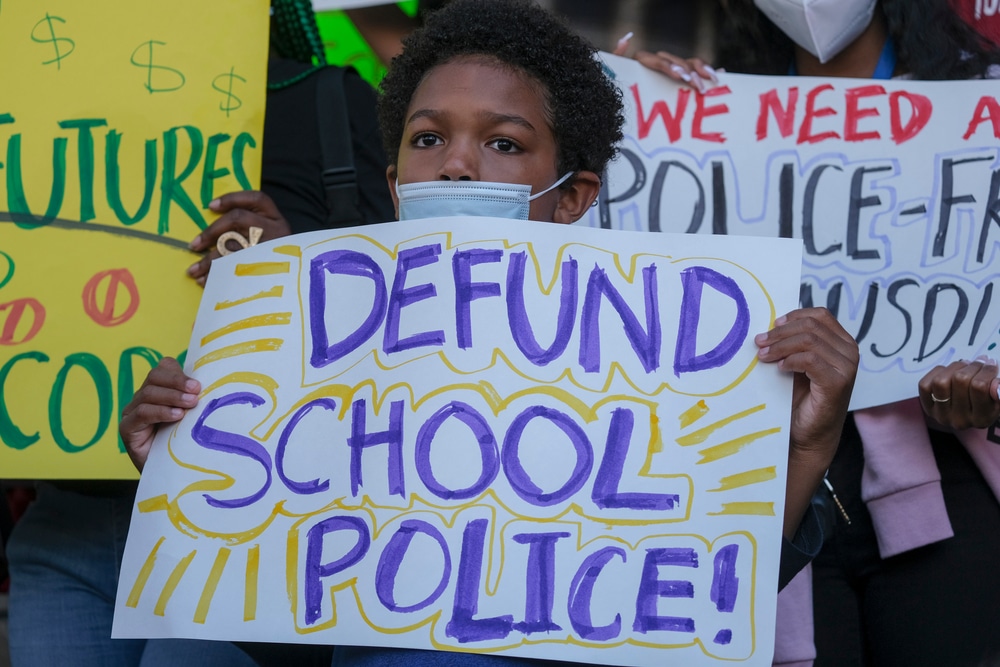
Students protest in Los Angeles, June 2021 (Credit: Ringo Chiu/Shutterstock)
Kyle Payne, a 16-year-old junior at Dorsey High School in Los Angeles, had long been uncomfortable with the presence at her high school of police, who seemed to target her and her friends for imaginary rule violations, according to a story by Capital B, a digital publication focused on Black issues. Her discomfort grew deeper, she says, after she witnessed arbitrary searches of backpacks and students get pepper-sprayed by school cops.
Payne, fellow students and community members formed a youth-led movement called Students Deserve to push the Los Angeles Unified School District to pull police out of schools and put the money into mental health support for Black students. Last February, the board trimmed a third of the school police funding and put it into a $36.5 million initiative known as the Black Student Achievement Plan (BSAP), which has added 221 restorative justice advisers, psychiatric social workers, counselors and coaches at schools with high numbers of Black students, high suspension, chronic absenteeism and low achievement rates. This year, student Simya Smith says she hasn’t seen any school police. That change – plus the increased presence of mental health staff – make students like her feel safer. “There’s a lot in society that we have to face,” she told Capital B. “BSAP really creates that safe space for you to be unapologetically Black.”
Helping cops improve their interactions with mentally ill people
Cumberland County, New Jersey, is using $1.4 million to improve police interactions with mentally ill people, including a county-wide program to train police in how to de-escalate confrontations and distinguish between a threat to public safety and a mental health emergency, according to an article on nj.com. The city of Millville will send police out on emergency mental health calls with social workers. “We don’t intend to put any lay worker into harm’s way,” said Cumberland County Prosecutor Jennifer Webb-McRae. “When we train and we work with our mental health professionals, and we allow them to train us, we all can have a better response.” The initiative will also include offering people who commit drug-related crimes an opportunity to have charges against them dismissed if they participate in a treatment program. The county also is creating a 24-hour mental health crisis response team.
In other news:
Drug manufacturer Johnson & Johnson and three opioid distributors will shell out $590 million to Native American Tribes in a proposed settlement, according to a story by National Public Radio. Deaths from opioids have disproportionately affected Native Americans and Native Alaskans. “This is an historic settlement that goes a small but important distance toward addressing a killing epidemic that devastated tribal communities,” said Lloyd Miller, an attorney representing 120 tribes in the case.
Overdose Deaths Involving Opioids Among American Indian and Alaskan Natives, U.S. 2000-2016 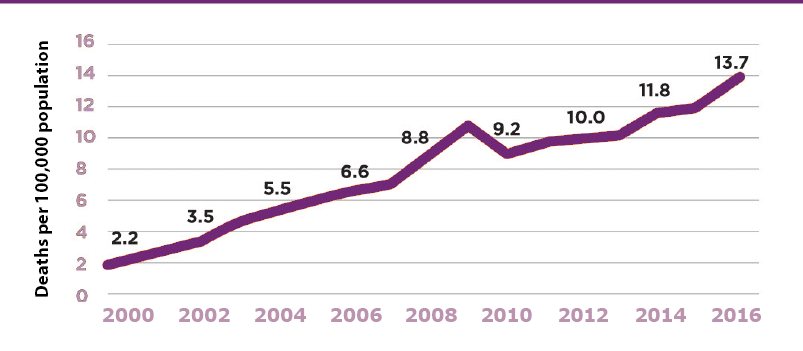
Source: Centers for Drug Control and Prevention
Stamping out “workjerkery”: Unwilling to cower under the pressure of toxic work demands, many proponents of “The Great Resignation” are now engaging in “good trouble” to press employers to be more responsive to workers’ needs, according to an article on Forbes. Singer/songwriter Connie K. Lim, known as MILCK, has personal reasons for jumping on the bandwagon. “I watched my Asian ancestors doing jobs where they couldn’t express themselves and keep their heads down and work,” she said. “I promised myself that when I became an adult, I would do what I needed to do to build a life where I could express my ideas.”
Aspen Strong: The nonprofit mental health advocacy group Aspen Strong began offering an online peer support group “Time-to-Talk” more than a year ago, according to an article in The Sopris Sun, a Carbondale, Colorado community newspaper, In December 2021, the group expanded its reach to a large online platform called Decentraland. “It’s been going great. The main thing we want people to know is that it’s a safe and confidential environment, where people can come in and either share their stories or just listen to other people share — there’s absolutely no pressure to speak,” said Andy Godfrey, Aspen Strong board vice-president and one of the developers of “Time to Talk.”
If you or anyone you know is considering suicide, call the National Suicide Prevention Lifeline at 1-800-273-8255. And if you’re a veteran, press 1.
Introducing: MindSite News Review of Books
This week, we inaugurated a new section in our arts and culture coverage: The MindSite News Review of Books.

Why Is Mental Illness Dogged by Stigma?
In Nobody’s Normal, anthropologist Roy Richard Grinker makes a compelling argument to embrace neurodiversity while while tracing the stigma of mental illness back to the Industrial Revolution.
Can Virtual Therapy Meet Our Need for Intimacy?
Teletherapy not only increases access and affordability to therapeutic insights, the author argues, it generates a sense of safety for those who prefer anonymity.

If you’re not subscribed to MindSite News Daily, click here to sign up.
Support our mission to report on the workings and failings of the
mental health system in America and create a sense of national urgency to transform it.
For more frequent updates, follow us on Facebook, Twitter and Instagram:

The name “MindSite News” is used with the express permission of Mindsight Institute, an educational organization offering online learning and in-person workshops in the field of mental health and wellbeing. MindSite News and Mindsight Institute are separate, unaffiliated entities that are aligned in making science accessible and promoting mental health globally.
Copyright © 2021 MindSite News, All rights reserved.
You are receiving this email because you signed up at our website. Thank you for reading MindSite News.
mindsitenews.org

The name “MindSite News” is used with the express permission of Mindsight Institute, an educational organization offering online learning and in-person workshops in the field of mental health and wellbeing. MindSite News and Mindsight Institute are separate, unaffiliated entities that are aligned in making science accessible and promoting mental health globally.


Author

Related Articles
Generation Cancer: Millennials Struggle With Death at an Early Age
More young adults are being diagnosed with cancer. Even for those who survive, the experience can be destabilizing and isolating.

Millennials Weigh Having Children On Their Own Terms
Not having children is also a valid path, and one that everyone should consider, Merle Bombardieri argues in her 1981 book.

Waiting for Word on Relatives Under Attack in Iran
Iranians in the US are caught between two “unrepentant regimes,” says Iranian-American writer and professor Shervin Malekzadeh.
