An Epidemic has Become a Crisis
What’s worse than fentanyl? Fentanyl + meth + THC + xylazine. The physician leading the team assisting newly released Israeli hostages talks about their needs.


Monday, November 27, 2023
By Don Sapatkin

Good Monday Morning! Magicians are less prone to mental illness than other creative types, who tend to have higher rates than the general public, the BBC reports. Guess it helps to be able to disappear when you want.
In today’s Daily: What’s worse than fentanyl? Fentanyl + meth + THC + xylazine. The physician leading a team assisting newly released Israeli hostages talks about their needs. Eating disorders increased even more than we thought during the pandemic. And Teenspace will offer free mental health services, virtually, to 400,000 adolescents and teens in New York City.
‘It’s no longer an opioid epidemic. This is an addiction crisis.’

In hindsight, the opioid epidemic was simple. Each successive wave – prescription pain pills like OxyContin, then heroin, then fentanyl – was more devastating than the last, but at least they were the same class of drugs. Overdoses could be reversed with the same emergency medication (Narcan). Addiction could be treated, with varying degrees of success, in the same kinds of programs, assisted by the same medications (methadone, buprenorphine, naltrexone).
It’s not so simple anymore. Most users now take multiple kinds of drugs at once, intentionally or not, and the combinations can be far more dangerous, the New York Times reported. Recent studies of people addicted to opioids have found that at least 70% of them also take other illicit substances, a shift that is impeding treatment (users of multiple drugs are more resistant) and confounding state and federal policies that are still attempting to save lives by targeting opioids. “It’s no longer an opioid epidemic,” said Cara Poland, an addiction medicine physician and associate professor at Michigan State University College of Human Medicine. “This is an addiction crisis.”
Non-opioid drugs in the mix include the animal tranquilizer xylazine (a.k.a. tranq), anti-anxiety medications like Valium and Klonopin, and older recreational stimulants like cocaine and methamphetamine. Dealers sell them, along with counterfeit Percocet and Xanax pills, often combined with fentanyl. Meth addiction is especially problematic because there is no approved treatment, and the drug can undermine therapies for opioid addiction. Mexican drug lords have learned how to mass-produce an especially potent version, sometimes called “super meth,” that has become popular on the West Coast and is moving South and East. While Narcan can reverse a fentanyl overdose, it has no effect on meth and cocaine or sedatives like tranq, whose overpowering effect will remain after the fentanyl is blocked.
1 in 6 U.S. residents 12 and older had a substance use disorder last year.
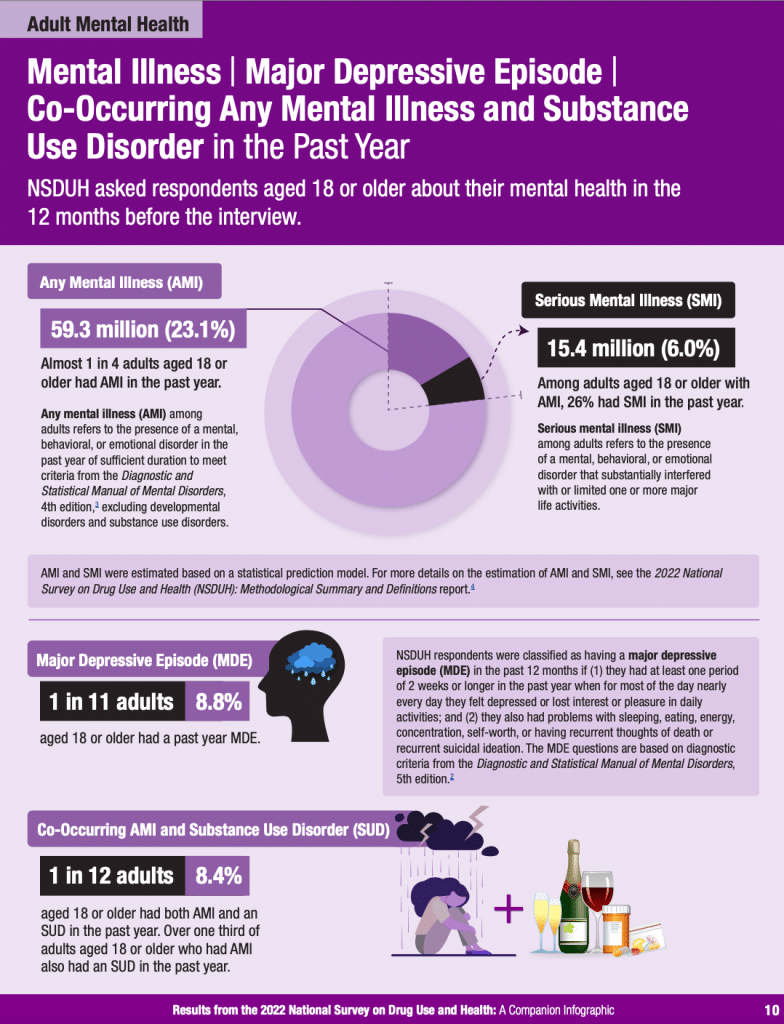
Also, nearly 1 in 4 residents 18 and older had a mental illness and 1 in 12 adults had both, according to CNN’s report on the biggest federal survey of its kind.
The 2022 National Survey on Drug Use and Health also found that 1 in 5 adolescents aged 12 to 17 had a major depressive episode last year, more than 1 in 8 had serious thoughts of suicide and almost 1 in 25 attempted it. So did 0.6% of adults – about 1.6 million people.
The survey is a snapshot in time, with dozens of measures based on interviews with more than 70,000 non-institutionalized civilians nationwide. Overall, the new findings were similar to the previous year’s, with plenty of exceptions. Substance use disorders were more common in 2022, reported by about 49 million people (up by 2.5 million from the 2021 survey) aged 12 and above. Suicidal thoughts increased among both adults and adolescents. Folks into data can download detailed files. I suggest everyone else look at this comprehensive set of infographics.
ICYMI: The only clear news out of that meeting between President Biden and Chinese President Xi Jinping was “the critical step of resuming counternarcotics cooperation between our two countries,” as Biden put it. China has already moved to shut down companies making and selling precursor chemicals shipped to Mexico, where drug cartels produce fentanyl. But Biden made clear he doesn’t trust Xi, so the U.S. will need to verify China’s follow-through, The Hill reported. Biden has put a priority on curbing the fentanyl supply coming into the U.S., and said he also made progress in a meeting with Mexican President Andrés Manuel López Obrador. He met with each leader during the APEC summit in San Francisco.
What will help freed hostages to heal?
The Israeli hostages being released from Gaza have spent seven weeks in captivity. Some witnessed parents and loved ones being killed; others didn’t know who in their families remain alive. How can they begin to recover from their massive mental and physical trauma? PBS NewsHour’s Nick Schifrin interviewed Hagai Levine, a public health physician at Hebrew University and head of the medical and resilience team that’s meeting the released hostages. Here are excerpts (sections not in quotation marks have been paraphrased for clarity and brevity):
Nick Schifrin: “What do they need mentally to begin to understand the trauma they have been through and begin to recover from it?”
Dr. Hagai Levine: “We need to help them to get back control over their lives.” They’ve been passive and afraid, an ordeal that began with a massacre and kidnapping. Some saw their loved ones murdered or haven’t known if they were alive, or weren’t fully aware of the atrocities that took place, Levine said. “Now we need to help them to be active again, to become humans again by making the choices…We need to help them gain back trust in humanity.”
Schifrin: “Do they also need a specific environment, open spaces, green, that they presumably haven’t seen for seven weeks?”
Dr. Levine: The hostages need everything they didn’t have in captivity: sunlight, physical activity, social encounters. “Maybe some of them miss most the pets, OK? So, that’s why pets were allowed to be brought to the hospital.” But not the news media. The former hostages “want to tell the story, but it’s difficult for them to be in a crowded place…They may need their anonymity. They became famous all around the world,” but “they want, most of them, just to come back to their normal life.”
PBS Newshour’s video of their conversation begins at 4:48. A transcript starts here.
Eating disorder claims surged during the pandemic, study finds
New research reported by Medscape shows in stunning detail how eating disorders –one of the most under-treated and deadliest forms of mental illness – not only rose sharply during the pandemic but also settled into new age patterns. Between 2018 and 2022, health insurance eating disorder claims increased 65% nationally as a percentage of all medical claims, with most of that jump coming between 2019 and 2020, the pandemic’s first year, according to a white paper published by FAIR Health, a respected nonprofit consumer and data organization. The study drew on FAIR Health’s repository of 43 billion private healthcare claim records, which the organization said was the largest in the nation.
All types of eating disorders increased, but at different rates: binge eating disorder, the most common diagnosis when only one disorder is involved, was up 81%. Anorexia, the second-most common single diagnosis, rose 73%. Bulimia, which is the smallest single diagnosis, increased 3%, while avoidant/restrictive food intake disorder, which is the least common and was given a diagnosis code only in 2017, was up 305%. Inpatient hospital stays related to eating disorders increased more than for other behavioral health conditions during the pandemic, especially among children. Age distribution patterns switched: In 2018, the largest share of eating disorder claims came from the 19-to-24 age group and the second largest from the 14-to-18 age group. The reverse was true in 2022.
One thing didn’t change: Females consistently represented more than 89% of eating disorder claims. About 72% of eating disorder patients over the four-year period were diagnosed with at least one co-occurring mental health condition that was not an eating disorder. More than 20% also had a substance use disorder. The study has not been peer-reviewed or published in a medical journal.
In other news…
Talkspace will offer free, virtual mental health services to more than 400,000 New York City adolescents and teens, Fierce Healthcare reported. The New York-based digital mental health company signed a $26 million contract with the city that will allow residents aged 13 to 17 to connect with a licensed therapist via video, phone and text, Talkspace said. In the new program, called Teenspace, eligible teens will be self-guided through an introduction to therapy, given mental health assessment tools and, when they’re ready, encouraged to match with a therapist through the company’s private platform. They’ll be able to send their therapists an unlimited number of private messages and have access to live tele-health sessions from their smartphones, tablets or computers, all at no charge.
Biden administration issues “playbook” for improving social determinants of health, Politico Pulse reported.
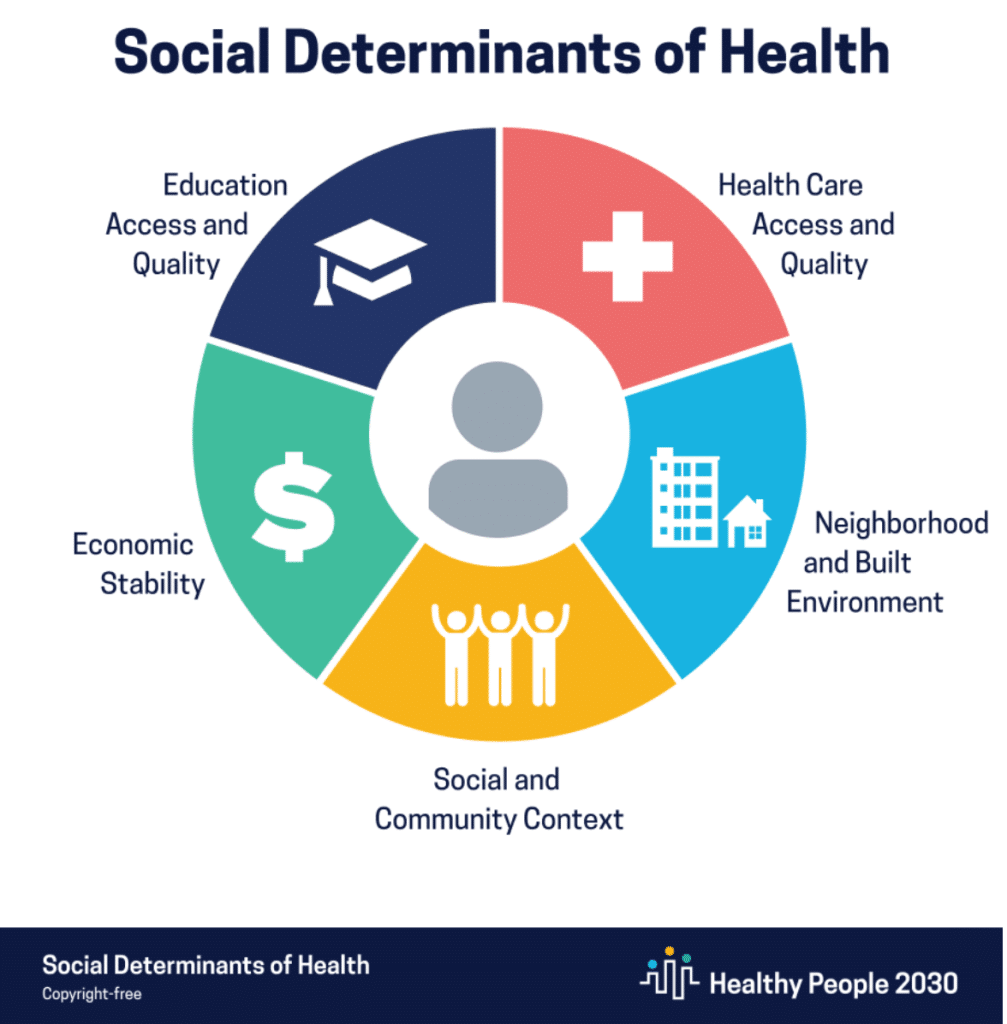
The playbook for federal action focuses on expanding data collection, adding flexibility to funding and supporting “backbone” organizations that play a key role in developing the infrastructure required to identify and target unmet social needs. Addressing social determinants like education and housing are especially important for improving mental health.
The playbook calls for Congress to boost Medicare coverage of nutrition counseling, among other requests. Bipartisan interest is growing, although congressional Democrats are more supportive. The Biden playbook envisions “a future where one’s social circumstances do not predetermine one’s health outcomes.”
Oregon’s law decriminalizing possession of small amounts of heroin, cocaine and other illicit drugs while investing in addiction treatment is facing broad pushback and likely revisions after a big increase in public drug use and a rise in deaths, some of them children, involving fentanyl and other opioids, the Associated Press reported. A lopsided 58% of voters in the progressive state approved the ballot measure three years ago. Now even top Democratic lawmakers who supported it say they’re open to changes.
Service members have feared for years that seeking help for mental health issues could lead to security clearances being denied or revoked, destroying their careers, despite military leaders’ assurances that reaching out would not harm their prospects. Turns out leadership was right. Military Times reported that Defense Department data it obtained shows that troops lose or are denied a security clearance due to psychological issues at a low rate.
If you or someone you know is in crisis or experiencing suicidal thoughts, call or text 988 to reach the 988 Suicide & Crisis Lifeline and connect in English or Spanish. If you’re a veteran press 1. If you’re deaf or hard of hearing dial 711, then 988. Services are free and available 24/7.
Recent MindSite News Stories
Cards to Cue You to Care for Your Own Mental Health

Mental illness is a clever, hard-to-kill beast, and escaping it is akin to defeating a cluster of wild boar. But with proper strategy and weaponry, the invasive species can be taken down. These cue cards may help.
Continue reading here…
Tribute to Rosalynn Carter, a Tireless Voice for Mental Health

Over a span of span of six decades, former First Lady Rosalynn Carter was a tireless advocate who fought to transform the way that mental illness – and the people who experience mental health conditions – were viewed and treated.
Veterans Urge VA to Speed Research, Funding of Psychedelics for PTSD

Despite high rates of PTSD and suicide among veterans, and despite the success of MDMA trials for veterans and others with PTSD, the V.A. has not funded any clinical studies of MDMA. That needs to change, said advocates and members of Congress.
If you’re not subscribed to MindSite News Daily, click here to sign up.
Support our mission to report on the workings and failings of the
mental health system in America and create a sense of national urgency to transform it.
For more frequent updates, follow us on Facebook, Twitter and Instagram:

The name “MindSite News” is used with the express permission of Mindsight Institute, an educational organization offering online learning and in-person workshops in the field of mental health and wellbeing. MindSite News and Mindsight Institute are separate, unaffiliated entities that are aligned in making science accessible and promoting mental health globally.
Copyright © 2021 MindSite News, All rights reserved.
You are receiving this email because you signed up at our website. Thank you for reading MindSite News.
mindsitenews.org

Mental health can't wait.
America is in a mental health crisis — but too often, the media overlooks this urgent issue. MindSite News is different. We’re the only national newsroom dedicated exclusively to mental health journalism, exposing systemic failures and spotlighting lifesaving solutions. And as a nonprofit, we depend on reader support to stay independent and focused on the truth.

It takes less than one minute to make a difference. No amount is too small.
The name “MindSite News” is used with the express permission of Mindsight Institute, an educational organization offering online learning and in-person workshops in the field of mental health and wellbeing. MindSite News and Mindsight Institute are separate, unaffiliated entities that are aligned in making science accessible and promoting mental health globally.


Author

Related Articles

How to Help Your Neurodiverse Child Out of the Cocoon
Neurodiverse burnout can leave children stuck in a “cocoon.” Learn how scaffolded parenting helps them move back to the world.

Chatbots May Spark Delusions Even in People With No Mental Illness
Psychologists say AI chatbots have led people to experience delusions, warning that more of us are at risk than we might think.

Minneapolis Mourns Hero Nurse Killed By ICE, Condemns DHS Gaslighting
We look at another ICE killing of a US citizen in Minneapolis, and the federal government’s ensuing firehose of lies and propaganda.
