As 988’s Second Birthday Approaches, All Eyes on Workforce and Training of Crisis Counselors
At a national conference on the U.S. mental health crisis response system now taking place in Chicago, crisis counselors, administrators and federal officials are discussing ways to improve the system amid worries over funding and training.
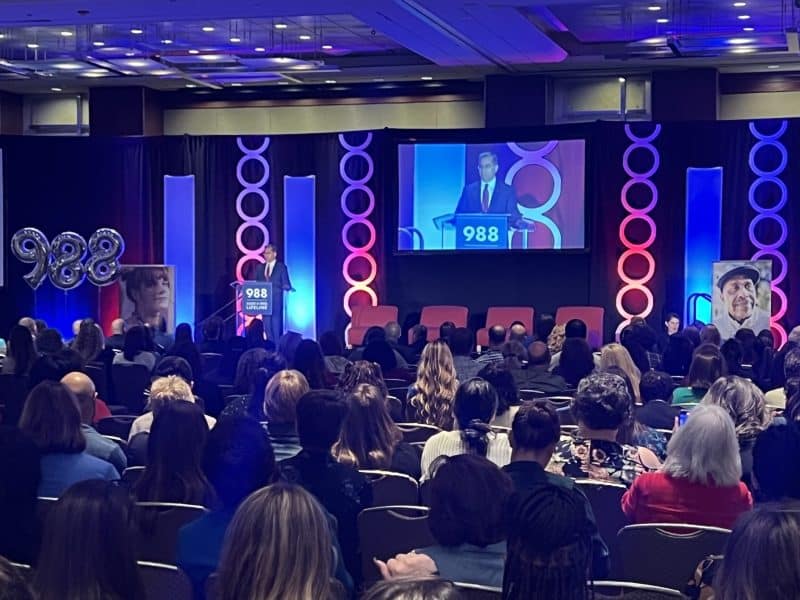
HHS Secretary Xavier Becerra comes to Chicago conference to praise ‘phenomenal’ growth of crisis response system
While Kristen Ellis was in graduate school for counseling, a loved one died by suicide.
She was there and saw it happen, and the experience changed her life, leading her to take an early job at a crisis center while she was still in school.
“As a family member I didn’t even know what to do,” she said. “It was scary.”

She soon found out that the work of a crisis counselor can be both stressful and rewarding.
“What an incredible opportunity to be able to support others when they are having the worst day of their life — to be able to hold that hope for them until they can hold it for themselves,” she said.
A lot has changed in crisis work over the last few years, especially since July 2022, when the National Suicide Prevention Lifeline transitioned to the three-digit number 988. The transition marked a national emphasis on suicide prevention, in a year when more than 49,000 US residents died by suicide – a death every 11 minutes, according to the Centers for Disease Control and Prevention.
Since its launch, the Lifeline has received more than 9.5 million calls, texts, and chats, according to Vibrant Emotional Health, the nonprofit that runs the hotline for the Substance Abuse and Mental Health Services Administration.
Tuesday, Ellis was in Chicago for a national conference focused on ways to continue to build the Lifeline and improve the mental health crisis and care system. She spent years managing crisis services for Recovery Innovations in Riverside, California, and now works for the agency’s crisis-consulting team, helping local governments build their crisis system.
She planned to preach the importance of involving peer support specialists in decision making – even clinical decisions. Because sometimes the role is seen as just a box to check, she said.
“I’m hoping to share that lived experience has a really strong voice in the crisis continuum so people actually view it as a vital piece that they would incorporate in their services,” she said. “It’s seen sometimes as a token role.”
Training and retaining staff
More than a thousand people gathered at the Hyatt Regency in Downtown Chicago for the three-day conference, which included crisis call center staff from across the country, policy wonks and politicians.
Tuesday afternoon, Secretary of Health and Human Services Xavier Becerra took to the stage to sing the praises of the rollout, which he called “phenomenal.” He also highlighted the Biden administration’s investment in the program, which, he says, grew from $22 million to a $1.5 billion commitment over the last three years.
“Too often when our governments are involved – local, state, and federal – there’s little trust that things will go well,” he said to the crowd. “That’s big money. But without you, it doesn’t happen.”

While Becerra extolled the program, mental health experts, users of the crisis system and staffers have shared critiques about the system and suggestions for how to change and grow it. While 988 was launched by federal action and has received significant federal support, state governments also contribute and implementation has been largely left up to individual states, creating a patchwork of different standards, designs and challenges.
Last month, the University of Chicago Health Lab released a study exploring the roll-out of 988. It pointed to several areas of concern, including the possibility that 988 call-takers may summon police when callers haven’t agreed to a safety plan, leading to unwanted interaction with law enforcement.
The report also pointed to on-line comments by callers who reported being hospitalized against their wishes as a result of calls to 988 and noted a staffing crisis at call centers, echoing concerns that have plagued the hotline since before the transition to 988.
“Everyone will acknowledge we don’t have enough crisis counselors and we don’t have enough people going into the training programs that let us have the professionals that we need,” Becerra told MindSite News in an interview. “We have to get more people – people who’ve got the lived experience, who come from the communities that are hurting. That’s what we’re trying to attract — a workforce that will be able to address these needs.”
Everyone will acknowledge we don’t have enough crisis counselors. We have to get more people – people who’ve got the lived experience, who come from the communities that are hurting.”
HHS Secretary Xavier Becerra
During its first year of operation, the Lifeline saw a 33% increase in calls and texts received, which could be placing an additional strain on counselors, according to the University of Chicago study.
In January, CrisisCrowd, an independent survey project developed by software engineer and former volunteer crisis counselor Dan Fichter, released the first national survey of crisis counselors. It found significant disparities among the network of more than 200 call centers in terms of staff training and support, as well as standards of care. (Note: Fichter is also a donor to MindSite News.)
Some centers exposed new trainees to dozens of real calls and chats and conducted extensive role-play practice, leaving counselors well-prepared for their first call. But others received less than two weeks of training without any exposure to what a real crisis may sound like. Specifically, counselors felt training touched too lightly on things like anxiety, depression, child abuse, eating disorders and abusive callers, according to the CrisisCrowd study.
“We’ve got to keep improving, because if we don’t, there’s a life on the line.”
HHS Secretary Xavier Becerra
The shortcomings in staffing levels and training must be addressed as the Lifeline continues to grow, Becerra said.
“We’ve got to keep improving, because if we don’t, there’s a life on the line,” he said, adding that it will be essential for call centers to raise wages to retain experienced counselors.
The University of Chicago study, called Inform 988, also raised concerns about data security and the potential use of geolocation technology, which uses GPS to track a caller’s location. Some users have expressed concerns their calls will be traced, taking away a level of anonymity and privacy and potentially leading to a visit from police or forced hospitalization.
But not using the technology has downsides too. Currently, the Lifeline doesn’t rely on geolocation and instead routes calls to centers based on the area code of the caller’s phone. That can result in calls from mobile phones being sent to call centers far from a caller’s actual location, where call-takers are likely to have less knowledge of local resources.
Supporting staff locally
In January, the National Alliance on Mental Illness Chicago opened a new call center in the city. It will be open only 16 hours a day, but will coordinate with the other Chicago call center, C4, to ensure that Chicago residents will have round-the clock access to the hotline, said Jen McGowan-Tomke, NAMI Chicago’s chief operating officer.
Before beginning to answer live calls, counselors spend four weeks in training so they know how to respond to different needs, are familiar with local resources and are “able to move with the trends of what we’re seeing on the line,” McGowan-Tomke said.
“This is a hard job, it’s frontline crisis work and we need to support them.”
McGowan-Tomke, NAMI Chicago’s chief operating officer
While the training prepares new counselors to answer calls, she added, the program also recognizes the need to provide counselors with additional training and supervision and support for their own mental wellness.
“This is a hard job, it’s frontline crisis work and we need to support them,” she said.
Ellis agrees. Though she never worked in a 988 call center, she sees the importance of supporting counselors with training that teaches them strategies for self-care and ways to fight burnout.
“They’re taking on a lot of people’s heavy experiences,” she said. “Your whole day is listening and supporting people that are not feeling so great.”
The CrisisCrowd survey also noted that some callers have been abusive towards counselors, who often were unprepared to handle it. Surveyed counselors said they hoped their crisis center would set up a system to share notes about particularly abusive callers and help them set up boundaries when dealing with callers. One counselor said they’d like to set up a way to block calls from numbers cited for repeated abuse.
Although the NAMI Chicago center is still relatively new, counselors have already encountered some abusive and extremely frequent callers. One called more than 140 times in a month, McGowan-Tomke said.
That “takes a lot out of our team and is clearly not the best resource for that individual,” she said.
Strategies for managing such callers include creating a plan for how to best respond to familiar callers and sharing it with supervisors and everyone on the team. Call-takers can also send verified abusive callers to a voicemail if they use the line inappropriately.
The agency is also providing counselors with opportunities to process and debrief after calls, wellness support during their shift and breaks as needed.
“We also ask them to rate how intense each of their calls are so their supervisors can monitor that and make sure to connect with them,” McGowan-Tomke said. “Really make sure that they feel supported.”
Careers in crisis counseling
Alex Boyd has held lots of jobs. He tended bars. He managed a warehouse. But in 2018, he says, he found his calling when he discovered the Trevor Project and volunteered to become a counselor.
“I was myself – a young queer person who had navigated mental health crises and a lot of suicidal ideation,” he said. “I wanted to give back.”
It became a passion project. He started by devoting a handful of hours, which snowballed into more hours. He moved up the ropes, going from volunteer to paid counselor to manager to senior manager. Along his journey, he’s seen the industry grow, especially in its services for the LGBTQ community.
“To have LGBTQ services be one of the specialized services really gave so much validation to the work,” Boyd said. And the growing volume of calls “show this was yet again another untapped population that really need support. Thanks to 988, they can receive that.”
The name “MindSite News” is used with the express permission of Mindsight Institute, an educational organization offering online learning and in-person workshops in the field of mental health and wellbeing. MindSite News and Mindsight Institute are separate, unaffiliated entities that are aligned in making science accessible and promoting mental health globally.


Author

Related Articles
1 in 8 Youth Turn to AI for Mental Health. ‘It Just Tells Me What I Want to Hear’
Youth with the deepest emotional needs are using chatbots for therapy the most – but many are unhappy with the outcome.

California Tribal Advocate Who Fought to Prevent Suicides Dies in Apparent Murder-Suicide
Celinda Gonzales of the Yurok Tribe worked to prevent suicides among Native Americans after losing a son and a brother. She “was a friend to many,” the tribe said.
Ghost Guns, Made at Home on 3-D Printers, Are Linked to an Increase in Suicide Rates
Homemade ghost guns are raising new challenges around mental health, firearm access and suicide risk.
