
Their Campus, Their Crisis: The Take from Columbia Student Journalists
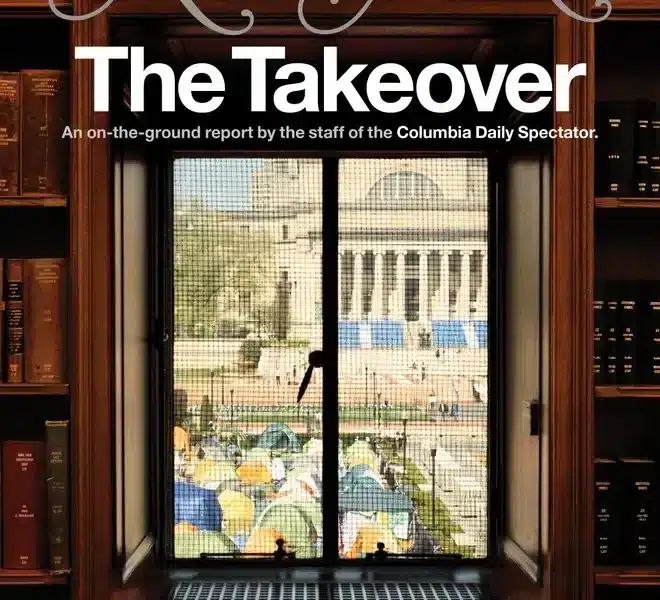
New York magazine’s cover story this week, put together by student journalists at the Columbia Daily Spectator, documents their work covering campus protests – and the stress and fear they and all students have been dealing with.

Wednesday May 8, 2024
By Courtney Wise and Rob Waters

Greetings, MindSite News Readers. Last week we ran a newsletter item about violence against students participating in pro-Palestinian demonstrations on campuses. It focused on the events of the previous two days in which police had been called onto several campuses and made hundreds of arrests, sometimes violently, of students and faculty members.
We received criticism from some readers that the story was unbalanced, and we were looking for ways to offer a broader look. In today’s newsletter, we are offering an extensive summary of an article – the cover story in New York magazine – put together entirely by student journalists working at the Columbia Daily Spectator. It documents at great length the protests, the police actions and the stress and fear of students who felt targeted as Jews or Muslims or supporters of Palestinians or Israel. It offers a student view of the events that have galvanized the country and been the subject of thousands of news articles – and, no doubt, lots of therapy sessions for parents and students.
We also present a MindSite News interview with Isabella Ramírez, the 20-year-old Columbia student who is editor-in-chief of the Spectator, about how her team coped with the stress of their reporting. Plus, some other news: Miss USA resigns to care for her mental health. And STAT investigates the risks and ethics of a research project that has been conducting biopsies of people’s brains.
Their Campus, Their Crisis: The Take from Columbia Student Journalists
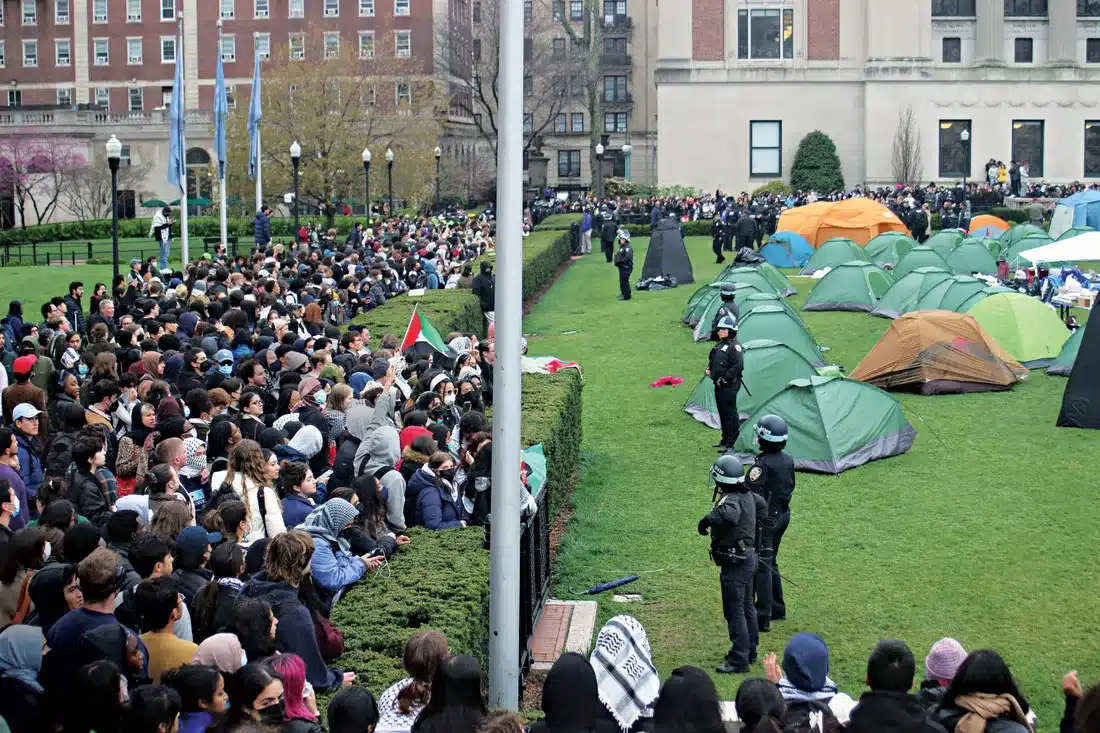
“On April 30, armed police officers swarmed the Columbia University campus for the second time in two weeks, shutting down a student occupation of Hamilton Hall and clearing what was left of the Gaza Solidarity Encampment. Students had first seized part of the South Lawn, then the attention of the entire Columbia community, and then the national political narrative, as imitation protests in support of Palestine erupted at colleges across America.”
So began the introduction by Ramírez to the New York Magazine-Columbia Daily Spectator article now running in both news outlets. She went on to describe the polarized mood on campus, one that mirrors sentiments off-campus.
“As the encampment impasse played out, it became clearer than ever that people were living in two different Columbias. As pro-Palestinian protesters built a community of hope and solidarity around their support for Gaza, many pro-Israel students reported feeling unwelcome and organized their own counterprotests on and around campus. Some of the latter group packed their bags and left, while many of the former were hauled off to jail and suspended.”
The Spectator-New York Magazine story consisted entirely of quotes from students and other members of the Columbia community, along with photos by Spectator photographers. Below, we present a few selected interview snippets from the 20-page article. Italicized type is used to provide context and bridge together the interviews, as it did in the students’ story. Some of those interviewed chose to be identified by only their first name or first initial to protect their identity. Others used pseudonyms, which have been marked with an asterisk.
K., a senior: I had learned so much about the precedent of organizing at Columbia and understanding that we have this massive history of protests and that there are all these eyes on us. I have so much privilege being here. I’m from a first-gen, low-income background. So I knew that if there was ever going to be an escalation, it was something I wanted to be a part of. I consulted a lot of my friends about it, and at first a lot of us were questioning whether this would be a fully planned, well-thought-out action, which in hindsight is ridiculous. It was incredibly well planned. And it made sense that they had to withhold certain information for safety and security.
On the morning of Wednesday, April 17, Columbia President Minouche Shafik was in Washington, D.C., scheduled to address Congress about antisemitism on campus at a hearing before the House Committee on Education and the Workforce titled: “Columbia in Crisis.” Hours earlier, in the dead of night, pro-Palestinian students began executing plans to occupy the school’s South Lawn. They gathered quietly around campus, trying to remain undetected until it was time to set up camp on the South Lawn. Later that morning, Shafik began testifying at about 10:30 a.m.
Stacy,* a professor: The terms of the questioning were just completely false. The question of whether or not Columbia is willing to protect its students against antisemitism has very little to do with whether students who are concerned about genocidal military tactics should be able to speak about that publicly. Those are two separate issues.
National attention quickly shifted to the demonstration on Columbia’s campus. While students who opposed the war in Gaza were galvanized, many pro-Israel students bristled at the protesters’ use of slogans like “From the river to the sea” and “Globalize the intifada.”
Henry Sears, a senior: I had a lot of complex feelings around the encampment. I support their right to free speech. However, some of the speech we were hearing out of there was really horrible.

Parker De Dekér, a freshman: As President Shafik was testifying about the implications of antisemitism, ironically, antisemitism was rapidly increasing at a rate I had never seen before on our campus. I don’t mean the protesters sitting on the lawns. Them sitting there and exercising their rights to free speech and advocating for peace in the Middle East is not antisemitism. What is antisemitism, though, is the numerous experiences I’ve been faced with. Wednesday evening, I was walking from my dorm to go to Chabad, a space for Jewish students at Columbia, and someone yells, “You fucking Jew, you keep on testifying, you fucking Jew.” I had clearly not been in Washington, DC that day testifying. I was not involved in anything political. I was simply a Jewish student wearing my yarmulke.
The more than 100 individuals occupying the South Lawn understood there would likely be significant consequences from both the university and the police. On April 18, Shafik suspended all of the students and authorized the NYPD to enter Columbia’s private property and clear them out. Early that afternoon, dozens of officers, many wearing riot gear, began their sweep. Hundreds of onlookers watched the largest mass arrests at Columbia since 1968.
Laura: I’m a senior; I’m supposed to graduate. I’m also a low-income student. A lot was on the line. My parents had been sending all these messages: “Please leave. You can’t afford to be there.” I’m really close to my family, so it was heartbreaking: “There’s other students there who have so much money, and that’s not you.” And “I’ve worked so hard at so many jobs for you to go to this school, and now you’re throwing it all away.” And “This is not going to matter. You being there or you being outside doesn’t make a difference.” But I asked myself, What am I willing to give up? If people in Gaza can keep giving up everything, it’s not a big deal to be arrested for a few hours.
Elizabeth Ananat, a professor: The students were left homeless in New York City. I never thought that I would be part of an organization that causes people to be on the street in the middle of the night. It was such an unnecessary cruelty and a betrayal of everything.
Jewish students reported numerous instances of antisemitism both inside and outside the campus gates, and pro-Israel students organized demonstrations of their own.
Chloe Katz, a junior: One day at noon, we stood in front of Butler Library. We had authorization. We put duct tape over our mouths to represent the women who are being silenced in the media and on campus when they express what happened to them or people they know — the horrific sexual violence that occurred. We linked arms and had signs saying RAPE IS NOT RESISTANCE and HAMAS WEAPONIZES SEXUAL ASSAULTS. We were near the encampment, and soon after we began, they began their own protest. They were chanting things like “Glory to our martyrs” and “Globalize the intifada.”
Lily,* staff: I consider myself Jewish. When I’ve been on campus, I have felt uncomfortable with the things some pro-Israel protesters are saying, but I have not felt unsafe. What I keep seeing is the conflation of not being comfortable with being unsafe, and I think it’s kind of a cop-out for the university to say this is about antisemitism. My opinions on the college really changed when pro-Palestine protesters were sprayed with a chemical. If it had been the Jewish or pro-Zionist students that were sprayed, we would be in a very different timeline.
As pro-Palestine students were arrested, onlookers spontaneously began a second occupation of the South Lawn.
Jared, a graduate student: They arrested a hundred people, and a thousand more sprang up in their place. People were sending food from all over the world. They donated on Venmo. Alumni showed up with supplies and blankets. An organization brought a bunch of meals to Earl Hall, and I was running back and forth. It took like three trips to bring everything in.

Aharon Dardik, a sophomore: The Friday night prayers, Kabbalat Shabbat, in the encampment were beautiful. There was a real sense of community and resilience — and attempts to fuse the love and joy of Shabbat with being in the encampment even in the face of oppressive forces.
Jude Webre, a lecturer: National media outlets have already written the narrative of what’s going on, and they’re not interested in understanding the position of the protesters on the inside. So they report more on what’s happening outside the gates, which is a different thing. In my mind, the problem isn’t the young people on the inside; it’s the adults on the outside who really escalated the situation because of their own preconceived notions of what’s going on.
Jared: I made the decision to skip my family’s Passover and go to the Passover Seder in the encampment because I kept seeing stupid-ass people online talking about how this movement was antisemitic. To me, it embodied the spirit of Passover, which is the liberation of oppressed people.
But concerns of outside agitators – and specific student protesters – sparked some concerns among Jewish students for their safety.
Shiri Gil, a junior: At this point, I’m not saying I’m Jewish, I’m not saying I’m Israeli. I’m barely on campus because I feel threatened. My friend was called a Nazi and physically pushed off the lawn where the encampment is — a space where everyone can be, a public place for everyone.
Parker: If you are a Jew who has any level of support for Israel, then you’re not welcome in progressive circles. In the lobby of my dorm, I ran into a Jewish student who was leaving. He was flustered and frantic and had a whole bunch of things that he needed help with. And as we’re trying to get his stuff out of the Lerner Hall turnstile to get out to Broadway, where his father is picking him up, people are beginning to stare at us and getting visibly upset. And they say, “We are so happy that you Zionists are finally leaving campus.” And another student goes, “You wouldn’t have to leave if you weren’t a supporter of genocide.”
Rebecca Kobrin, a professor: There’s this narrative that it’s all anti-Israel and no antisemitism. And there’s this other narrative that it’s all antisemitism and none of it is about Israel. And I believe that we just have not modeled listening to each other.
Henry: I think it’s important to highlight that while Jewish students definitely feel less safe on campus, it’s not just us. There have also been actions against Muslim or pro-Palestinian or Palestinian students. We’re all having to deal with this horrible campus environment.
At the General Studies Gala, I saw a bunch of students who had their keffiyehs ripped off and were called “terrorists,” “sluts,” and “whores.”
As days passed and talks between demonstrators and the University disintegrated, Pres. Shafik gave the students an order to disperse. Instead, they began occupation of Hamilton Hall.
Sueda Polat, a graduate student: The process of negotiations — no matter how much the university claims it was in good faith, it was not. We were also being surveilled by the university. We were told that the rooms we were caucusing in were bugged as well as the room we were negotiating in. On several occasions, we were followed. It felt like we were in a movie.
Alex Kent, a freelance photographer: As soon as they reached the doors of Hamilton, they just went straight in. There was a lone security guard who’s by the door who was really taken aback. People behind me came out with barricades. It was 15 or 20 minutes before both the doors were shut down. It was very intentional and purposeful, and even what was damaged, like the windows, was all out of functionality. The protesters just wanted the Facilities workers out. It almost was like they were pleading with them, like, “Please, we need you to leave. You don’t get paid enough to deal with this.”
MindSite News Interview: A Student Journalist on the Stress of Covering a Campus Under Siege
Isabella Ramírez, a 20-year-old junior and editor of the Columbia Daily Spectator, spoke with MindSite News about the stress and trauma experienced by her team of student journalists as they covered protests, occupations, police actions – and coped with accusations of being anti-Semitic and anti-Muslim over the past eight months.
I’m curious about the emotional and psychological stress you all were under, both as members of the Columbia community and as journalists trying to write about it.
These past two weeks with the encampment and the police sweeps have been a really traumatic time for a lot of our journalists who bore witness to a lot of incidents both of hate, but also of police brutality. We’ve witnessed a lot of violence – not just direct eyewitness, but also in the editing process, even when we’re fact checking. Our copy editors are watching the videos of the evidence that we’re reporting on.
It can be really emotional to write about the pain and suffering of your peers. No matter the type of source we’ve spoken to, that’s a lot of what people have echoed to us. People are in different states of emotional distress – sources who cry in front of you, who share stories that are so intimate to their lives. As a student journalist, you’re in a position to empathize with your peer and to really feel for that person. But being in a journalist’s role, you occupy something different than a friend to someone seeking solace. It’s a weird thing to navigate.
In other news…
Noelia Voigt, Miss USA 2023, has resigned her post after just 7 months to take care of her mental health, reports CBS News. She also urged others to do the same. In a post shared to her Instagram page, Voigt wrote, “I realize this may come as a large shock to many. Never compromise your physical and mental well-being. Our health is our wealth.” She continued: “My hope is that I continue to inspire others to remain steadfast, prioritize your mental health, advocate for yourself and others by using your voice, and never be afraid of what the future holds, even if it feels uncertain.” Accepting her decision, the Miss USA Organization said in response: “We respect and support Noelia’s decision to step down from her duties. The well-being of our titleholders is a top priority, and we understand her need to prioritize herself at this time.”
STAT News conducted a two-year investigation of the Living Brain Project (LBP), a research study at the Icahn School of Medicine at Mount Sinai. Intended to advance the understanding of how living human brains work beyond what we know from cadaver brain tissue, the LBP involves deep brain stimulation and a biopsy of the human brain. Researchers assured participants that little risk was involved in the procedures, despite disagreement among neurosurgeons who frequently conduct brain biopsies. But enough risk exists that the FDA submitted written warnings to Mount Sinai, explicitly citing regulatory and ethical concerns. Despite the warnings, Mount Sinai continued the biopsies, collecting more than 600 brain samples and partnering with another medical center. STAT’s investigation speaks to the implications of such a study’s expansion, the standards around consent in medical research, and the effectiveness of oversight by the FDA and similar institutions.
During the course of its investigation, STAT reached out to Mount Sinai with questions. Here, they’ve provided those questions and Mount Sinai’s written responses.
If you or someone you know is in crisis or experiencing suicidal thoughts, call or text 988 to reach the 988 Suicide & Crisis Lifeline and connect in English or Spanish. If you’re a veteran press 1. If you’re deaf or hard of hearing dial 711, then 988. Services are free and available 24/7.
Recent MindSite News Stories
As 988’s Second Birthday Approaches, All Eyes on Workforce and Training of Crisis Counselors

At a national conference on the U.S. mental health crisis response system now taking place in Chicago, crisis counselors, administrators and federal officials are discussing ways to improve the system amid worries over funding and training.
The ‘Invisible’: More Women Veterans Are Dying of Suicide and VA Still Lacks Resources, Advocates Say
The rate of women veterans dying by suicide nearly doubled from 2001 to 2021, according to a report from the Dept. of Veterans Affairs released in December. Now a new report from Disabled American Veterans offers more evidence offers more evidence that the VA lacks systems to protect women.
A West Side Story: How to Traumatize a Community

For residents of Police Beat 1122 on Chicago’s West Side – and for all who watched on TV or social media – the killing of Dexter Reed last month after he was stopped for an alleged seatbelt violation was a vivid reminder: Such violence could happen to them at any time.
If you’re not subscribed to MindSite News Daily, click here to sign up.
Support our mission to report on the workings and failings of the
mental health system in America and create a sense of national urgency to transform it.
For more frequent updates, follow us on Facebook, Twitter and Instagram:

The name “MindSite News” is used with the express permission of Mindsight Institute, an educational organization offering online learning and in-person workshops in the field of mental health and wellbeing. MindSite News and Mindsight Institute are separate, unaffiliated entities that are aligned in making science accessible and promoting mental health globally.
Copyright © 2021 MindSite News, All rights reserved.
You are receiving this email because you signed up at our website. Thank you for reading MindSite News.
mindsitenews.org

Mental health can't wait.
America is in a mental health crisis — but too often, the media overlooks this urgent issue. MindSite News is different. We’re the only national newsroom dedicated exclusively to mental health journalism, exposing systemic failures and spotlighting lifesaving solutions. And as a nonprofit, we depend on reader support to stay independent and focused on the truth.

It takes less than one minute to make a difference. No amount is too small.
The name “MindSite News” is used with the express permission of Mindsight Institute, an educational organization offering online learning and in-person workshops in the field of mental health and wellbeing. MindSite News and Mindsight Institute are separate, unaffiliated entities that are aligned in making science accessible and promoting mental health globally.


Author

Related Articles
How to Help Your Neurodiverse Child Out of the Cocoon
Neurodiverse burnout can leave children stuck in a “cocoon.” Learn how scaffolded parenting helps them move back to the world.

Chatbots May Spark Delusions Even in People With No Mental Illness
Psychologists say AI chatbots have led people to experience delusions, warning that more of us are at risk than we might think.
Minneapolis Mourns Hero Nurse Killed By ICE, Condemns DHS Gaslighting
We look at another ICE killing of a US citizen in Minneapolis, and the federal government’s ensuing firehose of lies and propaganda.
