
Report an Unhoused Person in Mental Health Crisis in San Francisco and Here’s What Happens Next
In San Francisco, as in many cities, it’s not uncommon to cross paths with a person experiencing homelessness in the throes of a mental health crisis. The scene can be tragic, confusing and can feel dangerous. Bystanders might wonder how to summon help from the city – and what will happen if they do. We created a flow chart to answer those questions.
This story was originally reported and published by San Francisco Public Press.
In San Francisco, as in many cities, it is not uncommon to cross paths with a person experiencing homelessness in the throes of a mental health crisis. The scene can be tragic, confusing and sometimes might feel dangerous.
Bystanders might wonder how to summon help from the city – and what will happen if they do.
We created a flow chart to answer those questions, though it does not capture all possible outcomes. Scroll down or click here to find it.
Cases traverse a tangle of pathways, through handoffs between dispatchers and myriad public workers. The person in crisis might spend days or weeks tumbling through the criminal justice system or health care facilities. They might get a reprieve from the outdoors in a sobering center or a communal recovery setting, where they can access food and information to help them seek social services. Their path depends on many factors, like the availability of the Street Crisis Response Team, what the bystander tells city personnel and whether responders can calm them.
Often, the person returns to where they started: the streets.
San Francisco emergency dispatchers can receive tens of thousands of calls per year about mental health incidents, including suicide attempts. According to a recent study by a city working group, there were nearly 13,700 recorded involuntary psychiatric detentions in the fiscal year that ended in 2022 – a conservative tally as the analysis did not include some facilities in San Francisco. The study found that African American residents were detained at disproportionately high rates, and unhoused people were frequent users of psychiatric emergency services.
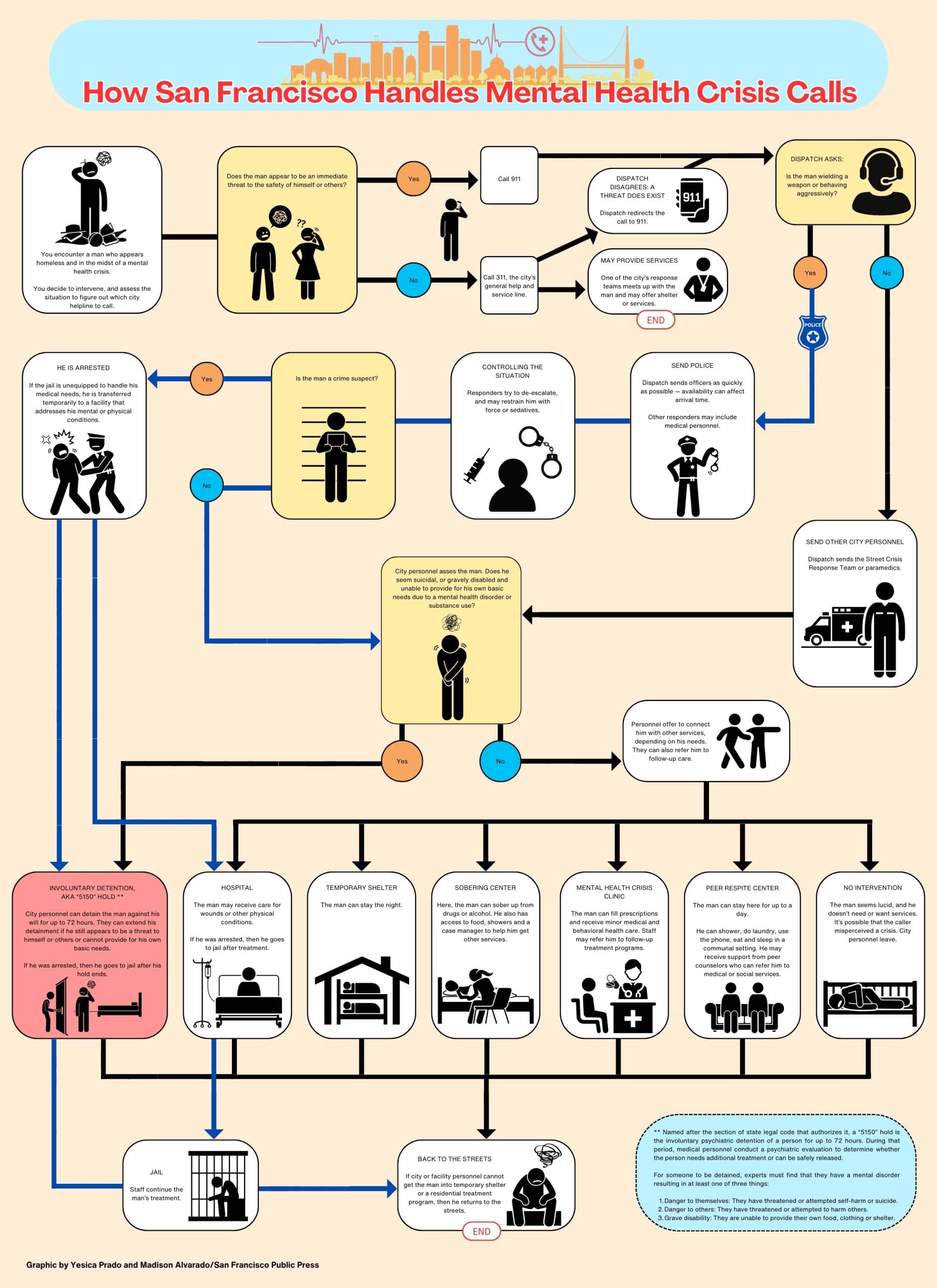
(Click the link below the chart to see a version that allows you to zoom in.)
The San Francisco Public Press spent months investigating how people can be detained involuntarily due to mental health crises and what happens to them afterward. The psychiatric detentions are commonly called “5150” holds, a nod to the section of state code that defines the criteria for this intervention. We examined hundreds of pages of call records, department procedures and training documents, and interviewed staff at numerous city departments directly involved in crisis response to map the city’s system of care.
A single phone call about an incident can trigger responses from multiple departments. Major responders include the Department of Emergency Management, Fire Department, Police Department, Sheriff’s Department, Department of Homelessness and Supportive Housing, and Department of Public Health.
People witnessing a crisis generally request help by calling either 911, the city’s emergency line, or 311, for general services and assistance. Dispatchers do their best with the information the caller provides to quickly determine whether the distressed person poses an immediate danger to themselves or others.
Calls about mental health crises often ping-pong between 911 and 311 as details emerge, said Burt Wilson, president of the union chapter that represents the city’s emergency dispatchers.
Many unhoused people carry weapons to defend themselves at night, and they might struggle with drug addiction or be mentally unstable, Wilson said.
“I don’t know how you differentiate, on the phone call, who to transfer to 311 and who to transfer to the police,” Wilson said. “Most of the 311 calls end up coming back to our call center because 311 just has to say a certain trigger word like, are they ‘aggressive?’ And then it comes right back to us.”
The Department of Emergency Management dispatches police in cases of calls about people threatening violence or wielding weapons; that doesn’t include people who are merely yelling, said Officer Robert Rueca, a spokesperson for the San Francisco Police Department.
But what qualifies as “violence?” The Department of Emergency Management could not say.
“‘Violent’ is not something we have a concise definition for,” a spokesperson said. “It will vary based on circumstances and the level of information the reporting party is providing.”
And a “weapon” is broadly defined as “anything that can be used as a weapon,” according to department guidelines. For many types of small weapons, such as pocket knives, possession alone is not considered a threat.
The shortage of support and funding is really a challenge. Without having continued support after being 5150’d, or [receiving] forced treatment, you’re just setting up someone for more failure.”
Mark Salazar, Mental Health Association of San Francisco
If a person is in severe crisis, police and medical personnel can put them on a 5150 hold.
But involuntary hospitalization can be harmful, said Sarah Gregory, a senior attorney at Disability Rights California. The organization advocates for community-based services for people with mental health disabilities, as an alternative to forced stays in hospitals or psychiatric wards.
Gregory called it a “traumatic” experience when someone “who’s already having a mental health crisis calls for help, and then receives a response that takes away the person’s rights.”
“Client after client says, ‘I came out of there worse than I went in,’” Gregory said, referring to places where patients were involuntarily detained.
When a person in mental distress is not an immediate threat, the call goes to medical personnel like the Street Crisis Response Team, Fire Department or paramedics. The crisis team is one of many created in recent years as San Francisco and other cities have shifted away from a law enforcement response following high-profile police killings, including those of Mario Woods, Tony Bui and George Floyd, in which the officer was convicted of murder.
The San Francisco Police Department “would never be dispatched to a medical call” even if the Street Crisis Response Team or an ambulance were unavailable, said the spokesperson for the Department of Emergency Management. The police were the crisis team’s backstop in its early years, but that stopped in June 2022, they said.
The team uses de-escalation strategies to calm a person in distress, like speaking softly, asking questions to get to know them, and offering snacks or water. When the person regains composure, the team might connect them to treatment or follow-up care with the Office of Coordinated Care, Homeless Outreach Team or Post Overdose Engagement Team, the spokesperson said.
The team might also simply leave the scene once the person is no longer in distress.
People who engage with the city’s crisis-response system might benefit most from having long-term case managers who can help them fully resolve problems with their health or living situations, said Mark Salazar, chief executive officer of the Mental Health Association of San Francisco. The organization provides case management and peer support services at courts, jails and Zuckerberg hospital after someone is released from a 5150 hold.
“But the shortage of support and funding is really a challenge,” Salazar said. “Without having continued support after being 5150’d, or [receiving] forced treatment, you’re just setting up someone for more failure.”
Support for MindSite News coverage of California is supported by the California Wellness Foundation and the California Health Care Foundation.
Mental health can't wait.
America is in a mental health crisis — but too often, the media overlooks this urgent issue. MindSite News is different. We’re the only national newsroom dedicated exclusively to mental health journalism, exposing systemic failures and spotlighting lifesaving solutions. And as a nonprofit, we depend on reader support to stay independent and focused on the truth.

It takes less than one minute to make a difference. No amount is too small.
The name “MindSite News” is used with the express permission of Mindsight Institute, an educational organization offering online learning and in-person workshops in the field of mental health and wellbeing. MindSite News and Mindsight Institute are separate, unaffiliated entities that are aligned in making science accessible and promoting mental health globally.


Authors


Related Articles

How Minecraft Therapy Is Transforming Child and Teen Mental Health Care
Two leading practitioners discuss how they do individual and group therapy that children want to take part in, using Minecraft, the most popular video game in the world. A MindSite News webinar.
Homeless Camp Sweeps Can Harm Health. Some Cities Are Trying a New Way
Several cities and counties are addressing street homelessness with a new approach, which experts say can clear encampments while protecting the health of people who are forced to move.
Along the Mexico-U.S. Border, New Barriers to Harm Reduction
Border militarization is making it harder for healthcare workers to reach people who use drugs.
