
Farewell to Larry Bensky, Journalist Extraordinaire and Supporter
We mourn the passing of an extraordinary activist journalist Also in this issue: intrusive thoughts, mental health stigma, and more.


May 29, 2024
By Diana Hembree and Courtney Wise

Good morning, MindSite News readers. Today, with deep sadness, we mark the passing of extraordinary journalist and rabble-rouser Larry Bensky, who worked everywhere from the New York Times and Ramparts to The Paris Review and KPFA, and who served as a book reviewer and editor at MindSite News. We will miss his unwavering support, friendship, humor, argumentativeness and endless fount of creativity.
In other news, a UCLA study finds “deaths of despair” are more common among Black and indigenous Americans than whites. Five keys to managing intrusive thoughts. Fighting mental health stigma. And more.
Farewell to Larry Bensky: Legendary Journalist and Book Editor at MindSite News

I can’t remember the first time I heard of Larry Bensky because it seemed like he had always been here, a towering figure in journalism circles: a former New York Times writer and editor of Ramparts and The Paris Review, a Vietnam War opponent and lifelong pacifist, a writer for The Nation, the Los Angeles Times Book Review and the local East Bay Express, a Proust enthusiast and an impassioned radio journalist and commentator, especially at KPFA, where he worked for 50 years and was (temporarily) fired and locked out along with other staffers in 1999 for his on-air criticism of station management.
MindSite News editor Rob Waters, who had known Bensky dating back to his own days at an alternative radio station, invited him onto MindSite News as a book reviewer shortly after our launch. After our first meeting, we asked Larry to send in a book reviewer bio for our news site, which he promptly did, along with a new title he liked better: Books Editor. A brilliant and voracious reader, he wrote a marvelous review we called Love in the Ruins and then began turning out reviews so fast we couldn’t keep up with his prodigious output. Unfazed, he sent them to the Anderson Valley Advertiser in Mendocino County but continued to consult with MindSite News, send tips on books and keep tabs on our progress. At lunch with Larry at a leafy outdoor café in south Berkeley, Rob, Larry and I brainstormed about mental health coverage and joked about the restaurant’s rather dour atmosphere. We didn’t know this would be our last lunch together.
What Larry didn’t dwell on was the accident that had left him disabled: falling down the stairs of a Berkeley public bus after being jostled by a crowd pushing to get out the door. Slamming into the concrete sidewalk, he broke his hip and had to undergo extensive procedures. He never complained about it or the pain, just told us about it matter-of-factly to explain why he was using a wheelchair. He had his mind on bigger issues: the state of the world, journalism, fantastic new books just waiting to be reviewed.
This February, we corresponded about the novels he was reading with mental health themes, including Paul Yoon’s “Run Me to Earth.” I had no idea he had just spent 7 hours in the emergency room a day earlier. Discussing literature via email, Larry was in good spirits and as enthusiastic as ever:
Larry: “Reviewing books: Any chance I could do this for you? I am seriously disabled and have to type on my phone with one finger. I am slow. But I could try!
I said I would watch for his new reviews, and Larry was pleased. We also planned a home visit with the help of Larry’s wife, Susie Bluestone. But his health suddenly took a dire turn, and the visit had to be postponed. A week ago, when I opened my computer and saw his obituary, I cried.
Larry was “prickly as a cactus but he was the most extraordinary news and commentary person I’ve ever heard,” said radio commentator Bonnie Simmons in an obituary in the Mercury News. “I never saw anyone who was able to, on his feet, moderate news during life events with such a breadth of history.” Similar tributes appeared in the San Francisco Chronicle, Berkeleyside, and KPFA. This is just one more. — Diana Hembree
UCLA study finds “deaths of despair” more common among Black and Indigenous communities—and swiftly rising among Latinos
For roughly the last decade, America’s opioid crisis has been billed as the plight of white Americans. It’s a concept based largely by the research of Princeton scholars Angus Deaton and Anne Case, reports the Los Angeles Times, a husband-and-wife duo whose 2015 paper examining “deaths of despair” solidified the image of rural and working-class white adults as the faces of the nation’s opioid crisis. In 2015, opioid overdose deaths among whites stood at 12 per 100,000, while Blacks were at 6.6 per 100,000. By 2019, however, “rates of cocaine and opioid mortality in Black Americans were considerably higher in 47 states than among white Americans,” according to findings by NYU Langone.
Now a new study by Joseph Friedman of UCLA shows that “deaths of despair” have surged past whites among middle aged Blacks and Native Americans and are on the rise among Latinos. That’s partly because the opioid crisis only shows part of the story if you are talking about “deaths of despair, “which includes deaths from drug overdoses, alcohol-related disease and suicide, argues Friedman, a social medicine expert, in a new paper published recently in the journal JAMA Psychiatry. Racial bias in the methodology of previous studies skewed past conclusions, he said.
By failing to consider the perpetual racial inequities endured by Black Americans, previous studies offered “a very small piece of the truth that was very interesting but was widely sold as something it wasn’t,” Friedman explained. Worse yet, Native Americans were often not factored into previous studies at all. And as illegal drugs like fentanyl and heroin overtake prescription opioids as the primary cause of overdose deaths, the rates of death for white Americans have actually begun to dip.
Friedman stresses that his critique isn’t to dismiss or minimize the deaths of white Americans. The goal, Friedman said, is to find practices that empower long overlooked communities to treat these problems. In Pasadena, California, for example, social worker Nakeya Fields has expanded her work to include screenings for high stress levels and “therapeutic play” gatherings for Black mothers and their children “to host more safe spaces for us to come and share that we’re suffering,” she said. This weekend, Fields will also co-host Rap 4 Peace in Santa Monica, California. The conference and gala will feature hip-hop icons and contemporary artists talking about mental health and reducing gun violence. — Courtney Wise
In other news…
Five keys to managing intrusive thoughts. Do you tend to obsessively replay arguments in your head or lie awake worrying about your performance review? This story from the Greater Good Science Center at UC Berkeley can help those of us stuck in rumination break the cycle and move ahead.
With the Social Work Licensure Compact, an increasing number of social workers are able to continue counseling clients who relocate to places beyond their state(s) of licensure. It’s good news, Detroit-based sex therapist Stefani Goerlich told Stateline. “It takes [people] such a long time to find somebody that they feel safe with,” she said. “To have a spouse get transferred in their job and to lose all of that? Statistically, people are more likely to just stop therapy entirely, because they don’t want to have to go through that again.” To date, 15 states apply the SWLC and 17 more are considering adoption. The agreement is similar to the PSYPACT for psychologists, legislation currently on the books in 36 states.
As we talk about reducing mental health stigma, we must also consider how racial bias can diminish the impact of or even inhibit access to mental health treatment. To that point, Capital B News spoke with two experts about the underdiagnosis and criminalization faced by Black men who are mentally ill.
In collaboration with Mississippi Today, ProPublica reports on Baptist Memorial Hospital-Desoto, which without a psychiatric unit of its own, sends severely mentally ill patients to jail to await treatment—despite not being charged with a crime. In response to their investigation, hospital spokesperson Kim Alexander wrote, “We discharge mental health patients with the hope they will be transferred to a mental health facility that can provide the specialized care they need. Jailing people who need mental health care is “not the ideal option. Our hearts go out to anyone who cannot access the mental health care they need because behavioral health services are not available in the area.”
If you or someone you know is in crisis or experiencing suicidal thoughts, call or text 988 to reach the 988 Suicide & Crisis Lifeline and connect in English or Spanish. If you’re a veteran press 1. If you’re deaf or hard of hearing dial 711, then 988. Services are free and available 24/7.
Recent MindSite News Stories

How Can We Combat the Rise in Suicides Among Black Youth? An Interview with Dr. Yolanda Lawson
Dr. Yolanda Lawson, president of the National Medical Association, talks with MindSite News about suicide prevention among Black youth. Continue reading…
MindSite News Reporters Win Two Awards

MindSite News, the nation’s only national news outlet reporting exclusively on mental health, is pleased to announce that two MindSite News reporters have won awards for excellence in journalism. Continue reading…
Report an Unhoused Person in Mental Health Crisis in San Francisco and Here’s What Happens Next
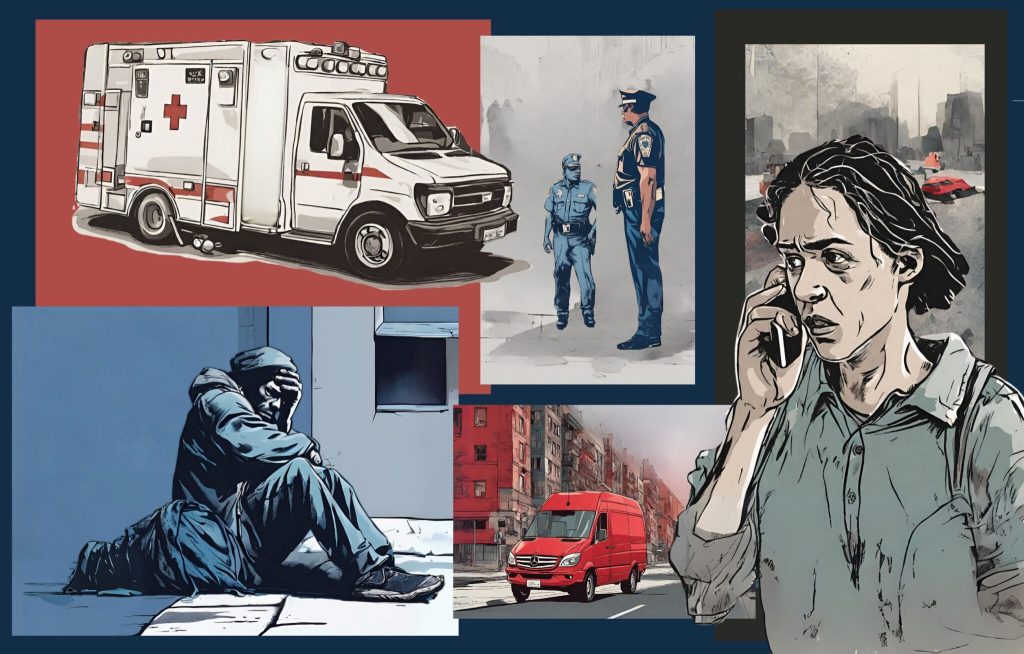
In San Francisco, as in many cities, it’s not uncommon to cross paths with a person experiencing homelessness in the throes of a mental health crisis. The scene can be tragic, confusing and can feel dangerous. Here’s what to do.
If you’re not subscribed to MindSite News Daily, click here to sign up.
Support our mission to report on the workings and failings of the
mental health system in America and create a sense of national urgency to transform it.
For more frequent updates, follow us on Facebook, Twitter and Instagram:

The name “MindSite News” is used with the express permission of Mindsight Institute, an educational organization offering online learning and in-person workshops in the field of mental health and wellbeing. MindSite News and Mindsight Institute are separate, unaffiliated entities that are aligned in making science accessible and promoting mental health globally.
Copyright © 2021 MindSite News, All rights reserved.
You are receiving this email because you signed up at our website. Thank you for reading MindSite News.
mindsitenews.org

The name “MindSite News” is used with the express permission of Mindsight Institute, an educational organization offering online learning and in-person workshops in the field of mental health and wellbeing. MindSite News and Mindsight Institute are separate, unaffiliated entities that are aligned in making science accessible and promoting mental health globally.


Authors


Related Articles

Millennials Weigh Having Children On Their Own Terms
Not having children is also a valid path, and one that everyone should consider, Merle Bombardieri argues in her 1981 book.

Waiting for Word on Relatives Under Attack in Iran
Iranians in the US are caught between two “unrepentant regimes,” says Iranian-American writer and professor Shervin Malekzadeh.
Will the Pursuit of Profit Suck the Benefits Out of Psychedelics?
Many new programs have removed the most transformative, curative and life-affirming parts of the psychedelic experience.
