
A Beloved Chicago Educator Was Shot to Death in the Midst of a Mental Health Crisis. Why Has No One Been Charged?
Something was going on with Abnerd Joseph, a young, Black assistant principal in Chicago. He was pacing the hallways of his downtown apartment building in his bathrobe and acting strange. Some of his neighbors called 911. Another took matters into his own hands.

When fine arts instructor Molly Miklosz met Intrinsic High School’s new assistant principal of culture at the beginning of the 2022-2023 school year, there was a lot to take in.
A slew of new administrators had joined the staff of the still-new school located in downtown Chicago after the previous principal left mid-year. But Abnerd Joseph stood out. He was well dressed and inviting, Miklosz noted — a tradition he held up every day as assistant principal.
“Abnerd initially struck me as very approachable and very distinguished because he showed up wearing a nice suit,” she said. “He was super excited about starting the school year and super excited about establishing culture and good norms. He viewed it as the ideal blank slate to make impressions on kids.”
For a school returning to in-person learning following a year-and-a-half of disruption and virtual learning due to the pandemic, Joseph was the kind of educator students and staff could see themselves in: a Black man in his early 30s with dreadlocks past his shoulders who was also in a position of power.

He came to Chicago from Atlanta, where he had served as an assistant principal at KIPP Metro Atlanta Schools, a charter school system in northwest Atlanta. At Intrinsic, appreciation for Joseph among the nearly 700 mostly Black and Hispanic students pulled from neighborhoods all across the city wasn’t immediate, Miklosz said, but he earned it. From her classroom on the third floor, she watched him interact with the students in the hallways between classes and gain their trust.
“In the beginning of the school year, he was just another new face. They got to know him a little bit better because he was really present. He didn’t hide in his office all day,” she said. “He was always in and out chatting with students, especially the students that needed some additional support.”
Barry Rodgers, Intrinsic High’s principal, was among the administrators that came in with him and was impressed by his infectious energy and positivity. He also was smart, able to easily converse on a range of topics from the TV show, The Office, to the Hubble Telescope, Rodgers said.
What really stood out, though, was his relationship with the students.
“He’s the kind of guy where if he knew a kid needed something he would go off to Target, spend his own money on it on his lunch break,” said Rodgers. “A day before he passed away, I remember him telling kids ‘Hey, you get that grade up I’m going to buy you Chipotle. I’m going to take you to Chick-Fil-A.’ It was very much a vocation for him.”
Those students never got those meals.
According to a lawsuit filed by Joseph’s family, he was fatally shot around 7:30 p.m. on September 14, by Garrett Mark Smith, a fellow resident of his luxury condominium building across from Millennium Park. At the time, Joseph was dressed only in his bathrobe, boxers, and was suffering from an apparent mental health crisis, the suit claims.
Smith was initially arrested by police but was later released and still has not been charged, according to attorneys from Romanucci & Blandin, the law firm representing Joseph’s family. After months of waiting for charges to be brought, the firm filed suit last month against Smith, a property manager, a security company, and the building’s owners for wrongful death and negligent decisions.
“Is there a way to mend a broken heart.”
From a song performed by Abnerd Joseph under the name Emilio joe
“Abnerd Joseph simply did not need to die,” said attorney Antonio Romanucci at a May 15th press conference announcing the lawsuit. He would still be alive, he added, “if the building security had done the right thing, the logical thing on that day, what we all believe their training directs them to do when they learned Abnerd was upset and needed assistance.”
What happened on Sept. 14th?
Here’s what happened that Thursday evening, according to the family’s lawsuit:
Joseph left his condo on the 29th floor of the Legacy at Millennium Park and began knocking on his neighbors’ doors saying he feared for his life.
Other tenants called 911 to report that Joseph was visibly disoriented and to request a wellness check. After Joseph left the floor, Smith exited his apartment, also on the 29th floor, armed with a 9mm semi-automatic Sig Sauer P938 and went to speak with a security guard in the lobby of the building.
Following the conversation, instead of waiting for police officers, Smith, another tenant, and the security guard pursued Joseph, confronting him in a hallway on the condo’s 48th floor.
Moments after confronting Joseph, Smith opened fire shooting him in the left hand, left forearm, chest, underarm, and twice in the abdomen, according to the lawsuit.
“He was surrendering. Instead, what happened? He was executed in his own building with building management and security standing by while vigilante justice was executed,” Romanucci said at the press conference. “Abnerd needed help. How do we know that he needed help? Because we know at a certain point his hands were up in the air. It was the symbol to stop, to wait. Abnerd was telling us with his hands to wait and deescalate the situation.”
But accounts given in police reports and summarized last September by the Chicago Sun-Times describe a more complex and volatile interaction.
When a doorman and four tenants approached Joseph on the 48th floor, he allegedly struck the doorman several times. Another tenant tried to calm him and was also hit and fell down, the Sun-Times reported.
Another tenant – presumably Smith – warned Joseph that he was armed and then began firing when Joseph “turned and charged” at the tenant, according to the Sun-Times.
Attorneys for the family did little to reconcile the difference between the accounts. They pointed to the lawsuit as a means of getting the evidence necessary to determine what really occurred in those final moments of Joseph’s life. Either way, they added, the response was not appropriate.
“It doesn’t matter to our lawsuit at all because even if there was some sort of physical aggression on Abner’s part, what you do in that situation is you step back, you deescalate and you give time,” he said. “Time is your best friend in these situations. Even if it means locking everybody down and leaving him alone in the hallway.”
Shortly after Joseph was shot, a property manager sent out an email alerting residents of “a shooting in the building this evening between residents” and alerting them that there was no ongoing threat.
Remembered for “radiating positivity”
Those who knew Joseph found the violent confrontation hard to believe considering his job and his normal demeanor.
Principal Rodgers said it was hard to imagine Joseph acting violent towards anyone, although he did admit that the job carried a lot of stress. As assistant principal of culture at Intrinsic, Joseph was known for reducing violent interactions and bullying between students. If he was going through personal troubles, you wouldn’t have known it from his presence at school, Rodgers said.
“When you’re in a high school full of kids and you’re in charge of discipline and you’re dealing with parents, you don’t always see people at their best,” said Rodgers. “He was always the person that was clear-eyed about things, who was a peacemaker, who would take things head on. I can only imagine when you do that all the time, you carry a lot of stuff with you too.”
In his family of seven — three brothers and three sisters — Joseph was known as a peacekeeper who never got in trouble and was always positive. He was working to get to the perfect place financially before starting a family on his own, his siblings said.
“Abnerd was that glue that kept us all together. That man radiated positivity,” his brother Bryan Bien-aime said at the press conference in early May. “This man didn’t have no type of hatred for nobody. He’ll give you the clothes off his back.”
Following his death, the doorman of the building ran up to the family distraught, Bien-aime said, explaining how his positivity helped him keep things together as he was suffering from cancer.
In the months since his brother’s death, Bien-aime’s intense sadness has made it difficult to perform his everyday duties as a chef. He said he thinks constantly about his brother and still hears that familiar voice in his head.
For him and other family members, the lack of charges or answers from prosecutors more than eight months after their brother’s killing adds to their distress. Both the Cook County State’s Attorney and the Chicago Police Department declined comment and said the case remains under investigation.
“Every day, every night, every second, I’m just thinking what could have been different because Abnerd was just here,” said Bien-aime “It’s like you know the puzzle is not complete because that one piece is missing and that’s how our life is.”
A school grieves and tries to move forward
Molly Miklosz was setting up her art room the morning after Joseph’s death when she started receiving texts from students asking why school was canceled for the day. Minutes later, a staff meeting was called and the staff learned the news.
The initial reaction was “stunned silence,” Miklosz recalled. The question for the school community then was how to grieve collectively, and how to move forward together.
A few days later, students from the downtown charter school provided a partial answer. They gathered in Federal Plaza and released balloons to honor the fallen leader, whom they credited with helping turn their school around, CBS Chicago reported.
“He had a good nature. Our school became better, and we weren’t labeled as a terrible school,” student Delilah Billinghurst told CBS Chicago. “He may have had his moments, but he made sure at the end of the day, all his students were good. He had relationships — individual relationships. He was involved.”
A tribute in the form of a mural
Nearly an entire school year has now passed, and the silence Miklosz felt back in September has given way to a different feeling as the last days of school approach. One afternoon last week, students in blue uniforms and bright hair made their way through the lobby, walking past graduation balloons and down the long staircase. Others ate ramen and finished final assignments.
Up on the third floor, just outside Miklosz’s classroom is a mural, created by the school’s mural club. It is dedicated to Joseph. When they were looking for ideas for what to put in the mural, the students introduced her to his music. Singing as his alter ego, Emilio Joe, Joseph had recorded a single, “Flewed Out.”
“Abnerd had a beautiful voice,” she said. “The colors were sourced from the cover art for his album – this beautiful picture of him silhouetted against the sunset behind him. The kids wanted to do that and they wanted to take a silhouette to put in the sun and make it even more reminiscent of him.”
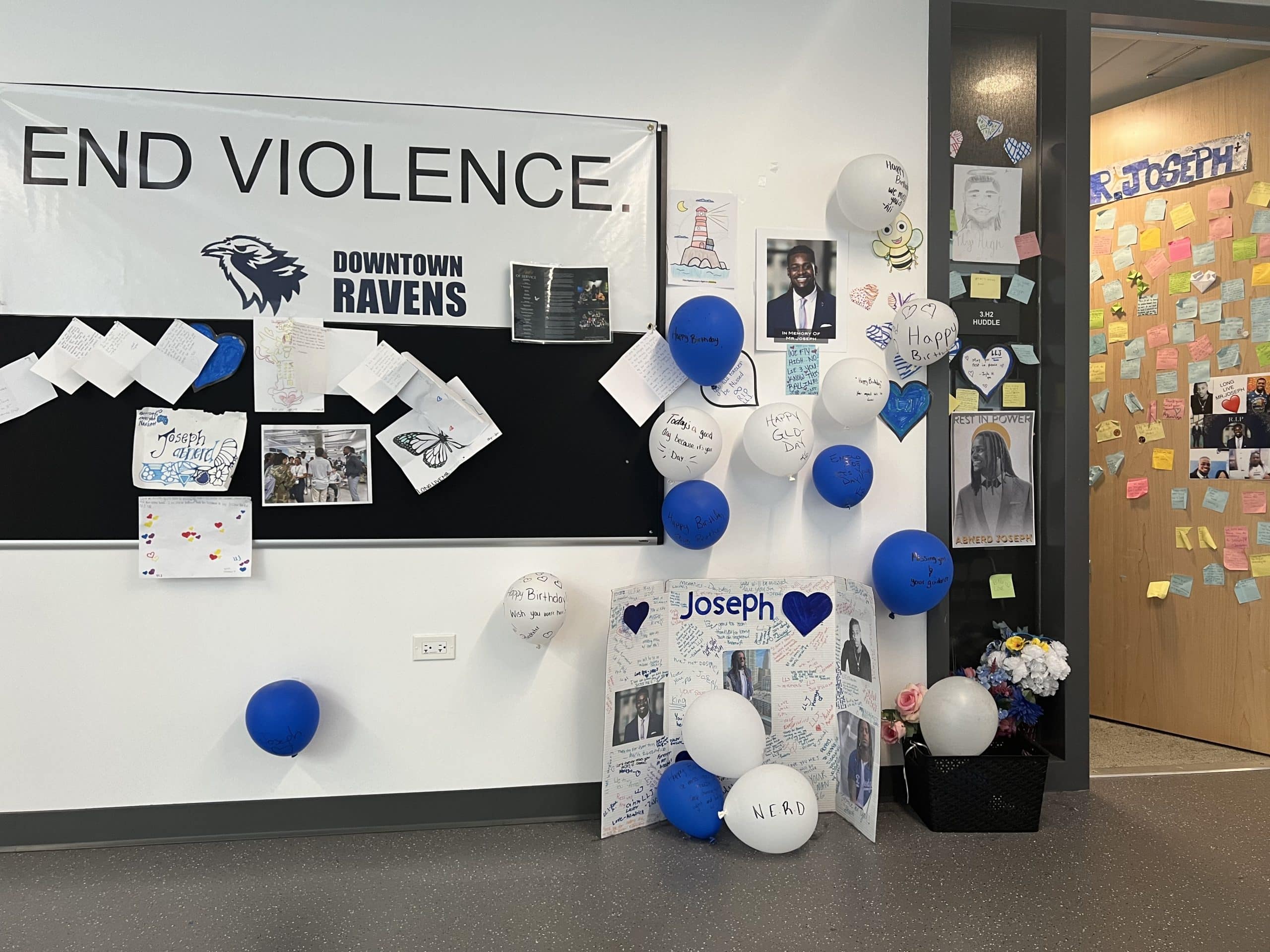
Away from the bright colors, at the other end of the hallway sits another memorial. Just outside his door sit more than a dozen balloons and a poster board wishing Mr. Joseph a happy birthday. Between the balloons his giant smile peaks out in picture after picture, even the ones hand drawn by students.
On his door are more than 50 multi-colored post it notes from students and other teachers, most with a similar message: Long live Mr. Joseph. Fly High.
The name “MindSite News” is used with the express permission of Mindsight Institute, an educational organization offering online learning and in-person workshops in the field of mental health and wellbeing. MindSite News and Mindsight Institute are separate, unaffiliated entities that are aligned in making science accessible and promoting mental health globally.


Author

Related Articles

Trapped and Alone: Fear of ICE Is Deepening Postpartum Isolation for Immigrant Mothers
Doctors say newly postpartum people need medical care, sleep and the ability to rely on friends and family for help. Immigration crackdowns have made that support impossible.

1 in 8 Youth Turn to AI for Mental Health. ‘It Just Tells Me What I Want to Hear’
Youth with the deepest emotional needs are using chatbots for therapy the most – but many are unhappy with the outcome.
California Tribal Advocate Who Fought to Prevent Suicides Dies in Apparent Murder-Suicide
Celinda Gonzales of the Yurok Tribe worked to prevent suicides among Native Americans after losing a son and a brother. She “was a friend to many,” the tribe said.
