
Ending Bullying With Some Help From the Mean Crowd
A Swiss program takes a novel approach to this age-old problem. Millions of kids are the primary caregivers for their parents. Dr. Greenberg on anorexia. And more.

June 13, 2024
By Courtney Wise

Greetings, MindSite News Readers! In today’s Daily, a program in Switzerland shows remarkable success at ending bullying by involving bullies in the campaign. Millions of child caregivers are flying under the radar in the United States. And a mother struggling with her son’s psychiatric crisis during her birthday celebration learns that’s it’s possible, normal even, to feel two very different emotions at once.
Plus, Dr. Barbara Greenberg on the real roots of anorexia in teens and adults — and why they deserve more attention. And for more news and information on early childhood and parenting, consider joining Footnotes by Minnesota Public Radio News. It’s free, and sign up information is below.
Swiss program resolves bullying with the help of…bullies
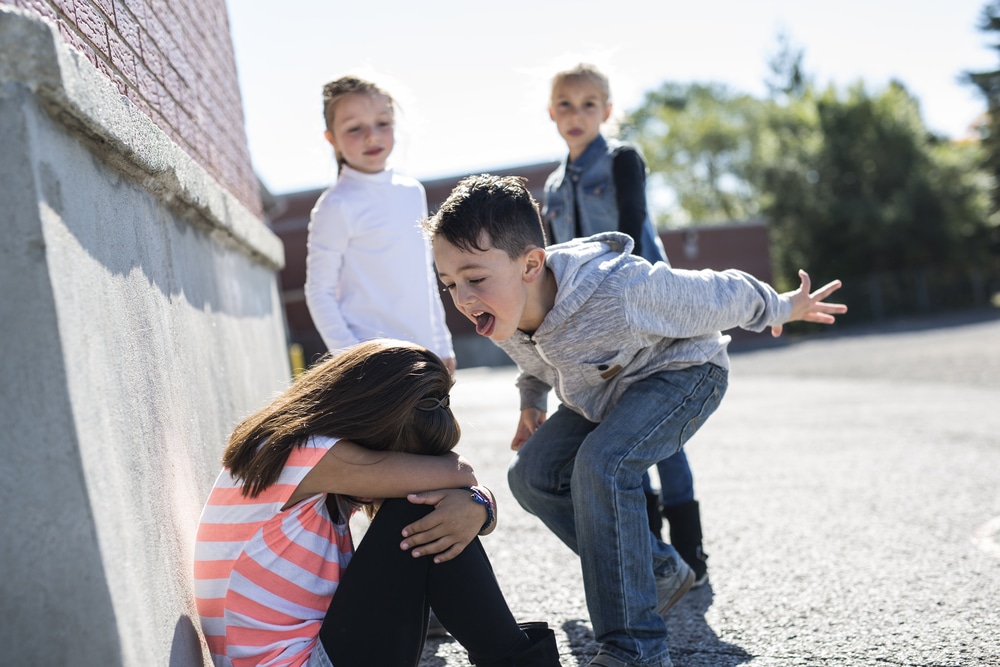
Sit still, in as quiet a place as possible, and take three deep breaths. Clear your mind. Now imagine you’re in middle school. Has the tension returned to your body? Consider that, in this imaginary junior high, you’ve been voted “class ugliest” in an online poll. Most days, the mere thought of walking from class to class is nauseating; a pair of popular goons will make sure to trip or shove you on the way.
It’s a common experience—and on the rise. Switzerland holds the undesired top spot as number one in the globe for bullying, Yes! magazine reports. Further research approximates that 20 percent of students in the United States and Europe have been bullied, while nearly half of teens in a 2022 survey from Pew Research Center said they’ve been bullied online.
Imagine, now, your favorite teacher escorts you to a special students meetup. Your bully is also a guest. Fight or flight kicks into gear, but you finally deduce it’s safe to relax. Such meetings between bullies and their victims, with a couple of “neutral” students sprinkled in, are key to ending the bullying epidemic, says Bettina Dénervaud, co-founder of the Swiss initiative Hilfe bei Mobbing (translated as “Help With Bullying”). The former teacher applies a “no blame” solutions-based approach to the meetings. “The goal is to change the social dynamic,” Dénervaud said, “and to lay open what has been happening…We talk about empathy, tolerance, and respect. How do I want to be treated, and how do I treat others?” Bullies, in an ironic twist, do most of the helping work.
In the process, victims are often able to heal from the harm they’ve experienced because bullies do the work of acknowledging the harm they caused and applying practical solutions. Results from the latest research on the program shows an 87 percent success rate, with it taking just two or three weeks for bullying in each Hilfe bei Mobbing- trained school to stop.
There are limits to the approach, Dénervaud said, including that her program isn’t freely available. Previous attempts to get public funding to make it no cost have failed, meaning she and her colleagues have to charge either the parents or the schools for their services. Further, she added, bullying that is allowed to go on too long can reveal patterns so ingrained that the victim’s best option is to leave the school and find a new community. That still doesn’t signify the end. In those cases, when a victim has no choice but to leave, “the school then still needs to work with the students who stay there,” Dénervaud said.
“My son was in a psychiatric hospital. Why was I celebrating?”
Five years ago, Kristina Kuzmič turned forty years old and struggled feeling happy about it. It’s not the number that gave her pause; reaching the milestone of middle age felt worthy of celebration, she wrote in the New York Times. But revelry felt wrong, considering her teenage son, Luka, was in the midst of a life-threatening mental health crisis. Days before her big birthday trip, all planned out by her husband, Philip, Luka entered the hospital for in-patient care. She told Philip to call the whole thing off; not focusing solely on Luka would make her a bad mom, right?
We can do whatever you want,” Philip told her. “But I don’t think you should cancel…Luka is safer than he’s been in months. He’s with people who are trained to help him. He can’t run away. He can’t hurt himself. And you deserve a break,” he added.
With her husband’s encouragement, Kuzmič gave herself permission to spend two days being celebrated by her friends and family, indulging in their attention and love. Articulating what many parents believe about the depth of their responsibility to their children, Kuzmič admitted that it was a while longer before she let go of her guilt, though.
“Somewhere along the way, I’d learned that if my loved ones were suffering, I, too, needed to suffer. Once Luka was happy, then I’d be happy,” she wrote. “Once Luka was healthy, then I could be healthy. Once Luka was able to live his life fully, then I would fully live mine.” But life doesn’t work that way. It’s scattered with mountains and valleys. “I am allowed more than one emotion at a time,” she concluded. “Pain and joy can coexist.” In a follow-up talk five years later, her son agreed. Read the full story here.
Why many women and girls aren’t eating enough

Teen and parent psychologist Barbara Greenberg, PhD, examines the roots of anorexia in girls and women, noting that they are often plagued by shame and perfectionism and seek to numb those feelings. Find out why new research suggests it is so important to examine that vicious cycle in therapy.
Millions of children care for their ailing parents all alone
At just 12 years old, Aleisha Thompson has more responsibilities than some thirty-somethings you know. Upon waking every morning, she gets her mother’s medication ready. She then prepares herself for the day, first making sure that her mother is fed before she leaves for school. Midday, when her peers are focused on recess, Thompson is checking in with her mother, ensuring that she’s taken her remaining medications and remembered to eat lunch. Caring for her mother, who is disabled and dealing with numerous other ailments – including diabetes, poor vision, nerve and bone issues, and another undetermined condition – has been Thompson’s job for a while now. But she’s not the only child in her plight. USA Today takes a look at the role reversal millions of youth navigate each day.
“Caregiving youth are not on people’s radar,” but their numbers are growing, said Connie Siskowski, founder of the nonprofit American Association of Caregiving Youth (AACY), which advocates for and supports child caregivers. She says the 5.4 million youth estimated to be primary caregivers for parents or grandparents is low. “I think it’s at least 7.5 million, conservatively.”
With an aging population, rising substance abuse, mental health challenges, shorter insurance-covered hospital stays and long COVID, experts say more children than ever find themselves holding the caregiver role. Depending upon the age of the parent and their needs, formal medical care like a nursing home or assisted living can be hard to find or too expensive, further complicating the problem. At just 49 years old, for instance, Thompson’s mother could require another thirty years of care.
Exacerbating the problem, child caregivers are unable to access financial support to help with their parent’s care, Medicaid reimbursement included. Medicare won’t cover stipends to pay family members providing care, while Medicaid only offers reimbursements to low-income families for adults. “There’s literally nothing out there in the way of government benefits to help,” Simasko said. She believes that nonprofits like AACY can help, along with long-term care or hybrid life insurance.
In other news…
Minnesota Public Radio launched text messaging club Footnotes to provide essential early childhood information to parents and caregivers of children aged 0-5. Joining is easy and free. Simply text “FOOTNOTES” to 612-512-0111. Once enrolled, regular updates curated by the MPR News team will be sent straight to your phone.
Extreme climate change appears to be wreaking havoc on children and youth, according to a story from Inside Climate News that was republished by Mother Jones. A recent study from the North Carolina Institute for Climate Studies found that “during periods of intense drought and heat, children and young adults showing signs of mood disorders and suicide risks visited emergency rooms at alarming rates. The risk soared in the hardest-hit parts of the state, especially in lower-income areas.”
Deborah Dorbert of Florida told ABC News that being denied the abortion care her doctor recommended caused her trauma that has since triggered a serious year-long depression. “It wasn’t until I … was starting to have suicidal thoughts and just having breakdowns at home, that I finally turned to my husband and I said, ‘I need help,'” Dorbert said.
If you or someone you know is in crisis or experiencing suicidal thoughts, call or text 988 to reach the 988 Suicide & Crisis Lifeline and connect in English or Spanish. If you’re a veteran press 1. If you’re deaf or hard of hearing dial 711, then 988. Services are free and available 24/7.
Recent MindSite News Stories
If you’re not subscribed to MindSite News Daily, click here to sign up.
Over 3 Years, 43 People Died in Riverside County Jail. Christopher Zumwalt, Violently Pulled from a Cell While Having a Psychotic Crisis, Was One

Ten correctional officers used pepper spray, stun shields, multiple Taser shocks and a Stinger 15 grenade to remove a single, naked man from his cell in Riverside County’s Larry D. Smith Correctional Facility. He didn’t survive. Continue reading…

Something was going on with Abnerd Joseph, a young, Black assistant principal in Chicago. He was pacing the hallways of his downtown apartment building in his bathrobe and calling for help. Some of his neighbors called 911. Another took matters into his own hands. Continue reading…
How Can We Combat the Rise in Suicides Among Black Youth? An Interview with Dr. Yolanda Lawson

Dr. Yolanda Lawson, president of the National Medical Association, talks with MindSite News about suicide prevention among Black youth.
Support our mission to report on the workings and failings of the
mental health system in America and create a sense of national urgency to transform it.
For more frequent updates, follow us on Facebook, Twitter and Instagram:

The name “MindSite News” is used with the express permission of Mindsight Institute, an educational organization offering online learning and in-person workshops in the field of mental health and wellbeing. MindSite News and Mindsight Institute are separate, unaffiliated entities that are aligned in making science accessible and promoting mental health globally.
Copyright © 2021 MindSite News, All rights reserved.
You are receiving this email because you signed up at our website. Thank you for reading MindSite News.
mindsitenews.org

The name “MindSite News” is used with the express permission of Mindsight Institute, an educational organization offering online learning and in-person workshops in the field of mental health and wellbeing. MindSite News and Mindsight Institute are separate, unaffiliated entities that are aligned in making science accessible and promoting mental health globally.


Author

Related Articles

He Almost Killed His Father. Now He Helps Others At Risk.
In today’s newsletter, we explore how one man healed after a dangerous psychotic break that nearly led him to murder.

Fallout Over Supreme Court Ruling on Conversion Therapy
Despite the Supreme Court ruling, conversion therapists can still be sued for a practice the United Nations calls “torture.”

On No Kings Day, Millions Rallied to Denounce Trump and “Epstein War”
Anti-Trump protests took place in all 50 states, Puerto Rico and other US territories and in countries around the world.
