
The Connection Cure: Exploring the Physical and Mental Health Benefits of Movement, Nature, Art, Service and Belonging
More physicians are doing“social prescribing” to help their patients reap the physical and mental health gains from art and nature therapy, movement, volunteering and community ties.

More physicians are prescribing nature therapy, volunteering and other activities. Here’s why.
In public health training, one of the first things students learn about is the construct known as the “social determinants of health.” They learn that a person’s zip code – a marker of their physical environment as well as their socioeconomic position – is a key indicator of health status. They learn that access to decent housing, clean air and water, nutritious food, and a quality education have a critical impact on individual health. As it turns out, so do safe places for recreation, social support and diverse community resources. In addition, students find that all of these factors help prevent people from getting sick to begin with.
While these basic principles have long been understood, a more recent trend called “social prescribing” has sought to harness this knowledge as a health promotion strategy. The term, which covers a broad range of possible initiatives and programs, essentially means what it says: A doctor or other health care provider giving people formal instructions to adopt a pursuit designed to address one or more of the social determinants of health. The social prescribing movement has gained steam over the last decade or so, with successful pilot experiments and more expansive efforts being rolled out in multiple countries.
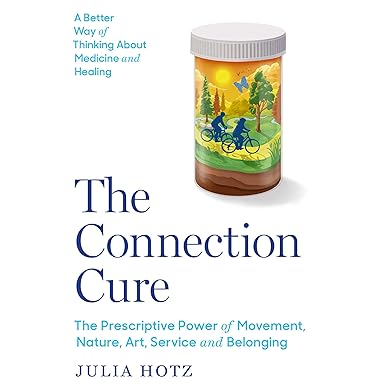
In The Connection Cure: The Prescriptive Power of Movement, Nature, Art, Service, and Belonging, journalist Julia Hotz provides a useful, informative and breezily written excursion through this emerging world. Hotz works for a New York City-based organization called the Solutions Journalism Network, and The Connection Cure certainly qualifies as solutions-oriented. The book presents a comprehensive overview of how this particular solution has been increasingly deployed to treat a wide range of mental health and other chronic conditions, such as depression, anxiety, ADHD, obesity and diabetes, persistent pain and fatigue, and loneliness.
Hotz stresses that social prescribing is not some woo-woo nonsense dreamed up by do-gooders. Instead, it’s a serious and scientifically vetted approach to care, either as a complement or alternative to pharmaceutical and other interventions.
“A social prescription is officially defined as a nonmedical resource or activity that aims to improve a person’s health and strengthen their community connections,” Hotz writes. “These are not small-talky, introvert hellscapes where docs sprinkle friendship fairy dust and motley crews of strangers suddenly become best buds. And they’re not prescribed only for social isolation. Social prescriptions can cover everything from orchestra practice to fresh vegetables.”
According to Hotz, social prescribing represents an effort to pivot our approach to health away from a system in which we wait to get sick, then trudge to the doctor for a diagnosis and a pill. Rather than reinforcing a focus on medical complaints, she explains, social prescribing is about looking internally and externally for ways to access and enhance the experience of joy, pleasure, creativity, and connection.
“Instead of just treating symptoms of sickness, social prescriptions reconnect us to our sources of wellness,” she writes. “And instead of just addressing, ‘What’s the matter with you?’ (‘Aches and pains’), social prescriptions address ‘What matters to you?’ (‘Playing music’).”
The book is divided into three sections. In the first, Hotz identifies and explores in successive chapters five domains that are common elements of social prescribing – movement, nature, art, acts of service and a sense of belonging. Each chapter is stuffed with information and data from studies that confirm the effectiveness of these strategies in generating and sustaining individual health. Hotz includes mini-portraits of sympathetic clinicians, program directors, former patients-turned-health-coaches, all touting the importance of seeking answers beyond the strictly medical.

Regarding nature, for example, Hotz cites a 2005 study from Japan on “forest-bathing” that found a three-day retreat in the woods was associated with increased immune cell activity. Related research found that exposure to nature reduced production of stress hormones, increased production of serotonin, and improved cardiovascular indicators. A 2009 study found that kids with ADHD who took 20-minute walks in a natural park setting improved their concentration a lot more than those who took walks in a neighborhood setting or a downtown setting.
In the chapter on service, Hotz references studies that link volunteering to long-term physical and mental health. She also mentions a nursing home in upstate New York that, in an experiment, introduced a menagerie of small animals, including hens, rabbits, dogs, birds, and cats, to be cared for by the residents; the nursing home’s death rate subsequently fell by 15 percent, and prescriptions per resident were half the rate as in a control nursing home. To demonstrate the importance of a sense of belonging for health, Hotz references, among multiple studies, a longitudinal research project called the Harvard Study of Adult Development, which found that close relationships are associated with longevity and happiness.
Each of these five chapter weaves in the stories of two people, whether in the United States, Australia, England, Denmark, or elsewhere, who are portrayed as having achieved typically successful outcomes from social prescribing in the five domains.
Heather, for example, is a 25-year-old from Vermont who is overwhelmed with family and work obligations. Her doctor diagnoses her with stress. She finds new inspiration after he also gives her a prescription to join NatureRx, a group dedicated to health promotion through “joyful outdoor group activities.” These activities include gathering in nature; closely observing, listening to and smelling the surroundings; and reading, writing and discussing nature poems.
Hotz checks in with Heather some months after she received her NatureRx prescription.
“She’s not completely cured; her stress, chest pains, and insomnia are all still there, but she says her nature prescription has helped to tone down her symptoms,” Hotz writes. “When she feels stressed about her stress, she says she simply goes outside. She takes more walks. She focuses on her breathing.”
In the second section, Hotz covers the history of social prescribing and demonstrates how it has been applied in several countries – including the U.K., Canada, Australia, Singapore, South Korea, Europe, and the U.S. places the trend in different national contexts. She highlights some of the key research that generated awareness of the social determinants of health, including a series of groundbreaking studies of British civil services by epidemiologist Michael Marmot. Marmot found that civil servants lower in the hierarchy had higher mortality from heart disease. Later studies, Hotz reports, found similar associations between lower rank and a “higher risk of lung disease, obesity, diabetes, and suicide.” She also examines the sorry history of excessive pill-prescribing in the U.S. and suggests that social prescribing could help blunt that trend.
In the third section, in an attempt to practice what she is preaching, Hotz engages in brief experiments in which she applies to herself the lessons she has learned through her book research – a mini-nod toward the genre of immersion journalism. For example, she and a friend sign up for an online session of an approach to art called “slow looking” – a visual counterpart to the “slow food” movement. These experiments are fun and entertaining to read about, but the results are predictable –each experience expands her horizons.
As a public health professional, I take for granted the role of the social determinants of health in, well, determining health. I don’t need persuading about the value of these strategies. But I’m also a gloomy type and tend to look for the darker corners, and Hotz’ approach is a bit too optimistic for my taste. While the international array of protagonists shows the geographic and cultural breadth of social prescribing possibilities, they all start to sound the same and blend together, given the uniformly positive outcomes reported. Everyone Hotz encounters seems to be, at a minimum, dramatically improved, if not all better.
“When Frank and Amanda felt stuck, movement reactivated them,” she writes near the end of the book. “When Heather and Nick felt demands on their attention, nature restored it. When Khuyen and Jonas felt consumed by worry, art helped them find new perspectives. When Akeela and Marianne felt frustrated, service helped them feel lighter. When Victoria and Glenn felt isolated, belonging helped them find new meaning.”
That’s all wonderful: You’d have to be a grinch to think otherwise. For many people, social prescribing obviously leads to genuine relief from their disabling ailments, not to mention new passions, interests and friendships. And yet I wanted to learn more about the failures of this approach. Not everyone is “cured” by connection. Some patients obviously remain depressed, addicted, obese and lonely – even after engaging in exercise, joining community choirs, volunteering in a soup kitchen or bird-watching.
Why do these modalities benefit some and not others? How many do not reduce their antidepressant dosages, lose the extra pounds, or experience drops in blood pressure? How do these non-responders feel about failing to improve from interventions that others experience as shining pathways to recovery? The Connection Cure is generally silent on these salient concerns. But ignoring them doesn’t make them disappear.
This is Hotz’ first book and she has immersed herself in the topic, ultimately emerging as something of a true believer. There’s definitely a place for that; no one can reasonably deny that social prescribing can be healthy for individuals and communities. But there is also a place for skepticism and doubts, and especially for the stories of those who do not improve from any of these approaches. For me, the lack of discussion of such thorny issues represents a shortcoming – and that’s why I feel the book is only moderately convincing. By omitting the warts, The Connection Cure paints a picture that’s a bit too pretty to meet the demands of reality.
But never mind. Hotz is a likeable and engaging narrator, and her enthusiasm for the promise and possibilities of social prescribing is infectious. For those understandably frustrated by modern medicine’s coldly clinical approach, The Connection Cure describes an alternative pathway to healing from which many people could benefit.
Support for this story was provided by the Commonwealth Fund.
The name “MindSite News” is used with the express permission of Mindsight Institute, an educational organization offering online learning and in-person workshops in the field of mental health and wellbeing. MindSite News and Mindsight Institute are separate, unaffiliated entities that are aligned in making science accessible and promoting mental health globally.


Author

Related Articles

Ahead of album release, Ye apologizes for hate speech, blames bipolar 1
Ye (Kanye West) issues a formal apology for 2025’s extremist actions, citing a 2002 brain injury and bipolar mania. Some experts and fans remain skeptical.
From “Girl, Interrupted” to “Girl in Pieces”: What I learned from reading three books about teen mental illness
How books on teens with mental illness help destigmatize and educate us.

‘The Factory of Maladies’: A Chilling First-Hand Account of Life in a Psych Ward
“The Factory of Maladies,” a memoir by Deborah Hartung, is a gripping account of being locked up in a San Francisco psychiatric ward.
