Mental Health Experts Continue Their “Duty to Warn” About Trump’s Mental Unfitness Up to 11th Hour
Trump shows “unmistakable” signs of dementia and is unfit for office, according to a coalition of mental health experts.
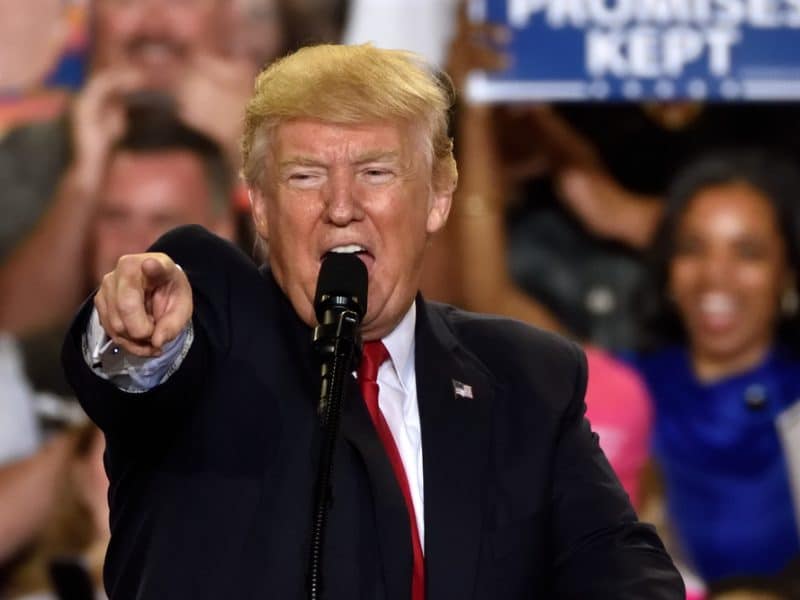
The group of psychiatrists and doctors that first warned about the “unmistakable” signs of Donald Trump’s mental instability in the first year of his presidency has continued its effort to sound the alarm right up to the last day before the momentous election that could return him to office. This time, they are also warning signs that Trump has dementia.
“We are a group of medical and mental health professionals with expertise in aging, mental fitness, and how these relate to the capacity for leadership and ensuring our national security,” the World Mental Health Coalition wrote in a statement on X (formerly Twitter) on Monday Nov. 4. “We feel an obligation to express concerns about the manifestations of poor cognitive function in former President Donald J. Trump.”
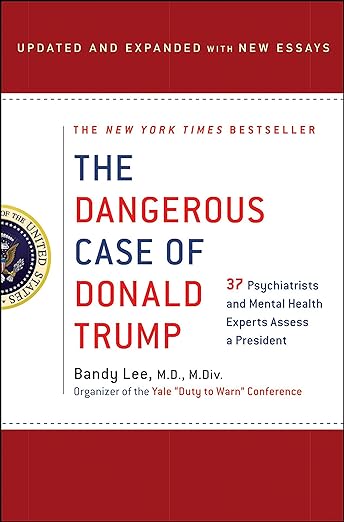
This group, led by forensic psychiatrist Bandy Lee, first came together in 2017 to publish The Dangerous Case of Donald Trump: 27 Psychiatrists and Mental Health Experts Assess a President,* which Lee edited, and then to organize a conference at the Yale School of Medicine and Yale Law School about the dangers of Trump’s mental instability and potential to unleash violence.
But the book and the conference received a chilly response from the American Psychiatric Association, which issued a statement reaffirming its stance that psychiatrists were ethically barred from publicly diagnosing mental conditions of public figures without an in-person evaluation and the consent of the public figure. The APA policy, known as the Goldwater rule, was created in 1973 after a number of psychiatrists were interviewed about the mental fitness of former Senator Barry Goldwater, the 1964 Republican presidential candidate.
The APA’s criticism appeared to deter further press coverage and effectively derailed the quest by Lee and her colleagues to widely publicize what they viewed as Trump’s dangerous instability, aggression and mental illness.
In a 2017 interview with Slate magazine, Lee asserted that the APA changed the Goldwater rule into what she and many others felt was essentially a gag order. APA leadership “reinterpreted the Goldwater rule in a way that it was never written to be and never was in the past,” she said. “They said that the Goldwater rule does not just involve diagnosis, it involves any comment of any kind on a public figure, no matter how dangerous the situation is. And that actually is very alarming.”
The controversy escalated as Trump’s term wore on. In a press release on Jan. 9, 2018, the APA called for an end to “armchair psychiatry” and assured readers that Trump was about to undergo his annual medical exam. The association’s statement at the time expressed certainty that if there were any concerning mental health issues, Trump’s physician would consult with “an experienced psychiatrist who would approach the consultation with objectivity and within the physician-patient confidential relationship.”
Trump’s White House physician at the time, Ronny Jackson, declared the president to be in “excellent” physical health and said he “had absolutely no concerns about his cognitive ability,” asserting that Trump had scored 30 out of 30 on the Montreal Cognitive Assessment Test. But Trump, who is about three years younger than President Joe Biden, never released any doctors’ records of either his physical or mental health.
Jackson went on to be elected to Congress as a Texas Republican in 2020, with Trump’s support. In July 2022, he was demoted by the Navy from admiral to captain, after a military investigation found he had behaved inappropriately as White House physician, including berating subordinates and inappropriate use of alcohol and Ambien.
In its 2018 statement, the American Psychiatric Association volunteered to recommend a psychiatrist to evaluate the president and suggested that mental health experts who publicly expressed concerns about Trump’s mental stability were “using psychiatry for political or self-aggrandizing purposes.” Representatives of the Trump campaign and the APA did not respond to requests for comment.
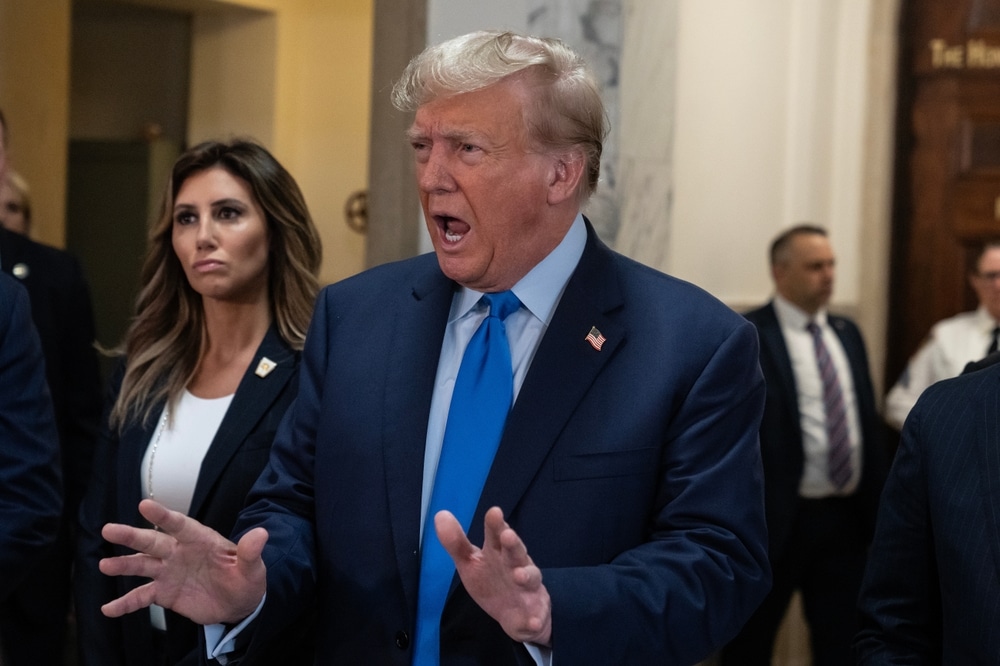
While the mainstream media was laser-focused on Joe Biden’s age, seeming frailty and public gaffes during his campaign this year, it was largely silent on Trump’s increasing incoherence during his rallies – with some notable exceptions.
In February, Salon.com did a story quoting psychologist John Gartner, a former Yale professor, on Trump’s alarming signs of dementia. In March, Newsweek published an article that interviewed Gartner and prominent psychiatrist and retired Harvard Medical School professor Dr. Lance Dodes, who said there was “overwhelming” evidence that Trump has dementia.
“Unlike normal aging, which is characterized by forgetting names or words, Trump repeatedly shows something very different: confusion about reality,” Dodes told Newsweek.
“If he were to become president, he would have to be immediately removed from office via the 25th Amendment as dangerously unable to fulfill the responsibilities of office,” Dodes said, referring to a constitutional amendment passed in 1967 that outlined a process for presidential succession and for removing a president from office due to disability. (Such action would have to be initiated by the vice president and supported by a majority of Trump’s own cabinet or another body “as Congress may by law provide.”)
“Unlike normal aging, which is characterized by forgetting names or words, Trump repeatedly shows something very different: confusion about reality.”
Psychiatrist Lance Dodes, Formerly of Harvard
Lee and her colleagues in the World Mental Health Coalition, which they had founded in 2017, continued to warn the public and government about Trump’s instability and held a related conference at the National Press Club in September 2024. The coalition also issued a new public warning of Trump’s dementia and cognitive decline, which was signed by 50 prominent mental health professionals and neuroscientists. Over the last few months, more stories about Trump’s mental decline have appeared in the media, including PBS, The Guardian, The Atlantic,, the San Francisco Chronicle, the Seattle Times and USA Today.
Gartner, who contributed to The Dangerous Case of Donald Trump, recently started a Change.org petition called “Our Diagnostic Impression of Trump is Probable Dementia: For Licensed Professionals Only,” which has been signed by nearly 3,000 clinicians. While the petition says that a definitive diagnosis would require further testing, Gartner says he is seeing “unmistakable signs” that suggest Trump has dementia, including ongoing deterioration in memory, thinking, behavior and motor skills.
‘A shocking deterioration’
The petition notes that forgetting names and dates is a sign of normal aging, while confusing people and generations “is a sign of advanced dementia.” Not only has Trump confused Nikki Haley with Nancy Pelosi, he has said eight times that he is running against Obama, according to the petition and news reports. Gartner also notes Trump said his father was born in Germany, though it was actually his grandfather who was born there.
In a section of the petition labeled “overall decline,” Gartner writes that Trump “shows a shocking decline in verbal fluency from his previous baseline. He was once highly articulate… Now, his vocabulary is impoverished, he often has difficulty finishing a thought, sentence or even a word. Typical of dementia patients, he perseverates and overuses superlatives and filler words. People who worked closely with Trump during his administration are reporting a shocking deterioration in just 4 years.”
Gartner notes Trump’s frequent use of disordered speech that is typically seen only in organically impaired patients. Forgetting a name or place is a sign of normal aging, he says, but creating non-words is not.
“Trump is verbalizing an increasing number of phonemic paraphasias, using non-words in place of real words that may include a fragment of the actual word,” such as “mishuz” for missile, or “Chrishus” for Christmas – or “just uses sounds that don’t resemble words at all,” Gartner’s petition states. As an example, he points to Trump saying at a March 2024 rally “Saudi Arabia and Russia will…. bluh-ub-bll…”.
“Trump evidences ‘tangential thinking’ where he drifts from one unrelated thought to another, and sometimes tries to confabulate them into a story,” Gartner declares in the petition. “But the narrative is literally incoherent. With increasing frequency, he degenerates into literal incoherence, where no one can tell what he was trying to say.”
As examples, Gartner points to Trump’s speeches that include the fictional serial killer Hannibal Lecter, along with worries about sharks, batteries and electrocution in the ocean. In a recent Pennsylvania rally in which a few people fainted in the audience, interrupting his speech, Trump announced he was turning the rally “into a music.” He then swayed silently onstage to a soundtrack for a painful 39 minutes.
Trump’s probable dementia ‘a national emergency’
Gartner posits that Trump has three mental disorders: dementia, hyper-manic temperament, and malignant narcissistic personality disorder, which is not an official psychiatric diagnosis but is considered a syndrome that blends malignant narcissism with antisocial behavior, sadism, an excessive need for admiration, a lack of empathy for others and deep paranoia.
“His hyper-manic temperament is where his anger comes to the fore,” Gartner told the Irish Times. “The 40 tweets in one night…even on holidays. His tweets are always filled with rage, constantly labeling people as losers. Trump is up at 3 am on a holiday, ranting about how anyone who doesn’t idolize him is a loser.”
Gartner notes in his petition that Trump also shows “marked deterioration in impulse control and judgment” and predicts that over time, “he will become even more erratic, impulsive, paranoid, and aggressive than he already is.” And that, he says, is the most frightening aspect: “A demented malignant narcissist as president of the United States would have unimaginably catastrophic consequences.”
“We feel an ethical obligation to warn the public, and urge the media to cover this national emergency,” he concludes.
*The book was republished in 2019 as The Dangerous Case of Donald Trump: 37 Psychiatrists and Mental Health Experts Assess a President.
The name “MindSite News” is used with the express permission of Mindsight Institute, an educational organization offering online learning and in-person workshops in the field of mental health and wellbeing. MindSite News and Mindsight Institute are separate, unaffiliated entities that are aligned in making science accessible and promoting mental health globally.


Author

Related Articles

1 in 8 Youth Turn to AI for Mental Health. ‘It Just Tells Me What I Want to Hear’
Youth with the deepest emotional needs are using chatbots for therapy the most – but many are unhappy with the outcome.

California Tribal Advocate Who Fought to Prevent Suicides Dies in Apparent Murder-Suicide
Celinda Gonzales of the Yurok Tribe worked to prevent suicides among Native Americans after losing a son and a brother. She “was a friend to many,” the tribe said.
Ghost Guns, Made at Home on 3-D Printers, Are Linked to an Increase in Suicide Rates
Homemade ghost guns are raising new challenges around mental health, firearm access and suicide risk.
