
Is Chicago’s Mental Health Crisis Response Team Ready to Go Copless?
A new evaluation of Chicago’s alternative crisis response team (CARE) finds a low threat of violence and offers insights other cities may find useful.
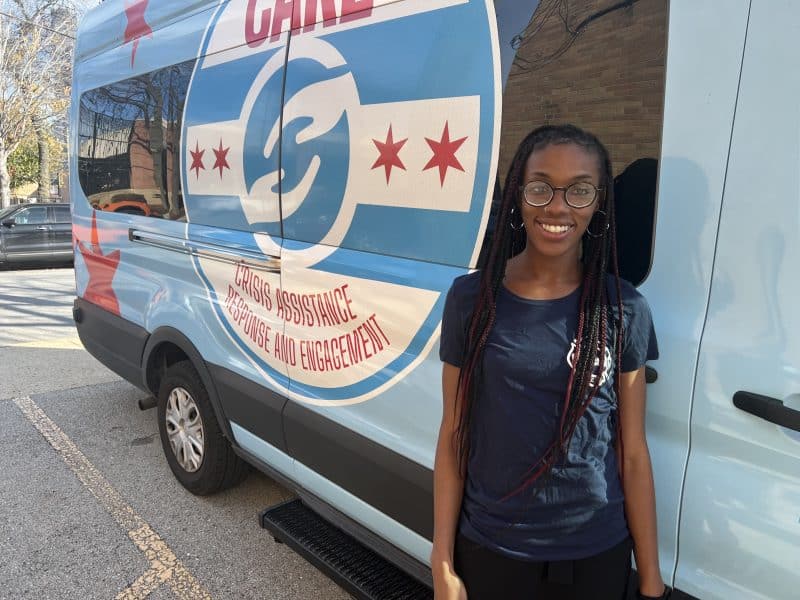
An evaluation of CARE, Chicago’s alternative crisis response pilot, finds low threat of violence and offers insights other cities may find useful
Back in September 2021, Chicago’s then-mayor, Lori Lightfoot, launched Crisis Assistance Response and Engagement (CARE), an alternative response program for people in mental health crises involving five city agencies, including the police and public health departments.
The pilot project launched with a multidisciplinary team – composed of a paramedic, a mental health crisis clinician and a police officer trained in crisis intervention techniques – designed to respond to mental health and behavioral health-related calls that had a possible risk of violence. Over the next two years, it added teams with just paramedics and mental health crisis clinicians – no police – to handle mental health calls with less risk of violence, and an opioid response team that offered follow-up services to people who had survived an overdose. All teams served a few neighborhoods known to need these services.
“The mere fact that these long-standing city agencies who didn’t have a lot of operational work together prior were able to get together and dedicate staff and resources to getting this program off the ground is success in and of itself,” Jason Lerner, director of programs at the University of Chicago Health Lab, told MindSite News. The research lab was charged with evaluating the program, which responded to more than 1,300 incidents during the pilot period.
This month, the University of Chicago Health Lab released its first evaluation. Among its key findings:
- Clients felt less distressed after interacting with the team
- The number of calls the team responded to grew by a third over the pilot period
- 40% of clients showed symptoms of schizophrenia, depression, anxiety, ideations of self-harm, and/or misuse of alcohol or drugs
While the study found promising results from the pilot, the administration of Mayor Brandon Johnson, which took over in May 2023, has begun making major changes to the program, including ending teams that deployed police or fire department personnel – a key promise of Johnson’s “Treatment Not Trauma” mental health agenda. Currently, only alternate response teams with a crisis clinician and an emergency medical technician are being deployed.
Following the release of the study, MindSite News spoke with Lerner and S. Rebecca Neusteter, executive director of the Health Lab about the findings and whether the program is ready for its next iteration. The conversation has been edited for clarity and brevity.
McGhee: What were some of the challenges you faced trying to evaluate this program?
Lerner: First and foremost, the data itself. The way the jurisdictions typically collect data is, the police go out, they respond to calls and they have certain infrastructure for collecting their data. Same with the fire department, and EMS/911.
CARE required the combining of a lot of these data to have a full view of the universe of CARE calls. The pilot turned up lots of instances where you got bits and pieces of the calls and sort of what happened when CARE teams were responding, but you don’t get this full picture and universe from the existing data.
We spent a lot of time with our partners, who were also very dedicated to figuring out where the data were and how to piece it all together. Ultimately, we were only partly successful in doing so. For us and the city partners, there were a lot of indicators about where things needed to go for the city to be able to collect that data. I think they’ll be on better footing now. That posed a challenge to our evaluation. The city could get the staff together to talk about what was happening on the ground, but that wasn’t reflected in the data.
What can other cities working to set up or expand crisis response systems learn from the Chicago experience?
Neusteter: While a lot of resources and time were dedicated to planning CARE, I don’t think there was a lot of foresight as to what data should be collected at the front end. So there were a lot of decisions on the back end about basic things like having an indicator that would allow one individual to be tracked between multiple systems so you can understand CARE’s larger reach. Without that, the city would not be able to do a meaningful outcome evaluation. We were able to come up with a variety of methods to combine data across the different agencies. We have made that technique available publicly. We think it was a really valuable add from this report, separate and apart from the findings. Being able to combine these data across different agencies is pretty remarkable.
One thing that could be explored is the city dedicating resources on the IT front to ensure that the right information is being collected and combined across agencies. There’s a front end investment that would be required, but it would pay off in the long run.
We talk about this as a city-run program, but the evaluation and many of the components of the pilot itself simply would not have been feasible or sustained without the deep involvement of the philanthropy and civic society in Chicago who were monitoring this closely. That was particularly important throughout the mayoral transition.
The data show that for the number of the incidents CARE responded to, there were half as many unique individuals. That shows that some people are coming into contact with the system multiple times. What does that tell us?
Lerner: It’s not surprising that the CARE teams are coming up to the same people multiple times. The standard first responders like police, EMS, and fire will say the same thing. There is a population of individuals who are high utilizers of the system – familiar faces we see again and again. That has repercussions for teams like CARE in Chicago and other jurisdictions. They may have different needs and may need different resources. The challenge really is with the broader system. In many respects, the fact of the 911 call reflects a failure of other systems upstream to provide the individuals with the care and resources that they need, so CARE, police, fire are left holding the bag to respond to these people as a last order of treatment.
In your findings, you say that 911 dispatchers and call takers are essential to the success of new forms of crisis response. Why?
Neusteter: From what I understand about what’s happening in the field nationally, this is one of the most consistent findings that’s being produced and it’s not surprising. One of the main differences for Chicago is that the opioid response team wasn’t designed to respond to 911 calls at all so they’re off in a little bit of a parallel universe. By and large, what we know from prior research is that there’s a lot of variability in how 911 professionals code calls and their comfort in terms of who will respond. What we’ve seen nationally is that if they aren’t able to identify calls that are eligible, for alternative response teams, or they aren’t comfortable deploying them, these response teams won’t be used – whether they include police or not. It really does hinge on the 911 professionals’ familiarity, comfort and discretion whether or not folks go down that route.
For our Fateful Encounters series, I’ve reviewed dozens of police interactions for these calls that have ended in violence. In most of these situations, no violence occurs or threatens until police are introduced into the situation. How did they determine which situations were too violent to deploy to and how did that change during the pilot?
Lerner: When you’re responding to any type of call, you’re eventually going to run into some form of violence. From our perspective, that didn’t seem to happen very much in CARE response, but we’re aware of a handful of responses where a team member was punched, kicked, or something like that. But those instances were few and far between. With respect to the definition of those calls, in the beginning, there were weekly review sessions where staff from each of the agencies would review all calls, look at potential calls, calls they went to and things like that. They determined the definition of violence was too narrow. It was simultaneously over and under-defined.
They were saying teams can’t go to calls where there’s violence and leaving it up to the call takers to determine whether they thought there was violence. Reviewing these calls, the partners would come together and say, “we don’t consider waving their arms around violent.” There was intentionality over the course of the pilot to more fully define the violence.
Now that police and fire are not involved in responding to these calls, how prepared are the teams to respond to calls?
Lerner: They’re coming along. There were some operational and logistical challenges associated with removing police and fire. The health department has not traditionally been dispatched by the 911 system so figuring out the logistics of how to be able to dispatch health department personnel was a big challenge. You wouldn’t traditionally have public health personnel riding around in their own vehicles responding to these things so there’s been some practical challenges. The city and our partners spent a lot of time at the tail end of the pilot figuring out those logistics.
The fact that CARE team members were able to see and treat over 1300 people over the course of three years was also great. The purpose of a pilot is to take away lessons to then apply as the program grows and expands and gets firm ground under its feet.
It’s hard, but I think they’re well-positioned. They’ve done a lot of hiring and are continuing to do some hiring. From an operational perspective of the teams working together once they’re in the field, they’re well prepared. But there’s a lot of preparatory things that the partners had to figure out over the past six months.
The name “MindSite News” is used with the express permission of Mindsight Institute, an educational organization offering online learning and in-person workshops in the field of mental health and wellbeing. MindSite News and Mindsight Institute are separate, unaffiliated entities that are aligned in making science accessible and promoting mental health globally.


Author

Related Articles
Mental Health Coalition Protests ICE Raids and Detention
Patients are avoiding health care, even in serious medical emergencies, because of ICE raids on clinics and hospitals.

‘It’s More Horrific Than What Is Being Told’: Filipinos Speak Out About Being Targeted by ICE
A series of audio interviews about detention, abusive treatment and deportation for the 4th largest immigrant group in the U.S.
The Trauma and Resilience of Afghans: An Interview with Dr. Qais Alemi
Alemi says refugee trauma stems not only from war atrocities, but from cultural dislocation and the loss of language and identity,
