
Losing My Vision Has Been a Blow to My Mental Health. I Cope by Seeking Help and Having a Sense of Humor
Twenty-seven years ago I went to my eye doctor for what I thought was a routine post-cataract-surgery visit. After some additional tests, I learned I had macular degeneration and that my vision was going to progressively deteriorate. Here are my suggestions for coping.
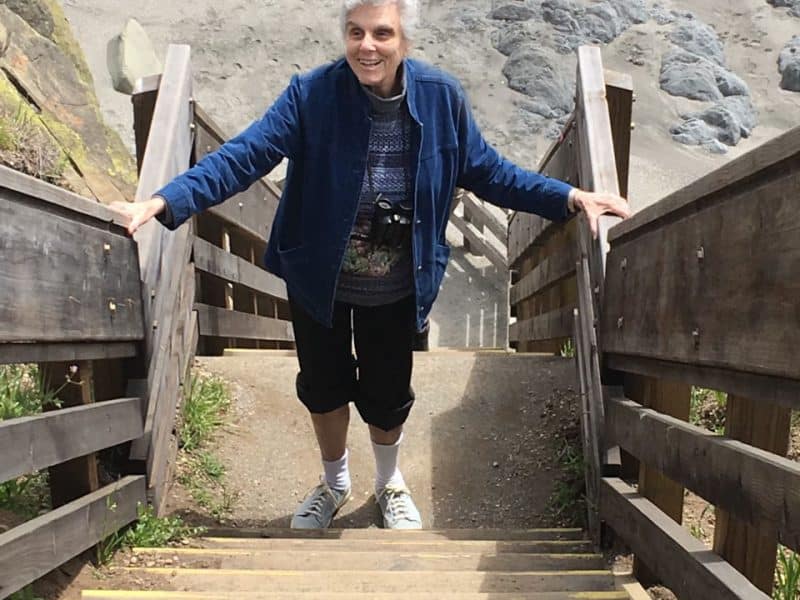
The writer offers suggestions for people losing their sight – and the counselors that help them
Elinor Waters, EDD, is a retired counselor who taught at Oakland University outside Detroit and for many years directed its Continuum Center, a program that provided peer counseling and training, especially to women wanting to reenter the work force in the 1970s and 80s. It was described as “a pioneer program and a model for preventative mental health care delivery…and received wide acclaim across the United States and beyond for its pioneering services to women.” She is 97 and lives near Washington D.C.

Twenty-seven years ago I went to my eye doctor for what I thought was a routine post-cataract-surgery visit. He praised his work and was confused when I asked why, if he had done such a good job, I couldn’t see any better.
After a couple more visits, he referred me to a retina specialist who took pictures of the back of my eye and told me I had AMD, age-related macular degeneration. I was unlikely to go completely blind, he said, but my eyes would steadily worsen. He assured me the cataract surgery had unmasked, rather than caused, the AMD, but there was nothing he could do. (The injections that slow or stop the progression of the disease weren’t yet available.)
He then had me watch a video that showed four women, dressed in what my grandmother called housedresses, playing a game with oversized cards. They’re nothing like me, I thought.
As I walked home in my jeans and sweater, trying not to cry, I realized that, fashion aside, I was in the same boat as the card-players – and was in danger of losing some of the independence I’d treasured all my life. When I got home, I handed my car keys to my husband.
In some ways, I was fortunate. We had just moved two years earlier to Washington DC from Detroit, where I had spent the past three decades working as a counselor, mostly with adult women, and training peer counselors. I loved many things about the Detroit area, but it was not a place you could get around without a car. In Washington, I quickly realized, I could get almost anywhere by Metro – a critical thing for maintaining my independence and sense of wellbeing.
Finding helpful resources
I pulled myself together and began a search for people and resources that might help me cope with my declining sight. I quickly scored with an optometrist who specializes in low vision.
While not trained as a mental health specialist, he seemed to understand and validate my feelings. Yes, he said, my life would now be different but I could still do most things I wanted to do, just in new ways. I told him reading was important and he filled out a form entitling me to free talking books from the Library of Congress and showed me how to use them on an audio player.
He took me to a resource center that had everything from signature guides – a piece of cardboard with a cut-out rectangle to show you where to sign your name – to closed-circuit television monitors that magnify written text onto a screen. There were cutting boards that are black on one side and white on the other so you can create contrast when cutting different foods and catalogs of products for people with vision loss. I left with a sense of hope.
At the time, I’d d begun serving on an advisory board for a local senior center and found myself frustrated that I couldn’t do some of the volunteer activities they needed. I approached the director and asked if she would like me to do something I did know how to do: run a support group. She liked the idea, and we soon started one for people with low vision.
When vanilla ice cream looks like chicken fat
In the group, we commiserated and laughed together. We bemoaned the fact that we couldn’t prepare and host large family dinners, pick up grandchildren from school, or work without special equipment. We laughed at situations we got into such as going the wrong way on the metro or mixing up food. The group was most amused when I told them that my husband didn’t think it was as funny as I did when I served him vanilla ice cream mixed with chicken fat for dessert. It looked just like lemon sherbert.
Over time, we also shared ideas about software that reads aloud from your computer, how to recognizably label food in the refrigerator, and using colored hangers to help identify clothes. And we shared our anger over the fact that low-vision equipment can be expensive and Medicare and many other insurers don’t cover it, just as they don’t pay for eyeglasses or hearing aids.
Mental health professionals working with people with low vision need to understand how they may struggle with the feeling that their independence is slipping away. Many clients are embarrassed by their poor vision and reluctant to talk about it. They may be particularly uncomfortable when they don’t recognize people who greet them, a feeling of unease that can lead to people staying home and becoming lonelier and more depressed.
Here’s how I handle it: I live in a large apartment building, and I encourage people I pass to tell me who they are – sometimes with humor: “Please don’t just say ‘Hi Elly,’ since most of the time I know who I am.” Practicing this kind of strategy can really help and so can feedback.
Buffet-style meals also pose a challenge that can be addressed by simply asking someone at the table to help identify and select food. This may even produce a bonus: finding someone new to talk with.
What? So what? And now what?
A useful model for helping clients address problems is to ask three questions: What? So what? and Now what?
What: What’s the situation or problem they are facing?
So what: How does it affect them or others?
Now what: What can they do about it?
This model can be used for major problems such as needing more support and flexibility from an employer, or figuring out the best place to live, as well as simpler, more common problems. For example:
What? Some people are reluctant to go to dinner at other people’s homes.
So what: They may be anxious about spilling something or breaking a dish or embarrassed when other people get up to clear the table and they stay seated for fear of dropping something.
Now what? If you explain the situation in matter-of-fact terms, your host may suggest you stay seated and invite someone else to join you in conversation.
Many clients and counselors like this model because it is simple and can be fun as well as helpful.
Support groups and counseling can be really helpful, too, if you know where to find them. Since most people learn of their low vision from eye care professionals, it’s important that these clinicians and their clerical staff know about low-vision resources and share them with patients. I had to ask the staff at my eye doctor’s office for this kind of information – and she eventually found some flyers in a drawer. If I hadn’t asked, I wouldn’t have gotten this vital information.
Another resource I found helpful and was able to find in the Washington D.C. area was a home-visitor who helps people with low vision arrange their homes and possessions to help them find things more easily.
As it turned out, my doctor of 27 years ago was right: I’ve progressively lost my vision, and today my eyesight is very poor, but I am not totally blind. I have trouble identifying food, even when it’s labeled. I use a walker when I go outside to keep me from tripping over uneven places in the sidewalk or sewer covers – things most people have no need to notice. In the house, I use a three-legged walker to guide me to the bathroom at night.
It takes a village
My mental health is up and down: I am not depressed all the time but certainly get down in the dumps. It’s especially depressing to realize that if my condition had started five year later, I would have had access to new and better treatments and might still be going to movies and plays.
What helps? I have three children and two grandchildren who visit fairly often (but, as a Jewish mother, let me also say: Would it kill you to visit a little more?). I belong to a “village” – a mutual-support membership group designed to help older people live comfortably in their homes. Volunteers from the village drive members to appointments, help with computer problems and grocery shopping. In my case, village members come visit every week to read to me.
Having lost most of my vision, and much of my sense of hearing, I’m trying my damnedest to hold on to my sense of humor. I’ll need it next time I’m crawling around on my hands and knee looking for the pills I just dropped. (It’s really hard when the floor is white.)
Elly Waters retired 28 years ago from a career in counseling. If her last name is familiar, it’s because she’s the mother of the founding editor of MindSite News.
The name “MindSite News” is used with the express permission of Mindsight Institute, an educational organization offering online learning and in-person workshops in the field of mental health and wellbeing. MindSite News and Mindsight Institute are separate, unaffiliated entities that are aligned in making science accessible and promoting mental health globally.


Author

Related Articles

Can ChatGPT Be Your Therapist? This Therapist Found Out for Herself
Can ChatGPT offer a viable alternative to traditional therapy? In this first-person essay, a licensed therapist explores that question.
What Was I Made For? Identity, Meaning, and the Emotional Cost of AI
Machines can now write, analyze, diagnose, and simulate emotional presence, triggering not just a technological disruption but one that strikes at who we think we are.

Brown University Shooting Again Reveals Why Trauma Care Must Begin Before People Seek It
A former Brown student and longtime mental health journalist says that how institutions respond after traumatic events can shape mental health outcomes for years to come.
