
Hungry Families in Deep South Find Food Bank Boxes Reduced by USAID Cutbacks
Families in Tennessee are distressed and hungry as USAID cutbacks reduce allotments to food banks. A California police force stops attending many mental health calls. And more.



Greetings, MindSite News Readers.
In today’s Daily, families in Tennessee are distressed and hungry as USAID cutbacks reduce allotments to food banks. A California police force stops attending many mental health calls. One Pennsylvania county forgave millions in pay-to-stay incarceration fees. Racial disparities in youth incarceration are worse than ever recorded. And a prison warden changes his mind on the death penalty. Plus, food banks in rural Tennessee are having to turn away hungry families due to federal cutbacks in USAID after DOGE’s intervention.
“It tore me up”: USAID cuts upend food banks in the Deep South
The mental health of food bank workers and their clients is at risk, due to the drying up of USAID and other related funds for the operations, says a source in rural Tennessee.
A MindSite News reader in Giles County, Tennessee, let us know that the massive cutbacks at USAID crippled food bank distribution in her county and neighboring Lawrence County this last weekend. “I usually go and pick up a box of food from our distribution center once a week, and it includes fresh produce as well as canned goods,” said the former law office employee, who is on a limited income after being disabled in a serious accident several years ago. “But the manager let us know that they will be distributing half the usual amount of food next week – or maybe not even distributing food at all – because they had lost access from food suppliers due to USAID cuts and the funds aren’t available now.” (USAID funds domestic food programs and anti-poverty programs as well as international efforts in countries ravaged by war and poverty.)
She also talked with a food bank manager in Lawrence County, where the median income is $29,000 a year. Like Giles, the county is predominantly white, low-income and rural with pockets of deep poverty. The bank is a lifeline to the rural poor there, she said, especially to foster parents in need of supplemental food. Because of the USAID cuts, the bank had to turn away hungry families. “People had run out of food and the kids in the cars hadn’t eaten and were crying from hunger,” the manager told me. “And we had to turn them away – it tore me up inside. It just tore me up.” – – Diana Hembree
What happens when police won’t respond to a mental health emergency?
For nearly a decade, Susanna and her husband have struggled to help their daughter navigate her mental illness. Withholding her name and the family’s last name to preserve privacy, Susanna told CalMatters that their house and bodies hold scars that tell the story. Her family has been managing her rages since she was in the fourth grade, and has, more recently, occasionally called 911 for help. But within the past year or so, Susanna said police seemed “more disinterested,” and one night, this past February, they simply told her they wouldn’t be coming.
Their daughter had just threatened to kill Susanna’s husband, and was trying to break down the door, holding a kitchen knife. But upon learning about her mental health issues, a 911 supervisor suggested the couple remain locked in their bedroom. A log of the call taken by the Sacramento Sheriff’s Office read, “No crime; not responding.”
Just a month before the call, Sacramento County Sheriff Jim Cooper had decided that his department would no longer respond to mental crisis calls unless a crime had occurred, was in progress, or someone other than the person in mental crisis was in imminent danger. His goal: to limit the liability of his officers. “Law enforcement officers are not trained mental health professionals,” Cooper said in a press conference. “We wear the badge; we carry the gun. We deal with crime – not mental health crises.”
While they agree that police shouldn’t be the default responders in a mental health crisis, other emergency responders feel that police support is still necessary in dangerous cases. Civilian crisis teams cannot legally or safely detain or transport people who refuse treatment, and firefighters, often the first among emergency responders to arrive, say the policy creates unsafe conditions for them. Co-response teams, comprised of a clinician and law enforcement, are particularly effective, experts say, but Cooper’s decision has now disbanded Sacramento County’s two teams.
It would be ideal for police to never be needed for such calls, said Dominic Sisti, a bioethicist at the University of Pennsylvania. “But when you have somebody who is potentially violent towards themselves or others, I don’t see any way around having somebody there who has the training to manage that situation from a safety perspective, not just a health care perspective,” he said. “These individuals are going to get sicker. They’re going to probably get more agitated. The families are going to suffer and we’re going to see worse outcomes.”
A postscript: In MindSite News’ Diagnosis: Injustice newsletter, we’ve covered many instances in which police response to mental health emergencies ends in the death of the person suffering from a mental illness. That’s why a team composed of paramedics and mental health professionals – or a co-response team accompanying the police – may have better results for all involved.
Jail debt promotes recidivism and is rarely recouped, so one Pennsylvania county forgave theirs
On July 7, 2022, officials in Dauphin County, Pennsylvania dealt Chad LaVia a new sentence, days after releasing him from a year in jail. Arriving in the form of a $14,320 invoice for “room and board” – $40 per day of incarceration – these bars were less visible, but nearly as restrictive, and confounding. LaVia had been acquitted of the charges that got him locked up. Added to an additional $2,751 in fees from previous jail encounters, LaVia’s total debt to the county reached $17,000 – an overwhelming amount for a 50 year old with a history of addiction and mental illness, trying to find his feet after incarceration. “It’s hard to be a productive member of society when you have $17,000 over your head,” his mother, Judi LaVia Jones, said to Bolts magazine.
If left unpaid for just two months, the debt would be turned over to a collections agency. “Try applying for an apartment with that. Try starting a business. It is always hanging over you,” she said. Across every state in the nation, people saddled with criminal-legal debt are disproportionately poor and non-white, matching historical disparities in rates of arrest, prosecution and incarceration for low-income, non-white people.
That’s why Justin Douglas, a recently-elected Democratic commissioner in the county, made jail reform an important part of his campaign, advocating for total jail debt forgiveness. Dauphin County actually replaced pay-to-stay charges with a $125 booking fee in 2022, because debts were largely going unpaid, despite costly collection efforts. Other Pennsylvania counties also have limited success recouping criminal-legal debt. Bucks County, for instance, collected less than 1% of the total debt owed there, despite an active Delinquency Recovery Program. “This is fake debt to begin with, in that we’re never going to recoup $66 million, and it’s comical to think we would,” Douglas said. Earlier this year, the 3-member commission voted to forgive the debt entirely. Now criminal justice reform advocates hope to see the $125 booking fee disappear.
For his part, Republican county commissioner Mike Pries said voting with Douglas to support debt forgiveness was easy. “We were literally spending money on a good conceptual idea and goal, but at the same time keeping individuals from reaching that goal by making it almost impossible to get credit, unable to get a mortgage, unable to rent an apartment, unable to get a car loan. That then becomes a cycle of despair and many times forces them to make decisions that put them right back where they started.”
In other news…
Governor Newsom prepares to impose minimum staffing on California psychiatric hospitals after years of profit-driven dysfunction. Psychiatric wings of general hospitals work to a 1:6 nurse-or-technician-to-patient ratio, but that regulation doesn’t apply to dedicated psychiatric facilities. Sandy Reding of the California Nurses Association told the San Francisco Chronicle that it was a “good start,” but that new standards need to be informed by clinicians.
Newsom’s administration has worked to expand psychiatric care since coming into power in 2019. For-profit facilities are the fastest-growing emergency providers in the state, and now treat a majority of children in crisis, but state officials have found that regulatory violations have been involved in at least 17 deaths across those 21 hospitals, and hundreds have reported sexual or physical abuse. It’s unclear exactly what ratios the state will eventually mandate.
A warden against the death penalty: Criminal, a true crime podcast looking at the impact of crime and our system of justice, recently re-aired Episode 314, “The Job.” In it, Frank Thompson, a former prison superintendent, who performed Oregon’s only two executions over more than 50 years, describes his changing feelings on the practice.
“I become acutely frustrated when it appears as if my being against the death penalty ignores the plight of those who lost loved ones.” Thompson said. “By supporting the death penalty, we create another set of victims by asking decent men and women who know nothing about killing anybody…to execute them. Nobody really thinks about taking the life of a human being until taking the life of a human being becomes newsworthy …The average citizen will never find himself looking a death row prisoner in the eye, administering a lethal injection and stating the time of death in front of observers and reporters. But we all share the burden of a policy that has not been shown to make the public any safer, and that endures despite the availability of reasonable alternatives.”
Though youth incarceration is more unequal than ever recorded, President Trump has declared, in an executive order, that the federal government “will no longer tolerate” Department of Justice policies that said schools may be violating civil rights laws “if members of any racial groups are suspended, expelled, or referred to law enforcement at higher rates than others. While there are not major differences between the racial backgrounds of children who commit crimes, there are huge differences between which children are more likely to be referred to the police; there are also neighborhoods that are more likely more likely to be heavily policed, Josh Rovner of the Sentencing Project told NPR. According to the most recent data, Black children are 6 times more likely to be incarcerated than white children, while Indigenous children are almost 4 times more likely. “We see that youth of color are just not given the leniency or the common-sense responses that white youth are given,” Rovner said. “The off ramps that exist throughout the system are much more available to white youths who are similarly situated than to Black youth.” Trump’s action stands to worsen those inequalities.Fatherless No More,a documentary from Super Bowl champion turned Orlando-based Pastor Tim Johnson, is described by Andscape as a “moving and powerful portrait,” in which “Johnson breaks through walls built from trauma and poverty,” to reveal “troubled young men who learn to express vulnerability, compassion, and love.” Building upon themes in Johnson’s book of the same name, the film follows young inmates at Rikers Island, and looks for a route out of the difficulties of fatherlessness, illustrating the power of faith, vulnerability and forgiveness.
The name “MindSite News” is used with the express permission of Mindsight Institute, an educational organization offering online learning and in-person workshops in the field of mental health and wellbeing. MindSite News and Mindsight Institute are separate, unaffiliated entities that are aligned in making science accessible and promoting mental health globally.


Author

Related Articles
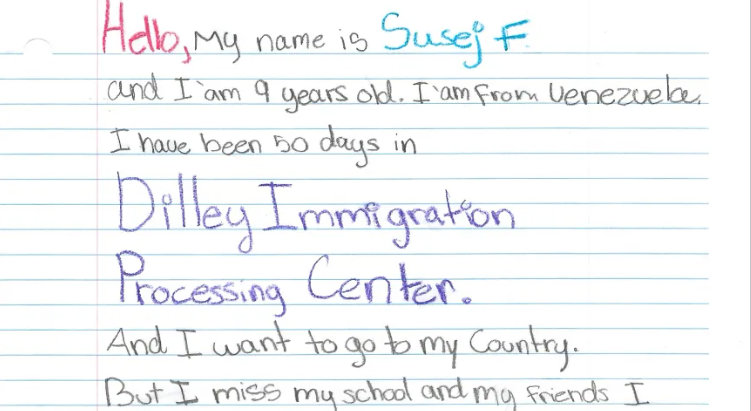
Health Organizations Condemn Traumatic ICE Raids, Family Separation
According to letters from children living in an ICE detention facility, living conditions are inhumane and their mental health is suffering.

In Teens, Social Anxiety Often Looks Like Anger
A study finds that some teens’ aggressive behavior may be due to social anxiety, not straightforward reactivity.
Expert Calls for Harm Reduction, Not Punishment, to Resolve Our Overdose Crisis
As the Trump administration pulls funding from harm reduction, an expert on the overdose crisis says it’s the best way to save lives.
