
Are Men Retreating from Connection?
A woman writer bemoans the withdrawal of men from connectedness, vulnerability, “presence.” Is the teen mental health crisis a sleep crisis? And bidding a fond farewell.

In today’s Daily: Men, women are asking, where have you gone?
Younger members of Gen Z are bucking an otherwise universally positive trend: More of them are dying of drug overdoses.
Plus: Proposed health care cuts keep growing. Could the teen mental health crisis actually be a sleep crisis? What to do when a loved one is diagnosed with dementia – and could delaying the disease’s progression be a bad thing?
But first: Alas, today’s newsletter is my last. I’ve enjoyed immensely finding and sharing the most intriguing journalism and research on mental health and addiction these past 3-1/2 years – the culmination of a nearly half-century reporting and editing career that moved closer and closer over time to the subjects that call to me (my first beat was local zoning boards). I have yet to settle on what’s next: trail maintenance, perhaps, or training to answer calls on a suicide hot line. More travel, for sure. (Madagascar in October is already booked.) Thanks for reading.
Editor’s note: And thank you, Don, for your invaluable contributions these last few years. In your honor, the “But first” section of the Daily will remain as a regular feature of the intro.
An impassioned plea for men to ‘come back, with your whole, beautiful, imperfect heart’
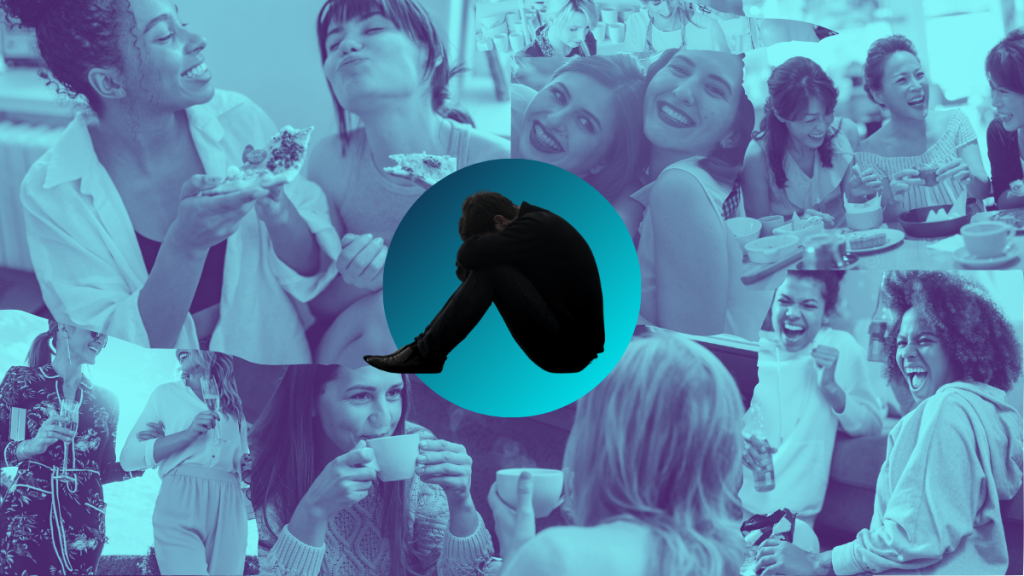
Rachel Drucker, a 54-year-old intellectual property professional in Chicago, remembers exactly when she first registered the absence of men. A dinner date had canceled at the last minute, but she ate at the restaurant anyway, people-watching. Only two tables nearby seemed to host actual dates. The rest were groups of women, or women alone.
“That night marked something. Not a heartbreak, but an unveiling,” she writes in the New York Times. “A sense that what I’d been experiencing wasn’t just personal misalignment. It was something broader. Cultural. A slow vanishing of presence.”
Relying mainly on personal experience, Drucker puts into words what (I assume) many women have been experiencing and, perhaps, some men are aware of: the withdrawal of men from connectedness, vulnerability, “presence.” She remembers when part of male heterosexual culture involved “showing up with a woman to signal something – status, success, desirability.” When a one-night stand “might end with tangled limbs and a shared breakfast. When the act of staying the night didn’t announce a relationship, just a willingness to be human for a few more hours.” Even that, she writes, is now rare.
Plenty of articles (and academic studies) focus on some men’s hostility to women. Drucker does not. She sees no malice in their behavior, just withdrawal to risk-free, frictionless activities: phone-scrolling, porn-watching, settling for situationships, hiding behind filters, curated personas and emojis. “This idea that vulnerability is a threat instead of an invitation has created a culture of hesitation, of men circling intimacy but never entering it,” she says. “Everyone performing closeness, but no one making a move that binds…A hunger for contact that has nowhere to land.”
She says she doesn’t blame men, though she does call on them to change. She sees not personal failure, but collective reality. She describes it as “directionless orbiting,” “perpetual maybe,” “abdication of ownership,” “isolation,” “retreat,” “avoidance,” “exhaustion,” “disrepair” – and, most powerfully, “indifference.” “You are missed,” she writes in the Times’s Modern Love section. “Not just by me, but by the world you once helped shape.” Men can come back, she says – pleads, really – “by remembering what connection feels like when it’s honest and slow. When it’s earned and messy and sacred. … As for me, I’ll keep showing up. Not because I’m waiting. Because I know what it feels like when someone finally arrives.”
An exception to plummeting overdose deaths
Fatal drug overdoses have declined sharply for every generation except one, or part of one, the Opioid Data Lab reports: younger members of Gen Z, specifically, those born between 2005 and 2011, who would have been 13 to 19 years old when they overdosed in 2024. This group accounted for less than 2% of fatal overdoses (Millenials and Gen Z made up nearly three quarters). But the difference is striking: For those born in almost every year from 1950 to 2000, there was a remarkably consistent 25% to 35% decrease in deaths between 2022 and 2024.
The University of North Carolina lab’s data analyses are often novel and mind-bogglingly comprehensive, and its newsletters have a human sense of compassion, too. This one, by Nabarun Dasgupta, Adams Sibley and Colin Miller, points out that while the roughly 29% reduction in deaths in 2024 is huge, the number who died that year is still four times (300%) higher than in 1999. Since 1979, they also note, “about 1.4 million people we love” have died.
Over the years, generational trauma has accumulated and been passed down. The data lab team cites a stunning fact. In 2019, according to a study, 1.8% of American children had lost kin to an overdose. That included 317,000 (0.4%) who lost one or both parents and 477,000 (0.6%) who lost a grandparent. Since the 1990s, the newsletter explains, “the carceral devastation inflicted on Black parents led grandparents to step in to raise another generation, reconfiguring kinship and community ties.” Losing that additional generation of carers inflicted profound changes on families.
For Gen Z, they write, neither prescription opioids nor fentanyl are the drug of choice. (Marijuana is, but few people die from it.) “Possibly, witnessing their parents’ and grandparents’ generations dying from overdose may be a strong deterrent.” Stronger, they point out, than an educational campaign like “Just say no.”
The report goes beyond most overdose death data analyses to specifically tease out three types of change potentially driving the trends: 1. “Age effects,” things that happen to individuals of a certain age regardless of the point in history. 2. “Period effects,” which happen to everyone at a certain point in history because of major events like shifts in policy. 3. “Cohort effects,” which happen to a group born around the same time because of shared experiences or circumstances.
Based on the numbers they’ve analyzed, the Opioid Data Lab identified three overlapping dynamics affecting generational drug deaths:
- Gen X and Baby Boomers are aging out of opioid use. Quite a few have died. Addiction treatment for the survivors “is critical, but not all feel comfortable accessing it.”
- Gen X and Millennials are engaging in less risky use, including by having naloxone on hand and not using alone. They also face less stigma (and self-stigma) in seeking out treatment.
- Gen Z’s tastes have shifted, and they’ve learned from the experience of heartache to avoid the unregulated drug supply.
“At the current time,” the lab team writes, “overdose prevention resources should be targeted at reducing deaths among Gen X and Millennials who made up 71% of deaths in 2024.”
As Trump’s budget moves forward, the outlook for health care continues to move backward
The Senate began voting Monday on a long list of amendments to its version of President Donald Trump’s sprawling domestic policy bill, which passed the House six weeks ago with severe cuts to health care programs and now contains even harsher reductions. But it was far from clear that the upper chamber would ultimately approve the legislation, or that the House could then agree to the changes by Trump’s July 4th deadline, the New York Times reported. Despite draconian cuts, Senate Republicans’ current version would add a whopping $3.3 trillion to the national debt, according to the latest Congressional Budget Office estimate – 38% more than what the House barely approved.
Meanwhile, a Kaiser Family Foundation policy brief determined that more than 1 in 6 people getting coverage through Obamacare marketplaces submitted claims with at least one mental health diagnosis in 2022. That means, based on overall CBO estimates, that more than one million people with a mental health diagnosis would become uninsured by 2034 – and the actual number could be significantly higher.
Schools in rural communities, where school counselors may be the only mental health professionals available to students, are already suffering because of Trump funding cuts, the Associated Press reports. The administration ended $1 billion in grants for school-based mental health programs that former President Joe Biden signed into law in the wake of school shootings.The new administration’s objection is that aspects of the grant programs touched on race. Districts around the country had used the money to hire more mental health workers – now, they’re having to cancel retention and training programs or lay them off altogether.
What does it take to develop an entirely new painkiller?
In January, the FDA approved Journavx (suzetrigine), the first new, non-opioid painkiller in 20 years. Though studies found it was just a little better than a relatively weak opioid, and it lists for $15 a pill compared to pennies for a generic opioid, it’s considered a major leap, in part because it targets pain signals where they’re sent, rather than where they’re received. Opioids do the latter.
In The New Yorker, Rivka Galchen traces the long, winding process that led to that approval – including a history of painkillers stretching back to 1st Century Greece, when the physician Dioscorides of Anazarbus recommended treating hip pain with mountain-goat droppings on oil-soaked wool, using boiled mandrake root or Memphitic stone as anaesthetic and applying an unguent of roses to the temples and forehead to treat migraine.
The eventual breakthrough came thanks to various physician-scientists between then and now whose discoveries, at least in their lifetimes, hit dead (though interesting) ends.
Cell biologist Paul Negulescu, whose team eventually synthesized suzetrigine, started looking into it 27 years ago. His curiosity was initially piqued when, as a history major in his junior year at Berkeley, he took a physiology class, and heard a professor explain the kidney’s workings. “It was all about keeping sodium ions and chloride ions and potassium ions in balance,” he tells the wordsmith Galchen, who translates: “The kidney, a tremendously under-celebrated organ, basically does four-dimensional sudoku with ions.”
Negulescu eventually went to work for that professor’s company, now part of Vertex Pharmaceuticals, where he is senior vice-president. His team’s laborious work looking for a drug that would act on pain-related sodium channels led them to the compound, and eventually the drug approval. How does he describe the day to day of optimizing the drug? “Painful.”
Galchen ends by recalling pain’s normal regulatory function – it shows us our limits – and then connects physical and emotional pain, via an excerpt from Edward Kessler’s 1995 poem “Pain”:
There are days when you wish your pain
Would hunker down on a toe or finger,
Some extremity you could do without,
Instead of wandering around the universe,
Calling itself fancy names like Angst.
In other news…
Perhaps the teen mental health crisis is really a sleep crisis, writes child and adolescent psychiatrist Paul Weigle, in an opinion piece for Stat. In 2021, 13-to-18-year-olds spent an average of eight hours, 39 minutes per day on screens, and more than 70% did not manage the recommended eight hours of sleep. Dozens of studies have connected excessive screen use to poor sleep, and many have highlighted a rise in youth mental health issues, but the link between those mental health problems and lack of sleep gets little attention, he writes. Many depressed youths value their late-night screen time – it can be a temporary relief from daily distress – but Weigle says it hurts them in the long run. Since teens find it easy to get around most restrictions, he suggests banning screens from the bedroom completely, charging phones in parents’ bedrooms overnight, and deactivating Wi-Fi automatically each evening. That might seem daunting, but it “offers a chance for parents to set an example by moderating their own screen habits.”
What to do when a loved one is diagnosed with dementia? There are no easy fixes, but dementia specialists and families who have faced the disease shared their best advice for coping and moving forward after a diagnosis with the New York Times:
π Adapt to your loved one’s new reality. (Try not to argue with them, even over what’s untrue.) π Ask the tough questions early on. (Have difficult conversations around what’s important to them and how they’d like to live as the disease progresses as soon as possible after a diagnosis.) π Be a strong patient advocate. (Finding good medical dementia care can take organization and persistence, and bedside manner can be hugely important. Once care is in place, families should plan and list questions to make the most of each appointment.) π Seek out support. (Caregivers typically have a long, psychologically-stressful, road ahead of them, and will need to stay on top of their own needs.) π Savor the small, good moments. (Dementia means unimaginable change on an unpredictable schedule. So celebrate small wins, and find joy and humor wherever you can.)
Is delaying dementia’s progression necessarily a good thing? Researchers interviewed patients and caregivers to find their perspectives on the “benefits or burdens of delaying dementia progression.” Care partners had loved ones with both mild cognitive impairment (mild-stage dementia) and moderate-to-severe stage dementia. Both patients and caregivers wished the disease could be reversed, but often qualified that hope as not realistic – the more likely hope, offered by currently-available medication, of slightly slowing disease progression, was acceptable for some, but generally for milder-stage disease, when some cognitive function might be preserved, according to the small qualitative study in JAMA Network Open. A number of care partners felt that halting or slowing disease progression could in fact be detrimental, causing unintended harm by prolonging or exacerbating patient suffering and caregiver distress.
The name “MindSite News” is used with the express permission of Mindsight Institute, an educational organization offering online learning and in-person workshops in the field of mental health and wellbeing. MindSite News and Mindsight Institute are separate, unaffiliated entities that are aligned in making science accessible and promoting mental health globally.

Author

Related Articles
Generation Cancer: Millennials Struggle With Death at an Early Age
More young adults are being diagnosed with cancer. Even for those who survive, the experience can be destabilizing and isolating.

Millennials Weigh Having Children On Their Own Terms
Not having children is also a valid path, and one that everyone should consider, Merle Bombardieri argues in her 1981 book.

Waiting for Word on Relatives Under Attack in Iran
Iranians in the US are caught between two “unrepentant regimes,” says Iranian-American writer and professor Shervin Malekzadeh.
