
“Danger Is At The Door:” A Latina Therapist on Counseling a Community Threatened By ICE
Bilingual therapist Mara Sammartino lets her Latino clients know it’s important to put on their own oxygen mask first.
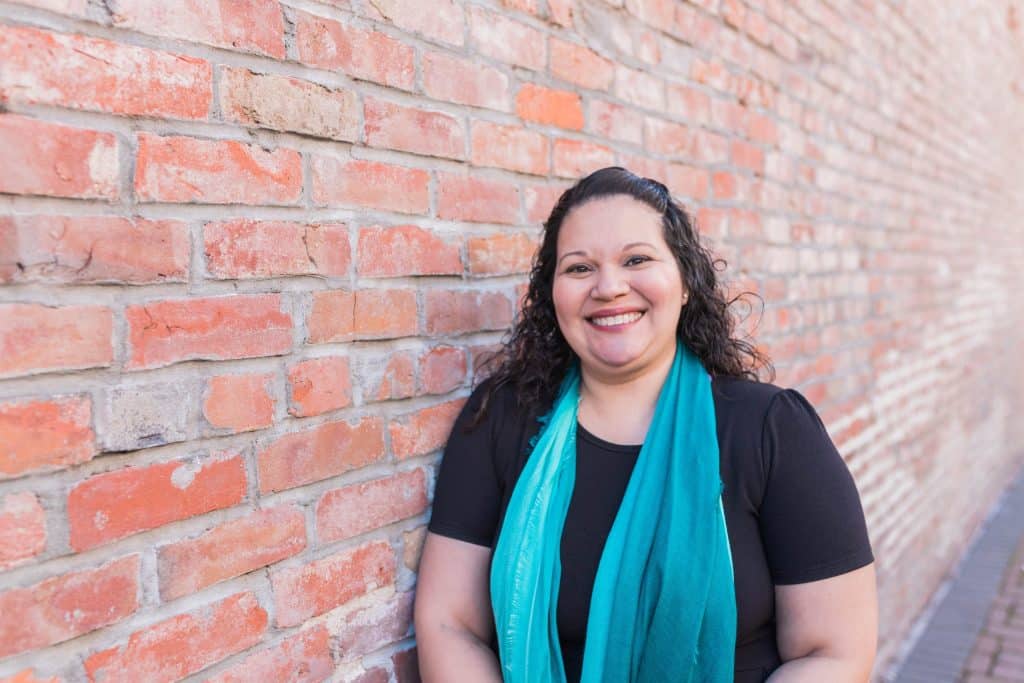
In more than 10 years as a therapist, Mara Sammartino, a bilingual licensed clinical social worker, has had a front-row seat to the impact of federal immigration policy – and the first and second terms of Donald Trump – on the everyday lives of immigrants living in California. She observed the fallout from the 2016 election, as Trump rolled out family separation policies that tore children and toddlers away from immigrant parents. Now the Nicaraguan-American therapist is working with patients living in the shadow of ICE raids and abuses of power that have harmed even Latino Senators and state leaders. It is, she says, a traumatic time for Latino families across the board.
While working at her online therapy practice for first-gen Latinos in Vacaville, California, Sammartino also brings her work outside of the therapy room by posting inviting and sometimes joyous videos on TikTok and Instagram as thelatina_therapist.lcsw that are followed by almost 20,000 people and have racked up more than 480,000 views. In 2022, she turned one of her TikToks into an essay for MindSite News, writing about the ways that first-gen Latinos reckon with intergenerational trauma in the Disney movie Encanto – and the lessons it holds for sharing her experiences and vulnerability with patients.
MindSite News co-founding editor Diana Hembree sat down with Sammartino to talk about how she and her clients are navigating the present moment – and how people can take care of themselves and their neighbors. The interview has been edited for clarity and length.
Diana Hembree: You’ve been working as a therapist for more than a decade, and now during the return to power of Donald Trump. What changes are you seeing since Trump took office this year?
Mara Sammartino: During the first Trump administration, when we had unaccompanied minors and parental separation at the border, people were upset. But I think the threat felt very distant for a lot of clients, whereas now it’s very much at the front door. I open TikTok – most of us are doing that nowadays – and I saw a protest outside of the local hotel in the city where I grew up. I would never have thought that ICE agents would be in Whittier. It’s a small quiet town, and there was a huge protest going on.
I haven’t lived in Whittier for 20 years, but for me, that’s my hometown. And I saw on social media that they picked up three gentlemen at the public library. For me, that was my library growing up. That’s where I spent my summers. That was a safe haven. And to see the video of (an ICE agent) in the library yelling, ‘What’s your name?! What’s your birthday?!’ – trying to get information – it’s like, holy crap, right? It is happening. Before it was far away, but for many of my clients it’s now around the corner – literally. And in these sacred places – churches, schools, and libraries.
How are your clients reacting to the ICE raids?
What I’m noticing with my clients now is that the danger is getting closer. I’m seeing more depression and anxiety, but also more anger and irritability. I can only speak to my perspective as a Latina as to where I think the frustration is coming from, but I think we’re not as united as we want to be. I had a client yesterday, we were talking about it – we don’t have leadership. Obviously as a state we have Governor Newsom, but for the Latino community, it’s not like we have a Cesar Chavez right now. As my client said, we don’t have someone who can lead us. I think not having clear direction is creating some of that anxiety, some of that frustration, some of that ‘let’s just have blinders on and keep moving forward.’
My client base is predominantly Latina, and a lot are in my age group: the millennials. And we’re feeling the angst. Some of us are paralyzed, some are mobilized, and some are thinking, I’m going to be in the background, but I’m going to be supportive. In therapy sessions, it’s ‘how are we taking care of ourselves?’ Obviously mental health is important, and everyone agrees you should put on your (oxygen) mask first. A lot of them are wondering, what is the next step? And then among those who have mixed status families, I hear ‘I’m afraid, but what other options do we have?’

Male farmworker with others working in a strawberry field (F Armstrong Photography/Shutterstock)
What is the feeling among Latinos in your community at large? Do some feel they or their parents or kids have to change their lives to try to avoid being seen or targeted?
The client I had this morning, they were talking about how they actually had to be more involved for the sake of the family. Because typically the grandparents would go to the school and pick up the grandkids, and the grandparents are now paralyzed with fear. And so where she typically wouldn’t be picking up, say, an extended family member, she is picking them up because she has legal status, whereas other family members don’t. So in terms of changing their day-to-day routine, yeah, I have clients who are saying, oh, my neighbors aren’t going to work; they’re afraid to leave the house. It’s hard, as a first gen, knowing my privilege of being born here and that some of the community don’t have that.
I hear these stories in the community, too, where I’ve also served as a social worker. And even in the social workers’ code of ethics, we are advocates. We are for social justice. I tell people out in the community that routine is resistance. Many kids here used to go to summer school, and a lot of people don’t want to take their kids there anymore. Our young children don’t know everything, but they do know that now all of a sudden they were going to summer school and now they’re staying home. It’s a loss of connection.
But there is something to be said about maintaining your routine. In January when Trump first talked about how churches and schools were no longer going to be sanctuaries for us, we were telling people, get your emergency preparedness plan ready. That’s something you should have, regardless of whether you’re documented or not. Who can your children count on if something were to happen? God forbid you have a car accident. With a plan your children can say, oh, I’m going to the so-and-so family or relatives and so on.
I think normalizing, too, that being prepared is not just for moments like this. Even myself, as a citizen, I should have a plan with my kids in case of an emergency, right? But the mental health part is that it’s fight or flight or freeze. And there are some people that are definitely in the freeze part of it. They’re just, ‘I’m not leaving the house.’ There are others that say, ‘I don’t want to go to the supermarket. It’s too risky.’
You have mentioned that you are not afraid to share your own experiences and vulnerability with clients. In another story featuring your practice, you told our MindSite News reporter: “Do you know how many times I’ve told abuelitas I work with that I have to cancel because my son is sick? And they’ll be like, ‘Put Vicks Vapor Rub on his feet and make sure you put some socks on. And please send me a picture of your son to make sure you did it correctly.”
You responded that you sent those photos promptly, adding: “That’s the thing about providing culturally responsive care. I am not bound to the white experience. Nor am I bound to the Latino experience. I am bound to the experience that I’m living in at the moment.” In this moment, what counsel are you giving to immigrants without papers who are in the “freeze” response to trauma?
I say, okay, let’s put this into perspective. You’ve been going to the supermarket for the past 10 years, and yes, it’s scarier now. So if you choose to stay at home, okay, let’s talk about it. But what can you do? How do you still have some autonomy over this?
It’s just so disheartening because it’s a vibrant community. And so to see the vibrancy be put out because of this fear, it is frustrating. And again, I do recognize my privilege. I get to walk around freely, so to speak. I’m not saying I don’t carry my passport – I do. I think it was an unconscious decision, but now that it’s in my purse, I don’t take it out. I do recognize that for the outside person, I’m still just another brown Latina. So there’s a lot I think that even that myself as a therapist have to reconcile with. So yeah, it’s hard being a Latina therapist at this time. I would say that.
Is there an organized effort for people in the community to take care of each other?
Yes. I’m part of the grassroots group POP (People Over Papers, a crowd-sourced group that tracks ICE movements). They’ll be texting, ‘Oh, we saw ICE at the Home Depot,’ or ‘we saw ICE trucks at this apartment complex.’ But sometimes it is hard to tell. The focus has been on LA, but obviously you have smaller towns, like Whittier or Alhambra or up here we have Vacaville, Dixon, and Vallejo. Because of the fear and the white trucks with green writing in LA, people are texting our group and asking if this is ICE. And I’m thinking, okay, well, let me go check. I have the privilege of driving without fear. And what people thought was an ICE van turned out to be a commuter van – a carpool van that will take you from, say, Dixon to the city.
But misinformation like this spreads like wildfire. It goes back to us not having the infrastructure to say, this is how we should be (tracking ICE), because everyone is just on their own right now.
So as a therapist, what I’ve been trying to do is to encourage my clients to tap the privilege that we have being first gen. It’s like, ‘Okay, if people are fearful and you feel like you have the capacity to act, what does that look like for you? Does it look like driving and checking out if that van is real? And some clients are like, yeah, I’m totally for it. Then I have clients who actually work in an immigration law office and they’re like, I just want to go home every day and get under the covers. And I tell them that’s valid too.
TikTok as a tool for spreading the idea of therapy and self-care among Latinos
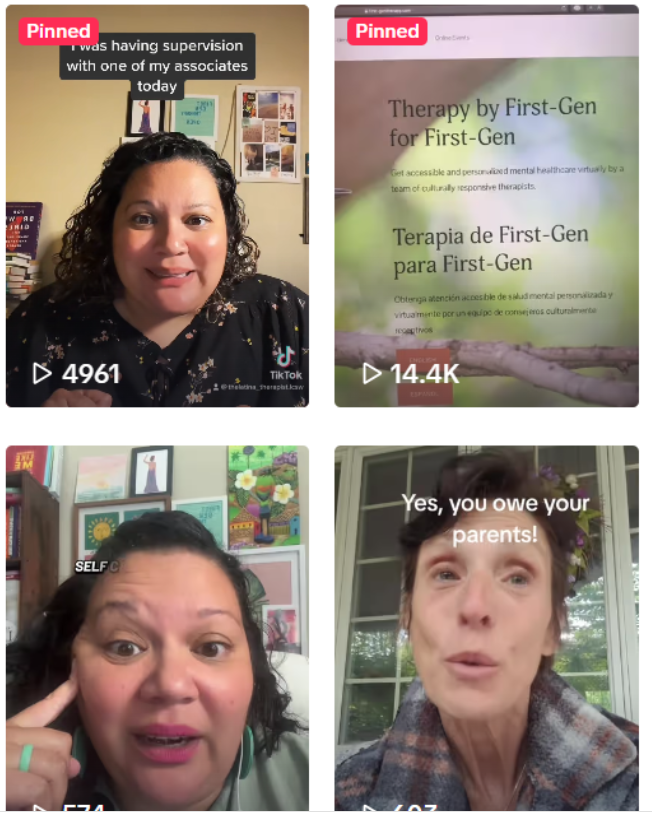
Marta Sammartino’s therapy channel on TikTok (a few of the many popular videos)
You have a TikTok channel with almost half a million views, including a video you made of a Latino march against ICE and deportations from Vacaville to the state capitol in Sacramento calling for “citizenship for all,” with jubilant music and gritos in the background. What are your key goals for this platform?
With my platform I hope to bring awareness to what’s happening and how it impacts the Latinx community’s mental health. My main goal is to educate on what mental health looks like in times of crisis and despair and to remind people that resistance of any kind is resiliency. I took my kids on the march that started here in Vacaville and ended in Sacramento. The march was about a mile down from my house, so I took my children, too; the video you mentioned — “Remember You Are The Ancestors Who Will Change the World” — was the one I made at that march. Speaking not as a therapist, I don’t feel that comfortable marching, but for my mental health I’m showing up. I had a client who said, oh, 20 years ago I took my dad to a march in downtown LA but I can’t do that now because I have three little kids. But I can make signs! I tell my clients you can be part of this important civil disobedience movement if you choose to, but if you don’t feel safe marching, you can participate in other ways.
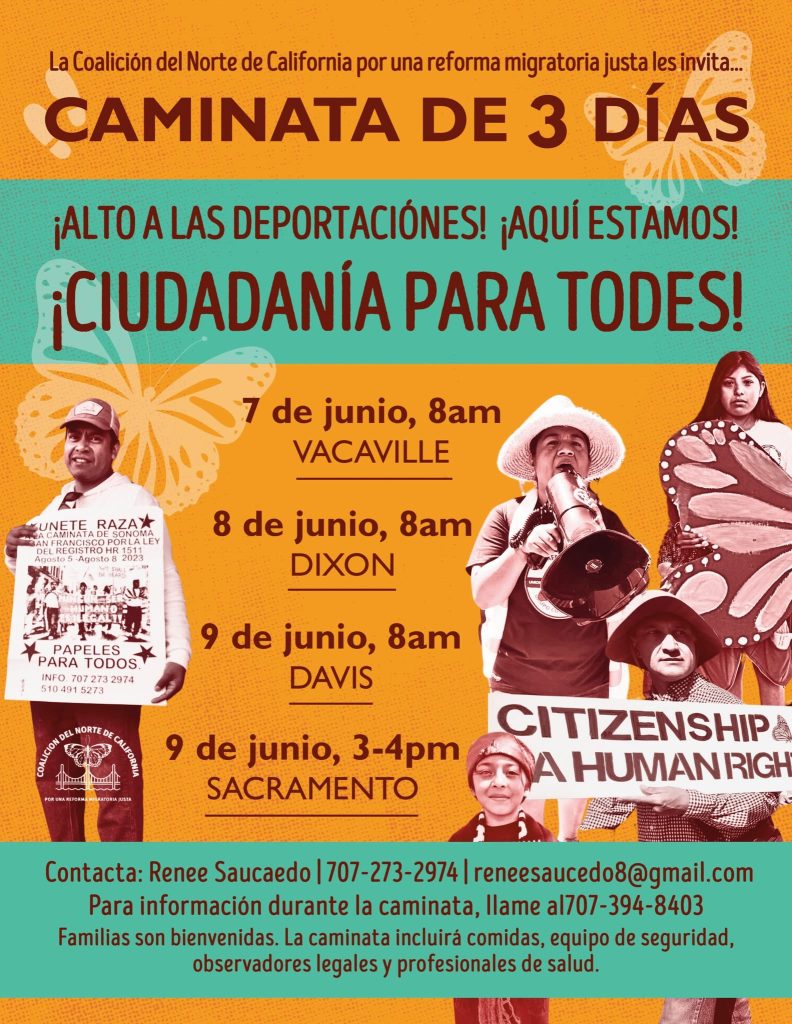
Angelenos protests against ICE raid and Trump’s immigration policies in downtown Los Angeles on June 8, 2025 (Michael Goldsmith/Shutterstock)
It must be exhausting to work as a therapist in this environment. Have any of your clients lost anyone yet to ICE or had someone deported?
They’ve been blessed to stay together so far, but the fear is there. Those who are at risk are probably not going out anywhere. But even for citizens, it has hit home. Like that one client I was telling you about, the reason she had to go pick up students who were extended family members is that ICE was around the corner. And the family member who usually picked them up was undocumented, and that relative was like, I’m not leaving my front door.
During Trump’s campaign last year, one of our writers, Alma Campos, talked with a grandmother who had been in the United States for decades but was traumatized this year by the way Trump demonized immigrants. The woman, who we called Ana, had thought about killing herself so she would not have to experience what was coming. The anxiety over it, the dread, was too much to bear. An immigrant advocacy group helped connect her to a therapist, though, who helped her through that period.
Feeling suicidal is a perfectly valid response to what is happening now. Having thoughts of suicide, we’ve all experienced that. Let’s not say we haven’t.
Within the Latino community, you have the stigma of mental health, and so people aren’t normalizing what are actually normal responses. It is very normal to be upset. It is very normal to be angry and scared. These are not exaggerated responses. What I’m doing as a therapist is psychoeducation. I’m normalizing some of these responses by saying you have every right to be upset; what is happening is not okay. But what are we going to do about that? It’s like understanding, oh, I’m starting to isolate because I’m feeling anxious and scared, and you know what? Obviously I can’t move about freely as much, but what can I do to perhaps minimize that anxiety and isolation?
It is really normal to feel depressed and frightened at what is happening. Yet we’re seeing immigrants, some without papers, who are taking part in protests. Could you talk about protests as they relate to community mental health?
It definitely is a personal choice whether you choose to protest. Most of the first-gen Latinos I know are college educated. We were brought up to be very much submissive and assimilate and acculturate, but we want to go to these protests. And the younger crowd right now is great. It’s interesting. So again, mental health-wise, if you know what it means for you, then do it because that’s part of filling your cup as well. But again, if it’s going to bring more anxiety, more distrust, more fear, then it’s also okay to say no.

No Kings March in New York City on June 14, 2025 to protest ICE raids (Shutterstock)
For immigrants who are experiencing vicarious trauma watching masked ICE agents on TV or Tiktok chasing down, beating or handcuffing people at work, what can they do to maintain their mental health?
Well, I think one of the things that I do myself is just limit social media. Although I think we do have to be realistic. It may not be possible for some people to turn off Univision or CNN – I’m thinking of my own family. My mom is 75 and she’ll have CNN on all day.
But I’ve been encouraging a lot of my clients to commit to at least 10 to 15 minutes where you’re just doing something that is not social media, not TV, whether it’s going to get the mail or going outside and touching the grass. But not putting it off-limits, because we’re social creatures. We want information. But I suggest, okay, can you commit to 10 to 15 minutes away from the screen?
For mental health, it’s also what’s going to bring you grounding. For some of my clients, like the one that works at the law office. I said, get out of your office clothes as soon as you get home. Teach your brain that you’re no longer at work or don’t go from work straight home if you’re able to. Maybe allow yourself a 15 minute walk around your building, something to disengage from that type of work. Can you do something that allows you to just shut off where there’s no commitment of you having to do anything but just be? And it’s hard.
There are social media posts and huge protests across the country condemning ICE, but social media is also peppered with comments from people who support it. What would you say to people who support the administration’s stance on ICE raids and deportations?
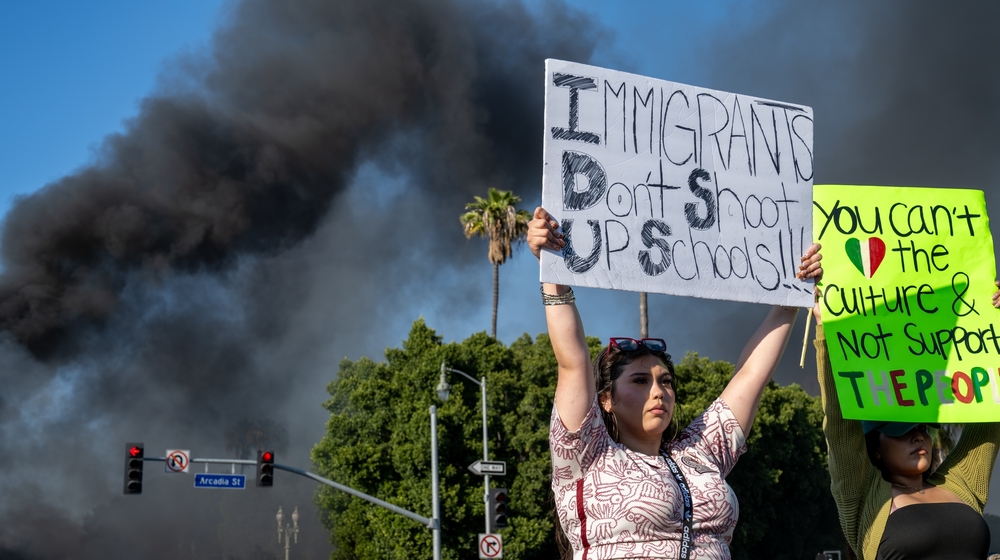
Angelenos protests against ICE raid and Trump’s immigration policies in downtown Los Angeles on June 8, 2025 (Michael Goldsmith/Shutterstock)
I guess I’m empathetic to a fault. I have heard that in my own extended family. I have people who voted for this person in the White House, and there’s a lot of emotion behind all these conversations. So I think that for both sides, whether you believe it’s right or wrong, I think that basically what I would say is, does it fit with your morals? And can you sleep at night with whatever decision you make? Because at the end of the day, I’m not going to spend my energy trying to persuade someone who may not have the same empathy that I have towards them. We’re not going to be quiet, but we’re not going to give them power by arguing.
Thankfully, I have not had any clients (who support the Trump administration stance toward immigrants). However, if they did, I would hold the same space of just listening because they have lived experiences that have led them to believe that. And again, it is their experience. It allows me to sleep at night knowing that even as a professional, I can hold space.
Stephen Miller has demanded ICE arrest 3,000 people a day, which has resulted in ICE wrongly stopping or handcuffing people who are here legally and then having to release them. Ironically, some Latinos arrested by ICE are American citizens.
Yes, and here’s the most ironic thing: my great-grandfather was denied entry into United States. He was Chinese. He came to Angel Island. And so he stepped foot in Angel Island, and he was denied entry because of the Chinese Exclusion Act, and then he ended up in Nicaragua. So some of these family members [who support ICE] are a direct descendant of someone who was legally denied entry.
In the book Defectors by Paola Ramos, she talks about how Latinos will perpetually be foreign. We’re the perpetual foreigner. And I think that also carries a lot with what’s happening right now, because I may be born here. I have kids that are born here, so now there’s two generations born here. But compared to my cousin’s kids who are white passing, I am still more likely to be seen as a foreigner.
Going back to the therapeutic part, there is a movement within mental health to decolonize and de-westernize a lot of mental health. But how do you do that when you live in a world that is telling you you don’t belong and you never will?
The most important thing right now, though, is keeping ourselves grounded. it’s not about losing ourselves in all of this. I guess the ultimate thing for anything is don’t shy away from feeling. Ultimately, that’s what they want you to do: To be numb.
The name “MindSite News” is used with the express permission of Mindsight Institute, an educational organization offering online learning and in-person workshops in the field of mental health and wellbeing. MindSite News and Mindsight Institute are separate, unaffiliated entities that are aligned in making science accessible and promoting mental health globally.


Author

Related Articles
Mental Health Coalition Protests ICE Raids and Detention
Patients are avoiding health care, even in serious medical emergencies, because of ICE raids on clinics and hospitals.

“It’s More Horrific Than What Is Being Told”: Filipinos Speak Out About Being Targeted by ICE
A series of audio interviews about detention, abusive treatment and deportation for the 4th largest immigrant group in the U.S.
The Trauma and Resilience of Afghans: An Interview with Dr. Qais Alemi
Alemi says refugee trauma stems not only from war atrocities, but from cultural dislocation and the loss of language and identity,
