Making Homeless Services More Accessible Through Google Maps

In today’s Daily, how one user-built Google map is making Detroit’s homeless services more accessible. Why ChatGPT may be the wrong place for people with OCD to seek answers to their questions. The psychology of tyranny and what we can do about it. And advocates say cutbacks in the just-passed Senate bill will devastate mental health services in California.
Plus, how meditation can benefit people around those who practice it, and the connection between menopause and eating disorders in older women.
Also, a US District judge appointed by Republican President Ronald Reagan has blasted the Trump administration about the cutbacks to NIH grants, which he said represented shameful discrimination against America’s LGBTQ community. (See more from his decision, below).
But first, how squirrels helped one man recover from a mental low: “Going outside and connecting with nature was my gateway to relief from depression,” said Derrick Downey Jr., who has befriended every squirrel in his neighborhood. “It brought me peace. I would see Richard [the squirrel] walking around, and talking to him made me feel good about the world.” Downey has since begun efforts to preserve local wildlife, GoodGoodGood reports. “When something brings you peace, baby, you protect it,” Downey said. “The squirrels may not have a lot of protections legally, but as long as I’m around, ain’t none squirrel nest going down.”
How a user-built Google map is helping homeless people in Detroit
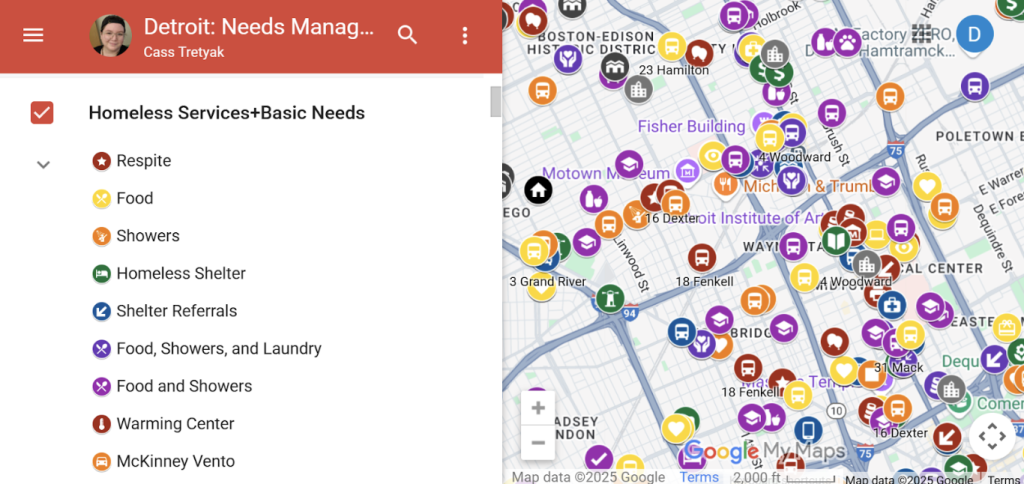
In order to help someone, you have to know how to – that’s where Cass Tretyak initially struggled in her work with unhoused folks. Clients needed help meeting basic needs like food and emergency shelter, but she didn’t know where to direct them. “If this is overwhelming to me,” she said to BridgeDetroit, “how must the client feel when they are in crisis mode?” So she started assembling a solution: The Detroit: Needs Management Map. In just two years, it’s become a must-have tool for Tretyak and her colleagues in the field.
Housing and food are both critical for survival, but so are showers, laundry services, and medical care – the map highlights all of these, along with notes about services offered, what languages are spoken, and if a place is LGBTQ friendly, making it a uniquely useful resource. There are also points identifying where to obtain Narcan, youth-exclusive support, bus routes, animal care, legal aid, and more. Tretyak built the site the (semi-)old fashioned way, using Google, phone calls, and word of mouth. Some of the most critical info – available housing rentals, other basic homelessness services, and bus routes – is updated regularly. Other items on the map are accompanied by a disclaimer that it’s been more than one year since they’ve been checked.
Shaina Shetty, a family physician for Detroit’s CHASS Center, said she refers to the map at least twice a week as part of her work administering primary medical care to unhoused residents of the city; she directs her clients to it with business cards, and those with phones have the database at their fingertips. The map is especially useful as funding for indispensable services becomes more precarious, she says. “As we think about federal funding cuts, I think that we are going to be forced to rely more on some of these pop-ups and mutual aid efforts,” Shetty said.
Homelessness is a growing problem in the US, and Detroit hasn’t been spared. The most recent one-night count of unhoused residents shows an increase of 16% from 2023 to 2024 across Detroit and its enclaves Hamtramck and Highland Park. Detroit has worked to improve its homeless services, especially following the February 2025 death of two children who were living with their mother and grandmother in a van. An investigation revealed that their mother had reached out for help multiple times. This map may help prevent future tragedies.
Confronting the psychology of tyranny

Throughout history, tyrants have done incalculable damage, says Ashley L. Peterson, a former pharmacist and mental health nurse who blogs at Mental Health @ Home. To get their start, she says, “they develop a unified in-group, in which others are dehumanized and made out to be a threat to the in-group, (which) is used as a justification for violence. The leader talks in lies the public wants to hear rather than the truth [and] information is controlled through the use of propaganda, including ‘the big lie’ and the cult of personality.”
If this sounds familiar, it’s because the subject is in the headlines these days: Even FIFA has sent a 2026 World Cup message warning potential attendees about Trump’s ”increasingly authoritarian government.” The Washington Post reports that people who came of age in the internet era are less concerned about democracy and more inclined toward authoritarianism, but our country’s massive No King’s Day rallies suggest otherwise. Moreover, the millions of Americans turning out to protest ICE raids, illegal federal cutbacks and authoritarian executive orders have an ally in our state and federal court systems.
In her June 17 substack column “Letters to an American,” Heather Cox Richardson discusses a post by Chris Geidner of LawDork, who notes that the legal system’s pushback to President Donald Trump’s attack on democracy “is very real.” Among other things, he cites a lawsuit by the American Bar Association (ABA) suing Trump for his attacks on law firms and lawyers, calling Trump’s actions “unprecedented and uniquely dangerous to the rule of law”:
Geidner also notes that lower court judges are upholding the Constitution, and he points especially to U.S. District Judge William Young, an appointee of Republican president Ronald Reagan. In a hearing yesterday, Young insisted on holding the government accountable “for both Trump’s actions and the follow-up actions from those Trump has empowered to act.”
Young called cuts to funding for National Institutes of Health research grants “illegal” and “void” and ordered the NIH to restore the funds immediately. “I am hesitant to draw this conclusion—but I have an unflinching obligation to draw it—that this represents racial discrimination and discrimination against America’s LGBTQ community. That’s what this is. I would be blind not to call it out. My duty is to call it out.”
“I’ve never seen a record where racial discrimination was so palpable,” Young said during the hearing. “I’ve sat on this bench now for 40 years. I’ve never seen government racial discrimination like this.” He added: “You are bearing down on people of color because of their color. The Constitution will not permit that.… Have we fallen so low? Have we no shame?”
In a series of posts discussing what Americans could do to promote democracy, UC Berkeley professor and economist Robert Reich recently shared a message on his substack about the Trump administration attributed to a Dr. Pru Lee (it was first incorrectly attributed to Liz Cheney). In an open letter, among other proposals, Lee calls on Americans concerned about growing authoritarianism at home to 1) form a nationwide investigative civilian coalition and make all its findings public ; 2) join the International Criminal Court and invite ICC observers into U.S. borders; 3) leverage international media and watchdogs; and 4) Create a digital safe haven for whistleblowers and defectors. –Diana Hembree
Folks with OCD need to be careful with ChatGPT
It’s common for people living with obsessive compulsive disorder (OCD) to seek reassurance – an attempt to externally soothe internal distress. They sometimes ask friends or loved ones for reassurance, or look for it in Google searches. ChatGPT offers an allegedly knowledgeable, friendly source for that reassurance, making it incredibly tempting. It is also unlikely to challenge your behaviour the way a loved one might. Psychologist Lisa Levine told Vox that her clients are already using OpenAI’s chatbot compulsively. (She specializes in treating patients with OCD.) “I’m concerned, I really am,” said Levine. “I think it’s going to become a widespread problem. It’s going to replace Googling as a compulsion, but it’s going to be even more reinforcing than Googling, because you can ask such specific questions. And I think also people assume that ChatGPT is always correct.”
Therein lies the danger. Firing off questions to a presumed all-knowing chatbot that lacks the ability to detect when ‘reassurance seeking’ behavior has grown out of control only worsens the symptoms of OCD, experts say. “You wonder: Can I get tetanus from touching a doorknob? You may go to ChatGPT to investigate the validity of that doubt,” said OCD and anxiety specialist Joseph Harwerth. The problem, he says, is that ChatGPT keeps feeding that loop of questions and doubts.
The clinical consensus is that people with OCD need to learn to tolerate uncertainty, rather than attempt to eliminate it. But ChatGPT can fall into the same trap that non-OCD specialists fall into,” Harwerth said. “The trap is: Oh, let’s have a conversation about your thoughts. What could have led you to have these thoughts? What does this mean about you?” It’s a helpful exercise for people without OCD, but the chatbot’s tendency to validate users’ thoughts, however erroneous, simply encourages those with OCD to ruminate further.
While Harwerth and Levine agree that AI companies have some responsibility to prevent compulsive chatbot use, they say it’s also on vulnerable users themselves to resist turning to chatbots for reassurance. “We cannot perfectly curate the world to people with OCD – they have to understand their own condition and how that leaves them vulnerable to misusing applications,” Harwerth said. “In the same breath, I would add that when people explicitly ask the AI model to behave as a trained therapist” – which some users with mental health conditions do – “I think it’s important for the model to say, ‘I’m pulling this from these sources. However, I’m not a trained therapist.’” (See also MindSite News June 24th story ‘Is ChatGPT Making Us Delusional?’ to learn about a GPT chatbot that ‘apologized’ for lying in order to manipulate users.)
In other news…
The passage of the Senate budget bill will devastate mental health programs nationwide by gutting the Affordable Care Act’s Medicaid expansion, according to the Steinberg Institute, a mental health policy group in California. For California, the Institute says, “the consequences could be catastrophic…The amended ‘Big Beautiful Bill’ adds even more Medicaid cuts, forcing counties to shoulder more than $1 billion in additional costs to keep behavioral health systems afloat.”Although five million Californians are eligible for Medi-Cal through the ACA, hundreds of thousands could lose mental health and substance use care without this funding. This follows a familiar pattern, the Steinberg Institute suggests in its latest research, Boom, Bust, Repeat: “California’s behavioral health system has been stuck in a cycle for decades: moments of political urgency lead to major investments, only to be followed by budget cuts that dismantle progress and leave counties scrambling to provide care with fewer resources.”
Meditation’s benefits can extend to those around you. Research has demonstrated the mental health benefits of meditation for those who practice it. But now research suggests benefits can extend beyond the individual. People who meditate regularly are more likely to show empathy, act altruistically and show less prejudice. Meditation also helps people manage their own distress, enabling them to respond compassionately to others’ suffering. There’s research suggesting that radiating positivity can even extend beyond one’s immediate circle. “It is a potent reminder of how bringing a spirit of calm and compassion towards oneself may translate into something beneficial to those around us,” psychology professor Mariah G. Schug writes in Scientific American.
“Time blindness” might seem a weak excuse for lateness – but is it real? Yes, it is, experts told USA Today, especially for people with ADHD and other conditions that affect executive function. “Time blindness is a difficulty with a perception of time, how much time is passed, how much time it’s going to take to do something, and it can be quite impairing to people,” said Stephanie Sarkis, a therapist and author specializing in ADHD, anxiety, and narcissistic abuse. “It is a real thing that’s been researched.” Like many conditions, its severity runs on a spectrum. But all hope is not lost. People who struggle with time blindness use scheduling apps, alarms, and written and digital reminders to help manage it. Switching to an analog clock may also help strugglers visualize and better understand the passage of time. And as always, the positive impact of consistent and restful sleep cannot be underestimated.
We associate eating disorders with puberty, but menopause also presents risks. As puberty affects adolescent girls, so too do perimenopause and menopause affect women later in life. The major hormonal shifts may trigger disordered eating, experts say. The physical changes women experience in midlife are profound, from changes in hair texture, skin elasticity, bone density, weight distribution, and more, causing some “to feel increasingly disconnected from the body they once knew – intensifying disordered eating as a coping mechanism,” Jason Nagata, a physician specializing in eating disorders, told National Geographic. Eating disorders often develop in response to a need for agency, and that element is “particularly salient in midlife,” according to Nagata, when difficult life changes often accompany menopause.
Experts encourage individuals – and doctors – to recognize the signs and take them seriously. “It is a myth that eating disorders resolve on their own,” said Cynthia Bulik, founding director of the University of North Carolina Center of Excellence for Eating Disorders. “Eating disorders are neither choices nor stages – they are serious illnesses that require attention,” and experts say early treatment gives the best chance of a complete recovery. (See Deadly Denials, our recent four-part series on eating disorders and insurers).
The name “MindSite News” is used with the express permission of Mindsight Institute, an educational organization offering online learning and in-person workshops in the field of mental health and wellbeing. MindSite News and Mindsight Institute are separate, unaffiliated entities that are aligned in making science accessible and promoting mental health globally.

Author

Related Articles

The Lindsey Clancy Murder Trial
Women nationwide watch the Lindsay Clancy trial and see themselves in her story, plus an investigation into hospitals that fail patients with addiction.

Grief and Rehabilitation in a California Prison
This month: a DUI offender’s path to rehabilitation, Lindsay Clancy revisited, Illinois prison protests, a fatal cell fire, and Missouri’s competency crisis.

Meta Pays $17 Billion Settlement for Lawsuit Over Child Harm
Meta will pay up to $17.1 billion and reshape how its platforms operate after 47 states argued that they are harmful and also addictive to children by design.