
Suicidal Thinking Is Falling Among Teens And Youth, New Federal Report Shows
Since 2021, the percentage of teens and young adults seriously considering suicide has seen a relative decline of almost 22%.

Teen suicide is still a crisis in the United States, but there is some reason for hope.
The latest report on an annual federal mental health survey found a striking divergence in age around suicidal thinking and planning that played out over a four-year period beginning at the peak of the COVID-19 pandemic.
Among teens and young adults – who have the highest rates of suicidal thinking of all age groups – the percentage who seriously considered suicide dropped from 12.9% in 2021 to 10.1% in 2024, a relative decline of almost 22%.
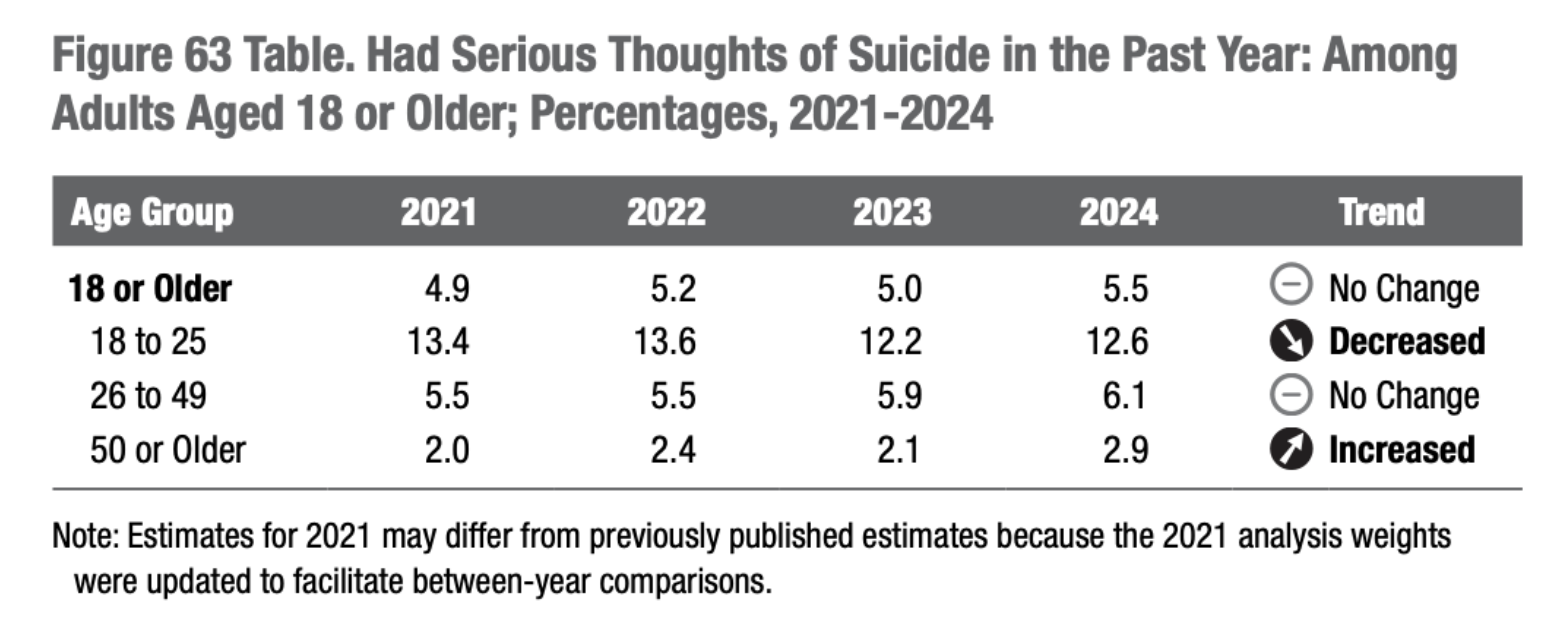
Among people 50 and older – who have a much lower suicide rate than younger age groups – rates of serious suicidal thinking jumped from 2% in 2021 to 2.9% in 2024, an increase of 45%.
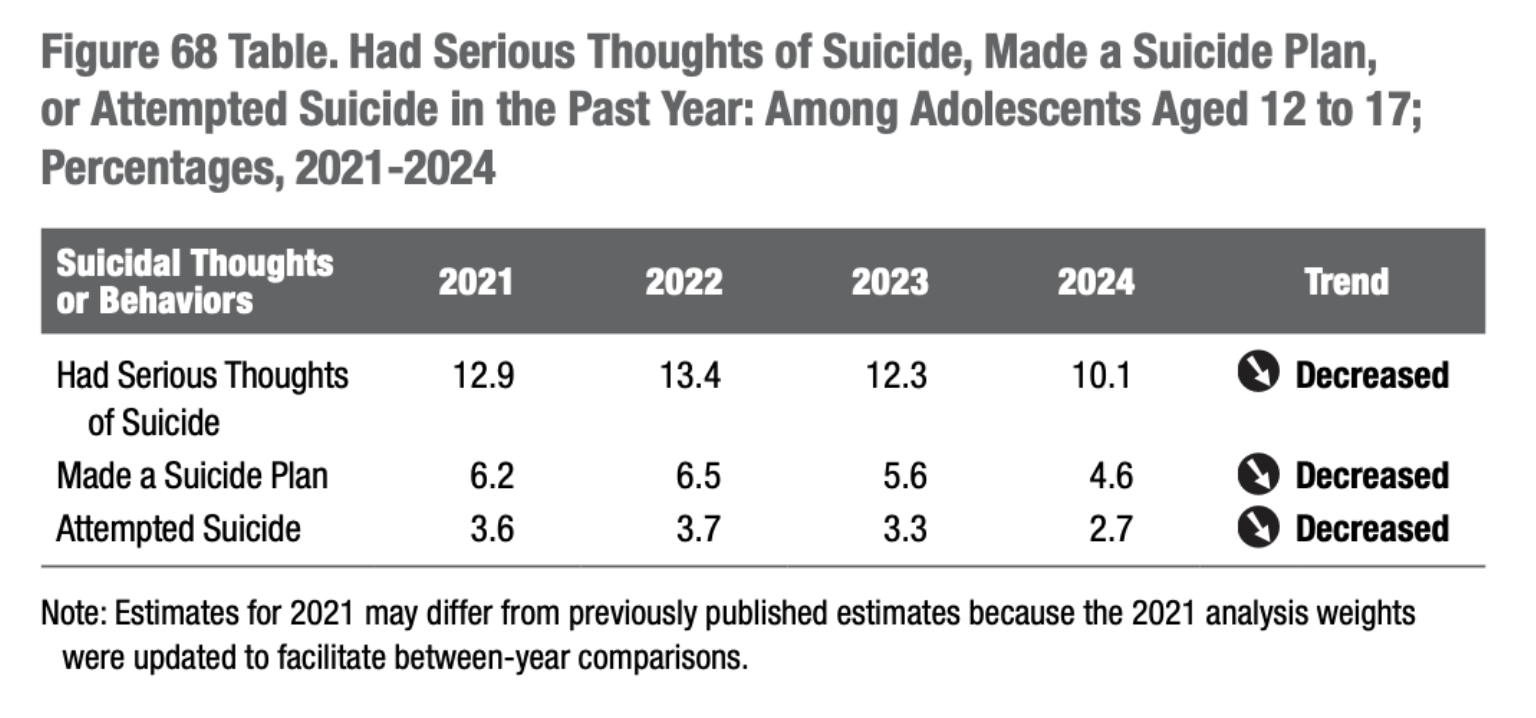
The decline in suicidal thinking and planning among teens, however, cheered mental health advocates. Suicide attempts fell from 3.6% at the peak of the pandemic in 2021 – when many teens were isolated and trying to attend school by Zoom – to 2.7% in 2024.
“I think it’s very promising, and we’re very hopeful about it,” Jill Harkavy-Friedman, senior vice president of research at the American Foundation for Suicide Prevention, told National Public Radio.
The new data comes from the latest release of the National Survey on Drug Use and Health, which has been conducted for decades by the Substance Abuse and Mental Health Services Administration (SAMHSA), a beleaguered federal agency that the Trump administration has pledged to close in its massive reorganization of government agencies and departments. The scientists and staff members who led the survey were all fired earlier this year.
The 2024 edition of the survey was based on more than 70,000 interviews – 14,000 conducted with adolescents ages 12 to 17 and 56,000 among adults 18 and older.
Overall, completed suicides remain alarmingly high, topping 49,000 a year in 2022 and 2023 – the greatest numbers ever recorded in the U.S. – according to data released earlier this year by the Centers for Disease Control and Prevention.
Men made up nearly 80% of those suicide deaths, and, in 2024, more than 14 million adults reported being plagued by suicidal thoughts, with 2.2 million adults attempting suicide. The survey also noted that the percentage of adults who made a suicide plan increased from 1.4% in 2021 to 1.8% in 2024, with the jump being driven by adults ages 26 and older.
Suicide is a pressing problem in the United States, where someone dies by suicide every 11 minutes. In 2023, it was the 11th leading cause of death among people of all ages nationwide, as well as the second leading cause of death among people aged 10 to 34. The total count of suicide deaths is nearly double the figure for homicides.
Researchers have expressed concerns that the new report doesn’t go into as much depth as those from earlier years – prevalence and treatment rates, for example, were not broken down by race and ethnicity.
“Removing these data limits our ability to track behavioral health trends and any differences in access to care,” Heather Saunders, a researcher with Kaiser Family Foundation, told NPR.
A spokesperson for the Department of Health and Human Services told NPR that demographic data was on the way.
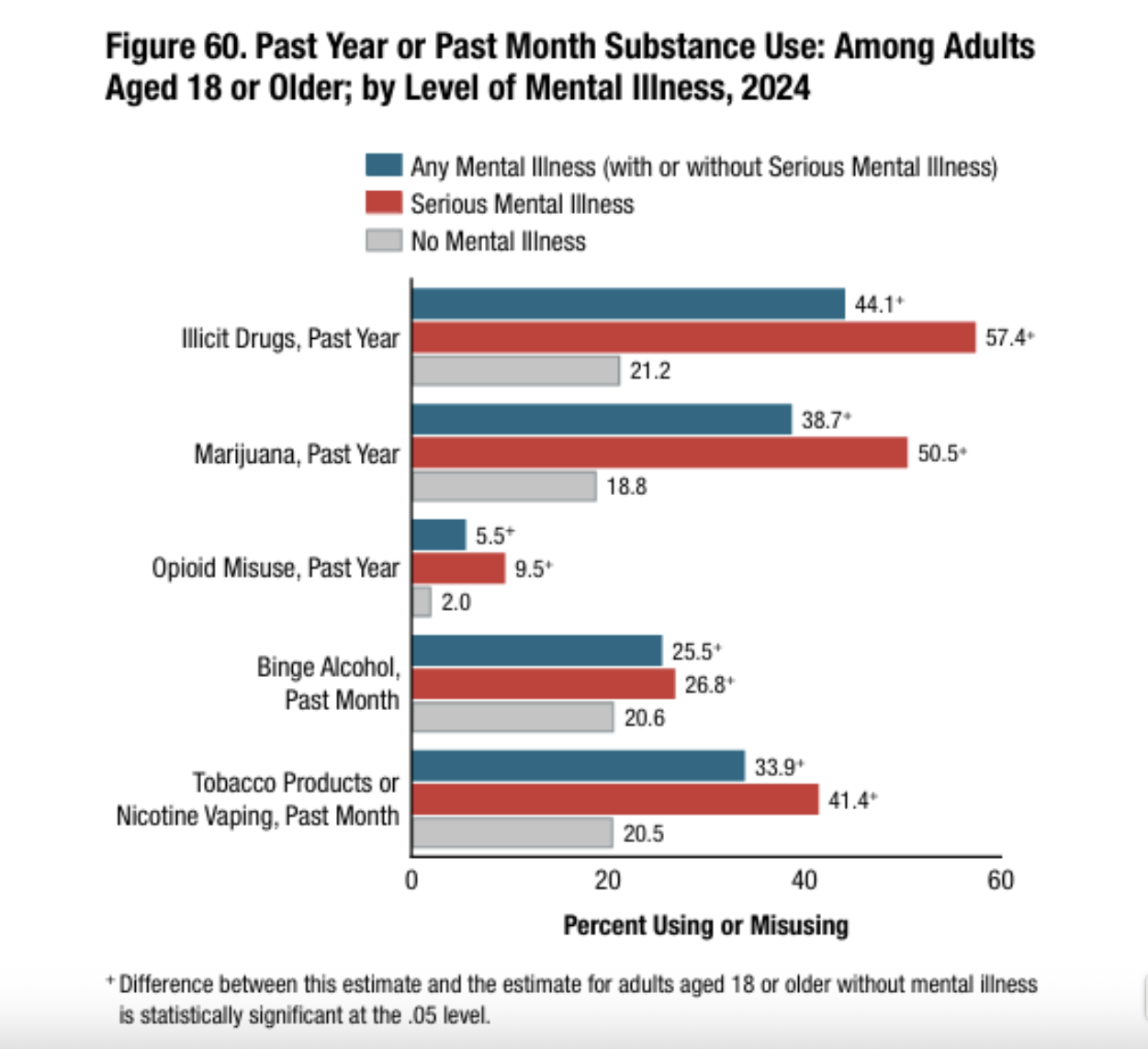
Not surprisingly, the report also found a strong correlation between mental health problems and substance use. Researchers found that in 2024, “adults aged 18 or older who had moderate or severe symptoms of anxiety in the past 2 weeks” were more likely to have engaged in substance use in the past year or past month. According to the most recent CDC update, roughly 87,000 people in the US died of drug overdoses between September 2023 and September 2024, a 24% decline over the previous year.)
The survey – an annual data collection going back to the 1970s – covers residents of households and people in noninstitutional group settings, including shelters, boarding houses, college dorms and halfway houses. Yet the survey may underestimate the country’s substance use and mental health disorders.
It excludes people who are homeless but not in shelters, military personnel on active duty, and people in institutional group settings such as jails, nursing homes, mental health institutions and long-term care facilities. An unfortunate omission since suicidal thinking among people in jails, nursing homes and long-term care facilities is common.
Likewise, Psychiatry Online noted the omission of people who are unhoused, in jails or in psychiatry facilities “likely means that many individuals with substance use disorders (SUDs) are missed.”
Mental health can't wait.
America is in a mental health crisis — but too often, the media overlooks this urgent issue. MindSite News is different. We’re the only national newsroom dedicated exclusively to mental health journalism, exposing systemic failures and spotlighting lifesaving solutions. And as a nonprofit, we depend on reader support to stay independent and focused on the truth.

It takes less than one minute to make a difference. No amount is too small.
The name “MindSite News” is used with the express permission of Mindsight Institute, an educational organization offering online learning and in-person workshops in the field of mental health and wellbeing. MindSite News and Mindsight Institute are separate, unaffiliated entities that are aligned in making science accessible and promoting mental health globally.


Author

Related Articles

Trump Freezes $10 Billion in Childcare Aid to 5 Democratically-Led States, Baselessly Claiming “Widespread Fraud”
A $10 billion federal child care funding freeze targets California, Colorado, Illinois, Minnesota, and New York.

Seeing Guilt for What It Is: Motivation to Change
Psychology professor Chris Moore explores the difference between guilt and shame, revealing how healthy guilt can motivate healing, repair relationships, and drive restorative justice.
New Senate Bill Targets ‘Troubled Teen’ Industry and Residential Treatment Abuse
Senator Ron Wyden introduced the BRIDGES for Kids Act to increase oversight of residential treatment centers and create a national dashboard to track abuse.
