
Seizing Black Homes By Eminent Domain Leaves Intergenerational Scars
Eminent domain has had a disproportionate impact on Black Americans, resulting in widespread mental and financial pain.

Black families have just a fraction of the wealth of white families. Specifically, about one sixteenth: households with a white homeowner or renter hold 80% of the country’s wealth; Black householders have less than 5%.
One often-overlooked driver of that inequality is eminent domain, which allows the government to acquire property for public use. Real estate is one of the main ways families can build wealth and pass it on to another generation, but many Black Americans have had property taken away by the government – and not always used in the public interest.
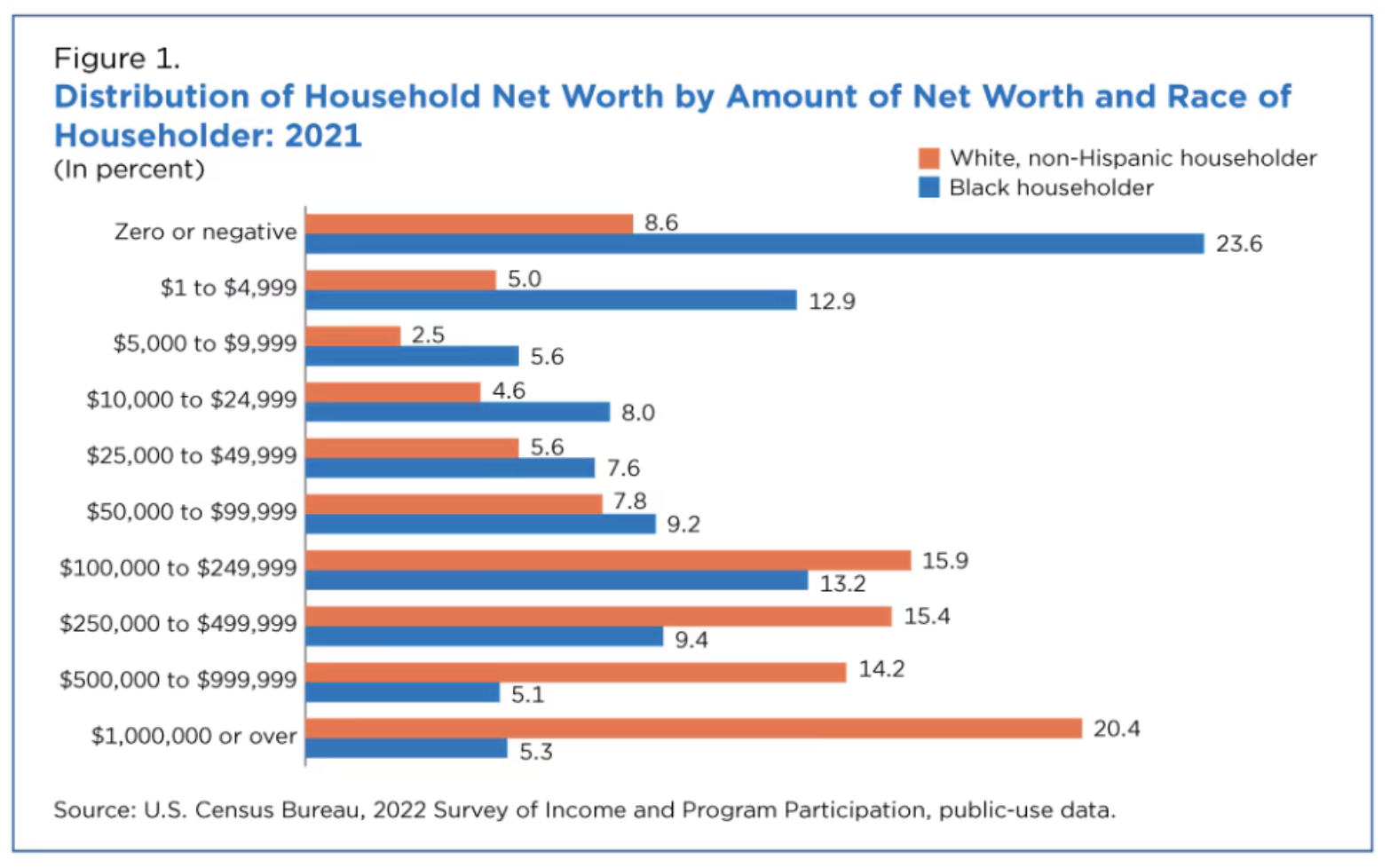
Across the country, houses and entire neighborhoods of Black Americans were often seized by local governments for demolition and “urban renewal” – affecting the financial security and mental health of future generations. In an analysis of government projects that displaced one million people between 1949 and 1973, Black people were five times more likely to be displaced by eminent domain than white people.
An under-discussed side to eminent domain is the intergenerational mental health damage that follows losing homes and thriving communities. In her report on African Americans and eminent domain, Mindy Thompson Fullilove cited Alexander Leighton’s “theory of community integration” – i.e., that individuals flourish when they are connected to their community through close relationships and shared resources – “as the source of mental health.”
Leighton compared a “disintegrated” community to an “integrated” one and found that rates of mental illness were higher in the disintegrated community. “In fact, the poor people in the integrated community had better mental health than the well-to-do in the disintegrated community,” Fullilove wrote.
It takes time and effort to build a strong community – breaking one can cause long-term damage. In one study she cites, 25% of residents “displaced from a Southwest neighborhood in D.C… had not made a single friend after being forced from their old neighborhood.” Also, studies have shown that the tangible effects of forced dislocation include increased risk from stress-related diseases like depression and heart attacks.

Healing families from the toxic stress of racism
By Diana Hembree • Newsletters • January 11, 2024
In a recent piece, USA Today explores how the policy has also stymied Black families’ financial security over generations. For one family, the threat of seizure with eminent domain led them to sell their land cheaply – the district then sold it on to a private developer twelve years later, for double the price.
“Any chance of anything being passed down to their kids and grandkids was just taken,” said John Houston, 71, whose father was forced in 1968 to sign away his 10-acre property and home in Renton, Washington, to make way for a middle school that was never built; million-dollar homes now dot the plot. “My mother and father got robbed. Me and my brothers and sisters got robbed. There’s nothing left for us… It breaks my heart.”
The name “MindSite News” is used with the express permission of Mindsight Institute, an educational organization offering online learning and in-person workshops in the field of mental health and wellbeing. MindSite News and Mindsight Institute are separate, unaffiliated entities that are aligned in making science accessible and promoting mental health globally.


Author

Related Articles

Does Contemporary “McMindfulness” Reinforce Our Suffering?
A Buddhist teacher and professor argues that a commodified mindfulness solely focused on the self is only a stopgap fix.
“No Beds”: Despite Improvements, Detroit’s Shelter System Continues to Let Families Down
When a Detroit mom and her two sons faced homelessness last year, she spent months calling the city daily for beds – in vain.

988 call responses plummet in Georgia after insurer cutbacks
After an insurance company made cutbacks, Georgia’s 988 response rate to mental health crisis calls “fell off a cliff.”
