
Mentally ill and starving to death in American jails
An investigation has documented dozens of cases where people with severe mental illness, many of whom were jailed during a crisis, have starved or died from neglect in U.S. county jails.

Welcome Back MindSiters,
This month, we’ll look at a truly shocking investigation that documented the outrageous number of people with mental illness who are literally starving to death in jails across the country. We’ll also tune in to a Q and A session with two incarcerated writers about their new book on solitary confinement. Finally, we visit ProPublica’s investigation into psychiatric hospitals releasing people in crisis and the lack of accountability these institutions have faced.
Let’s get into it…
Starving to death in jail
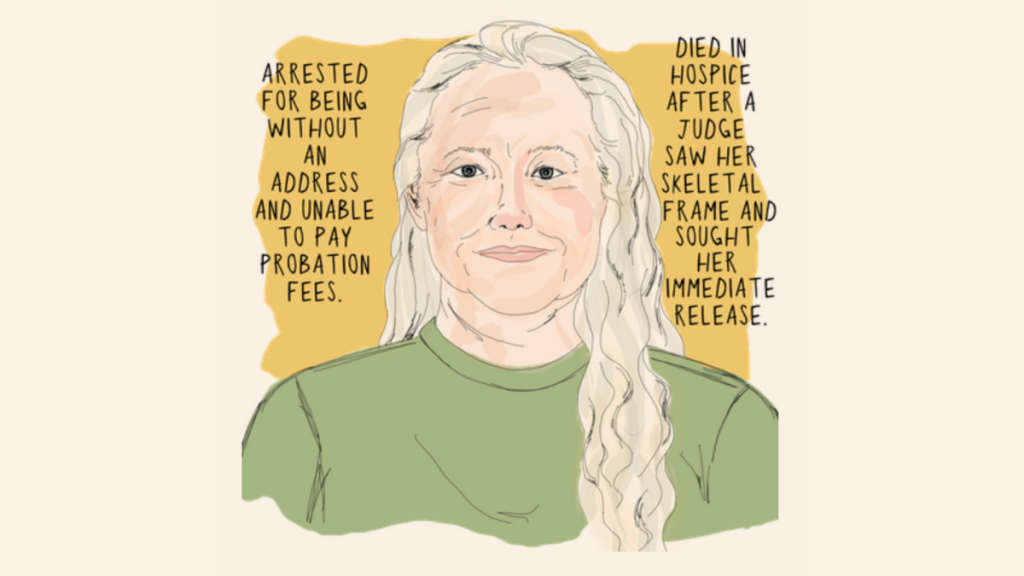
Mary Faith Casey was the kind of mom who would sew her two kids Halloween costumes by hand. A loving, engaged mother who attended school field trips but also struggled with addiction and mental health issues.
Eventually, her life spiraled out of control. Her marriage broke up, she got involved with abusive men and moved in and out of women’s shelters and hotels. She followed her son to Arizona, but her troubles continued there. She cycled in and out of homelessness and in and out of jail. Eventually, she was jailed for a probation violation. Despite making it clear she needed medication for her mental illness – she was diagnosed with schizophrenia and bipolar disorder – she went stretches without her meds.
She lost so much weight during her four months in jail that when she appeared in court, she looked like a skeleton and had to be urgently hospitalized.
“She looks like a famine victim,” her son said when he went to see her at the medical center in Tucson.
He vowed to investigate. She never recovered.
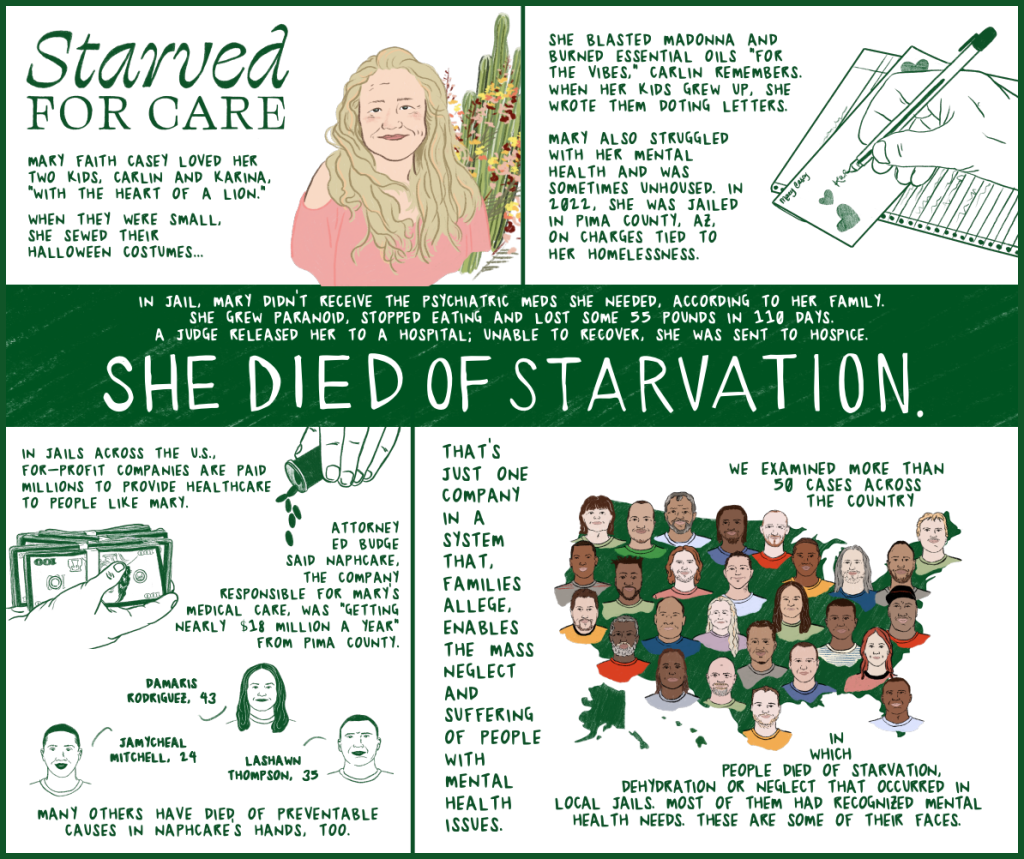
His investigation led him to some discoveries. Although his mother had been incarcerated at the Pima County Jail, the health care services there were provided under contract by a private company — as they are in more than 60% of U.S. jails, according to a 2020 examination of jail-death data by Reuters. At the Pima facility, health care had been outsourced to an Alabama-based firm, NaphCare, one of five companies that dominate the market.
According to the Reuters story, jails that contracted for health services through those five companies from 2016 to 2018 had death rates 18% to 58% higher than jails whose medical services were publicly managed. NaphCare’s death rate was the highest.
“This is a multibillion-dollar industry dominated by a few major players,” said attorney Ed Budge. “NaphCare is one — they were getting nearly $18 million a year to provide medical and mental-health care at the Pima County Jail.”
Casey’s story is one of more than 50 cases in which people died of starvation, dehydration or other medical crises in jails in recent years. Almost all of them were arrested during a mental health crisis. The cases were documented by Pulitzer prize-winning journalist Sarah Stillman in The New Yorker; she gathered their stories as part of a project with the Investigative Reporting Lab at Yale called “Starved for Care.”
Many of the cases could be considered homicides, Stillman told Tradeoffs, a podcast focused on tough choices in health care.
“We’ve reached a point where starvation in a U.S. county jail – like something that atrocious – could happen while other people were not just looking on, but actually making millions of dollars,” she said. “I think that speaks a lot to the failures of these systems.”
While Casey was given food and water, she didn’t consume most of it — a common finding in these deaths. She repeatedly requested medication, and jail medical records contain multiple notations of jail staff members and fellow prisoners noting that Casey wasn’t eating and was becoming increasingly ill. Some people with untreated mental illness become fearful that the jail is trying to poison them, Stillman said. In other cases, severe depression takes over and they just stop eating.
“Many of the cases, it was more the consequences of untreated psychiatric distress and oftentimes the compounding factor of being put into solitary confinement when you’re in the midst of a mental crisis,” she said.
You can read Stillman’s New Yorker story here. Listen to her interview with Tradeoffs here.
Incarcerated writers on the toll of solitary confinement
Christopher William Blackwell and Kwaneta Harris spent years locked in cells barely the size of a parking space. For both of them, the ordeal has reshaped their lives.
Now, they’ve taken their first hand accounts and created a powerful new book documenting the effects of solitary confinement on prisoners in the words of those who’ve experienced it.
“Ending Isolation: The Case Against Solitary Confinement” weaves together Blackwell’s experiences at Washington State prison and Kwaneta’s time in Texas with the legal and medical expertise of Professor Deborah Zalese and Dr. Terry Kupers.
The book includes writing from several other currently and formerly incarcerated people and has chapters on juveniles in solitary, mental illness, racial injustice and environmental issues.
In Bolts, a nonprofit news site that investigates criminal justice and policing, Blackwell and Harris answered readers’ questions about what it’s like to write a book from prison – and about the human impact of solitary confinement.
“It’s punishment, plain and simple. Don’t let them fool you with that ‘administrative segregation’ language. It’s designed to break you down,” said Harris. “I’ve seen women thrown into solitary for refusing a guard’s sexual advances, for filing grievances about medical neglect, for being gay or trans and not conforming to the administration’s idea of femininity.”
You can read their Q and A here.
Turned away in crisis
When Melissa Keele got a late-night call that her 21-year-old son was wandering naked and alone in the Colorado desert, she jumped in her car and floored it. She was fortunate to find him and quickly rushed him to a nearby facility that touted itself as “Colorado’s Best Psychiatric Hospital.”
She told a nurse about her son’s years-long mental health battles – which included an attempted suicide. She told them he’d stopped taking his medications and struggled to keep a job or a roof over his head. Despite this information, the hospital released him after just 102 minutes. Hours later, police would find him roaming again – naked, sunburned and dehydrated.
The speed of the initial release triggered a federal investigation and within days regulators determined the hospital had violated a 1986 federal law that requires hospitals to screen and stabilize patients regardless of their insurance status.
An investigation by Propublica found that over the past 15 years, more than 90 psychiatric hospitals have violated that law – the Emergency Medical Treatment and Labor Act (EMTALA) — collectively committing more than 300 violations.
Almost all of them have avoided severe consequences for violating it, according to ProPublica.
Since 2019, inspector generals at the Department of Health and Human Services have issued just three penalties for EMTALA violations — totaling about $427,000 in fines.
“Facilities are not facing consequences for providing poor quality of care,” Morgan Shields, a professor at Washington University in St. Louis, told ProPublica. “The market isn’t punishing them and regulators are not punishing them…that’s an excellent environment to make money.”
The widespread violations come as suicide rates in America have reached near-record highs and at a time when the Trump administration has been busy closing 10 HHS regional offices and purging a quarter of its staff.
To read the full investigation click here.
Until next time,
Josh McGhee
The name “MindSite News” is used with the express permission of Mindsight Institute, an educational organization offering online learning and in-person workshops in the field of mental health and wellbeing. MindSite News and Mindsight Institute are separate, unaffiliated entities that are aligned in making science accessible and promoting mental health globally.

Author

Related Articles

Waiting for Word on Relatives Under Attack in Iran
Iranians in the US are caught between two “unrepentant regimes,” says Iranian-American writer and professor Shervin Malekzadeh.

Will the Pursuit of Profit Suck the Benefits Out of Psychedelics?
Many new programs have removed the most transformative, curative and life-affirming parts of the psychedelic experience.
New Mexico to Probe Allegation that Epstein Ordered the Burial of Teen Girls Near His Ranch
New Mexico has announced it is probing into an allegation that Epstein ordered the bodies of two girls to be buried on Zorro Ranch.
