
Digital Communities Are a Lifeline for Trans Youth
Digital communities are a lifeline for trans youth, as a new study from Hopelab and Born This Way reports.

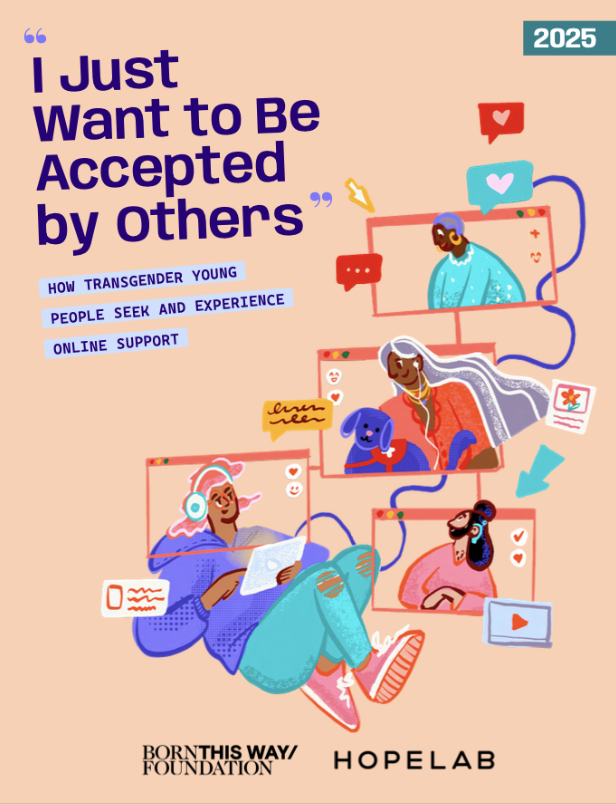
New research from Hopelab and Born This Way Foundation shows that online communities are critical lifelines for transgender young people, who face much higher rates of depression, anxiety, and suicide risk than their cisgender peers.
The report, “I Just Want to Be Accepted by Others”: How Transgender Young People Seek and Experience Online Support, draws on data from a survey of 1,267 LGBTQ+ youth and young adults aged 15 to 24 in the United States, including 696 who identify as transgender.
Notably, trans youth worked to co-design the survey and refine its results through interviews, further grounding the report in the experiences of the communities it aims to understand.
The state of trans youth mental health
Just 7% of transgender youth surveyed felt “very safe” expressing their identity in real life, but 47% said they did online, underscoring how important digital spaces can be. Young respondents say such spaces offer affirmation, role models, and practical resources to help mitigate the stress of real-world discrimination and rejection. “[A] Facebook genderfluid group helped me discover and be proud of my gender when I was questioning and being shunned by my family,” wrote one Latinx youth who identified as trans and nonbinary.
One white trans young man said he had gay, lesbian, and bisexual role models and support, but trans adults were hard to find. “I didn’t even really know where I would go if I wanted to talk to someone who was transgender, especially someone who is older or could serve as a role model,” he said. “And so I found online communities where that was an option really important for me when I was discovering that about myself.”
But digital communities have their limits, one Black adult who identified as trans and genderqueer told researchers: “Definitely helps having a community online, but it’s still essentially in your phone or in your computer. So it’s small. You can put it away… It’s a lot easier to just forget about it in a way, as opposed to when you can see it in person, when you can feel it more in person.”
The report shows that online communities can be vital supports, but aren’t a replacement for real-world acceptance. Great power and responsibility still lies with families, who can affirm their loved one’s gender exploration – and thereby support their mental health – by using chosen pronouns, listening with openness, and standing up for their right to be themselves. Transgender young people who were proud of their trans identity were significantly less likely to meet depression criteria, the report noted.
For further reading, check out MindSite News articles about Hopelab’s research on the importance of online communities for lonely rural youth, including a personal story by one of our editors, and a richly illustrated report on the importance of online communities for LGBTQ youth.
Mental health can't wait.
America is in a mental health crisis — but too often, the media overlooks this urgent issue. MindSite News is different. We’re the only national newsroom dedicated exclusively to mental health journalism, exposing systemic failures and spotlighting lifesaving solutions. And as a nonprofit, we depend on reader support to stay independent and focused on the truth.

It takes less than one minute to make a difference. No amount is too small.
The name “MindSite News” is used with the express permission of Mindsight Institute, an educational organization offering online learning and in-person workshops in the field of mental health and wellbeing. MindSite News and Mindsight Institute are separate, unaffiliated entities that are aligned in making science accessible and promoting mental health globally.

Author

Related Articles

Trump freezes $10 billion in childcare aid to 5 Democratically-led states, baselessly claiming “widespread fraud”
A $10 billion federal child care funding freeze targets California, Colorado, Illinois, Minnesota, and New York.

Seeing Guilt for What It Is: Motivation to Change
Psychology professor Chris Moore explores the difference between guilt and shame, revealing how healthy guilt can motivate healing, repair relationships, and drive restorative justice.
New Senate Bill Targets ‘Troubled Teen’ Industry and Residential Treatment Abuse
Senator Ron Wyden introduced the BRIDGES for Kids Act to increase oversight of residential treatment centers and create a national dashboard to track abuse.
