
ICE Agents Turn NY Immigration Court Into Hall of Terror
Immigrants are seized and dragged off by ICE agents in front of their families after appearing at court hearings for asylum.

Greetings, MindSite News Readers.
In today’s Daily, photographers from New York magazine capture the daily horror of families being ripped apart in immigration court. Plus, an 8-minute “happiness break“ helps listeners get centered. Parents of children lost to drug overdose share the ways they’ve grieved, and families and cartoon characters discuss mental health in a new PBS Kids show.
But first: don’t miss our webinar, “Diet as Medicine: The Rise of Keto Therapy for Psychiatric Disorders” tomorrow at 12:00pm PT. We’ll be joined by Lauren Kennedy West, Matt Baszucki and Dr. Georgia Ede to discuss a groundbreaking new approach to treating schizophrenia, bipolar disorder, and other severe mental health disorders.
ICE agents have turned NYC’s immigration court into an impenetrable trap
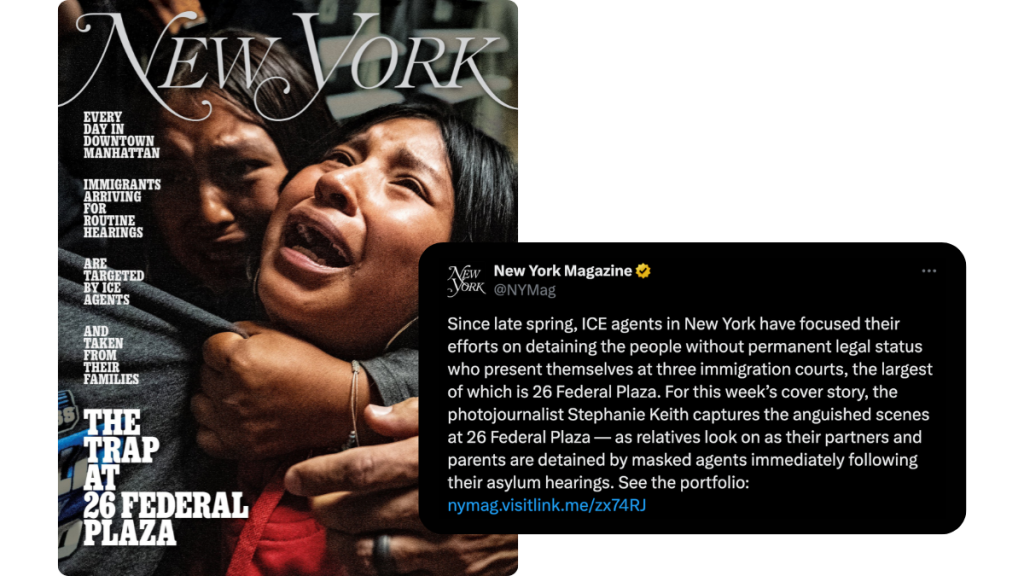
In a heartbreaking photo essay, New York Magazine reveals the devastating impact of the Trump Administration’s deportation campaign. Rather than flood the streets with officers as they’ve done in Chicago, ICE just seizes people at immigration court in New York City. People following the law, attending asylum hearings, are stolen away, physically ripped from their families. Young children are imprinted with the memory of their fathers being snatched, unable to offer – or receive – a hug goodbye, let alone an explanation. The agony, confusion, and despair families feel is captured on film, stark against the indifference of the ICE agents inflicting that pain.
One agent, called “Icicle” for her small size, and described by one lawyer who has repeatedly dealt with her as “extremely, extremely volatile,” insisted that someone in ICE custody had no right to remain silent. When rebuked by a judge for detaining people in inadequate conditions, she complained that officers “wanted more people to arrest.”
One man, Carlos, became quiet and anxious – a far cry from his naturally jovial disposition – in the lead-up to his asylum hearing. “He had nothing to hide” and nothing to run from, his sister Lilian said, and it seemed the judge agreed, setting his next court date for 2029. But that didn’t stop ICE from snatching him away. His sisters latched onto him, seeking to keep him from being taken, but an agent flung them to the ground. “It was horrible,” Lilian said. “I can’t get over it. I relive it every time I see another arrest.” Still, her brother is one of the lucky ones, Carlos was detained for just 15 days before a judge granted a release – a legal opinion ICE actually honored.
The Trump administration has stripped away any pretense of reasonable conduct from ICE’s activity, directing it to conduct arrests that are impractical, inhumane, or potentially illegal. “What this administration has done,” says immigration attorney Benjamin Remy, “is it has broadened the scope [of detainable offenses]… so anyone here without lawful status can be detained without a hearing and without a bond.” Though the ACLU and other civil-rights groups are fighting these overreaches of power, and some federal judges continue to make sound rulings from the bench, arrests persist, day-after-day.
How Are We Today? brings conversations about mental health to family living rooms

Gen Alpha are far more open about feelings than generations past, which can be a surprise for those of us who only started talking about mental health later in life. So it’s about time for something like How Are We Today?, a new PBS sitcom from Tyler Coe, modeling helpful conversations for parents and children to address common mental health topics. It’s aimed at youth ages 11 and up, with the knowledge that many mental illnesses first present in adolescence, leaving families scrambling – sometimes for years – over what to do. “That’s one of the reasons why I wanted to make this show,” he told Parents, “is that the stories we hear, the strife we have to go through, the amount of time it takes – we have to start shortening those years. We have to put a dent in that timeline.”
While the show works with professionals to ensure its content is accurate and supportive of sound mental health, it also boasts a host of experiential experts in its cast, who have personal knowledge of depression, anxiety and ADHD. Coe, who lives with bipolar disorder, has also overcome addiction challenges and a suicide attempt. The show hopes to make conversations about mental health more common, and to spark more empathy and compassion for folks struggling, as all viewers become educated about the complex ways our brains work.
Central to the show’s impact is its collaboration with clinical psychologist Erin Newins, or Dr. Erin, who ensures every episode blends accurate psychology with actionable tools. Unlike social-media advice that can be fragmented or misleading, How Are We Today? emphasizes evidence-based strategies that viewers can try immediately. For instance, one episode on panic attacks features “awareness activities” like breathing exercises, journaling, and body scans – easy, accessible, and affordable strategies that anyone can employ to regulate stress.
Coe hopes for the show to fill a gap in today’s mental-health advocacy: “[It’s not] enough to just talk about these things,” he says. “We are giving you real-time things to do.” The show also serves as an entry point for parents and kids who might want to talk about mental health together, but have no clue where to begin. Watching together, families can use the show’s storylines as openings, asking questions as simple as “Have you ever felt that way?” to spark conversation and connection.
Dr Erin likens its appeal to therapy – it’s not just for people with “something wrong with them” – everyone can benefit. In Coe’s words: “If you’re going through life, this is a good show for you.”
Inspired by PBS icons Fred Rogers and LeVar Burton, Coe crafted How Are We Today to mix kindness, education, and humor and make the science of the mind approachable. Its subject matter might be heavy, but “Kids nowadays can handle it,” he says. “They can handle it better than we did. They’re not stupid.”
In other news…

A quiet, 8-minute Happiness Break: In addition to reporting on the science of resilience and well-being, the Greater Good Science Center produces podcasts aimed at helping listeners improve their knowledge and cultivate some joy. In an edition of Happiness Break published earlier this month, listeners were guided through an 8-minute meditation to practice finding peace within, noticing the clarity available in the quiet.
In an attempt to support readers experiencing grief, USA Today launched a series documenting various grief journeys. There are no universal stages to grief, just waves in which the loss washes over you, sometimes without warning. There is no linear or simple process.
“It is easy to get frozen in the loss, and it is not a good feeling,” wrote Astrid Oliver and DeAnne Slaughter, who shared their experiences in this week’s installment. They both lost children to drug overdose, and met and bonded in a support group. “You have the sense that when this happens, you will never move forward or heal. But maybe you can heal. Maybe you can shift to a place where you connect to the love, and not the loss, of your child. Maybe you can appreciate yourself for who you were, and who you are now. We started a year-long conversation to find out what that might be like, and how to do it.” They also started a podcast, Two Moms with Two Dead Kids, to give their grief a productive place to go.
USA Today continues to welcome other voices to share how they move forward in grief. If you’d like to share your story, submit it here.
The name “MindSite News” is used with the express permission of Mindsight Institute, an educational organization offering online learning and in-person workshops in the field of mental health and wellbeing. MindSite News and Mindsight Institute are separate, unaffiliated entities that are aligned in making science accessible and promoting mental health globally.

Author

Related Articles

Waiting for Word on Relatives Under Attack in Iran
Iranians in the US are caught between two “unrepentant regimes,” says Iranian-American writer and professor Shervin Malekzadeh.
Will the Pursuit of Profit Suck the Benefits Out of Psychedelics?
Many new programs have removed the most transformative, curative and life-affirming parts of the psychedelic experience.
New Mexico to Probe Allegation that Epstein Ordered the Burial of Teen Girls Near His Ranch
New Mexico has announced it is probing into an allegation that Epstein ordered the bodies of two girls to be buried on Zorro Ranch.
