No Kings Protest One of the Largest in US History
Seven to eight million people attended the nationwide protest of Trump’s policies on No Kings Day on Saturday.
Good day, MindSite News readers!
In this edition, how collective protest might help your mental health (as well as our country). Also in this edition, why eye care is important for mental health, what post-9/11 vets’ mental ill health can teach us about the effect of childhood trauma and long deployments, and how Medicare and Medicaid private plans have been exaggerating mental health treatment options. Plus: California speeds up approval for psychedelic research, our upcoming seminar on keto therapy for mental illness, and we remember South Korean author and mental health advocate Baek Se-hee.
But first, don’t miss “Mental Health Is Real Wealth: How Black men prioritize healing in a Los Angeles community.” Desmond Carter, 37, lost his best friend to suicide. He had been diagnosed with schizophrenic depression, but Carter feels he often hid how he was doing. He often shares the story at the start of bi-monthly meetings, where Black men of all ages are encouraged to talk openly and vulnerably. “I see so many of my peers and people who look like me walking around, fly, cool, fresh with the weight of the world on their shoulders, and acting like they are just fine, ” he said. “And it led me to what I’m doing now.”
Inflatable frogs and superheroes accompany #NoKings marchers in enormous peaceful protest

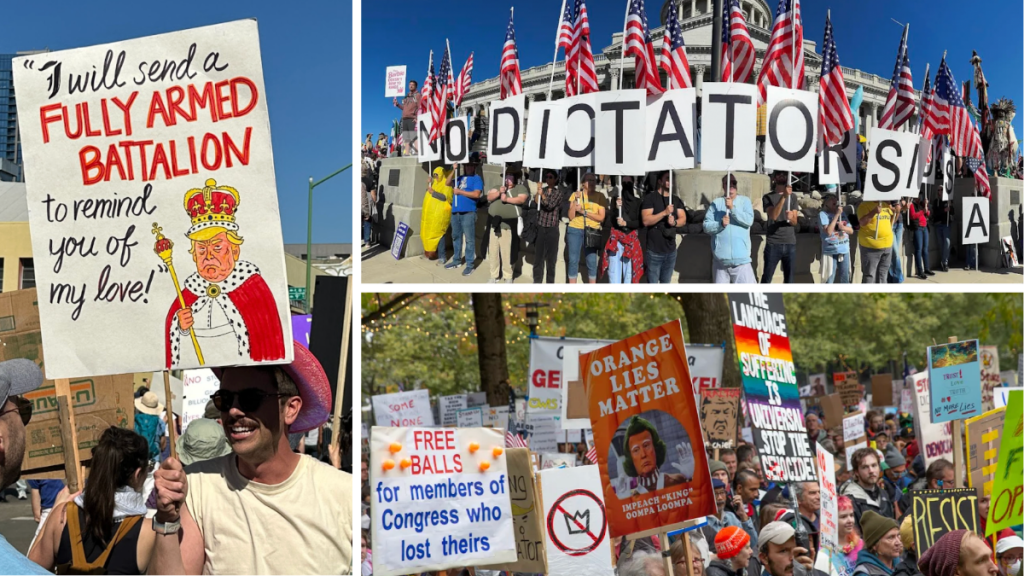
On Saturday, October 18, an estimated 7 million people from coast to coast came together in the second No Kings’ March. They were drawn to the streets to fight for “democracy over dictatorship” in what was the largest one-day street protest in American history (the national Earth Day celebration in 1970 drew 20 million participants).
Portland-inspired frog costumes abounded, as well as inflatable costumes of Superman, Batman, Spiderman and other American heroes. Protests were peaceful, with police departments in Charlotte, N.C., Austin, Texas, and San Diego and elsewhere thanking the organizers for that, although one 53-year-old female protestor in Alabama was arrested – on obscenity charges – for wearing a penis costume and carrying a sign that said “No Dick-Tator.” One protester appeared to have been injured in a deliberate hit and run.
Decades of studies suggest that collective protests like these can be good for your mental health. One 2002 study by psychologists at the University of Sussex found that people who became involved in political demonstrations experienced a boost in their psychological well-being that could help them manage stress, anxiety, depression, and even pain.
“Empowering events were almost without exception described as joyous occasions,” said researcher Dr. John Drury in a statement at the time. “Participants experienced a deep sense of happiness and even euphoria in being involved in protest events. Simply recounting the events in the interview brought a smile to the face of the interviewees.”
Judging from our experience, as well as photos from around the country, there were definitely a lot of smiles at Saturday’s protests. Filmmaker Michael Moore collated those sent to him by fans across the country, and more photos appeared in outlets including NPR, BuzzFeed, and USA Today.
Trump responded to the nationwide repudiation of his conduct and policies with an unhinged AI-generated video of himself flying a jet labeled “King Trump,” showering protesters with feces. If anyone was in doubt about the “brown liquid,” as the New York Times described it, the publication Zeteo says a senior White House official confirmed that “It is shit. A lot of it … What else would that be?”
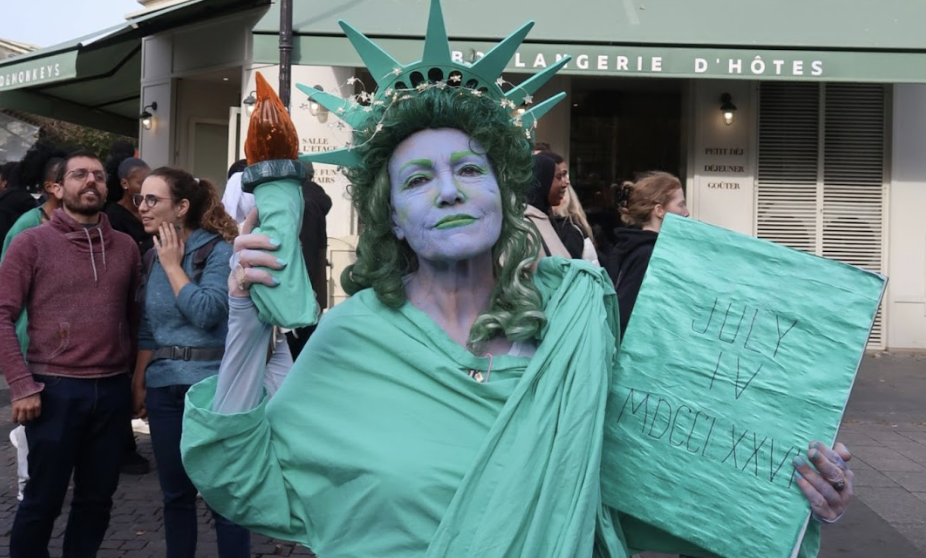
The #NoKings protests extended beyond the US, with examples from Europe to South Korea. My son attended a protest in France, and spotted the Statue of Liberty among (of course) inflatable animals. He noted that though participants were French, Lady Liberty was an American in Paris.
“The eyes have it”: Why we regular eye care is key for our mental (and physical) health
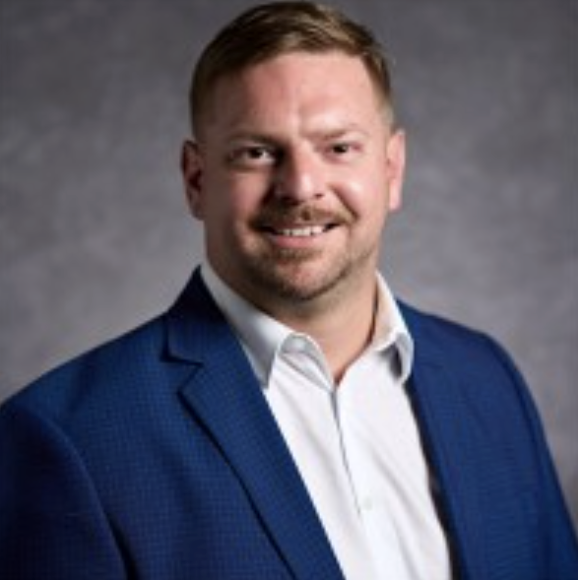
Dr. Alex Martin, chief medical officer of Eyebot, is an eye doctor on a mission: He’s passionate about ensuring that everyone has the right to eye care. And as medical director for Boston Vision in Lawrence, Massachusetts, he is also well aware of the relationship between vision and mental health, and was able to take time from his packed schedule for an interview with MindSite News about his work, including his role for Eyebot, a company that has removed traditional barriers to vision testing through the use of kiosks where people can test their vision for free in 90 seconds (and for $20, send the test results to telehealth eye doctors to generate eyeglasses).
MindSite News: Many people associate a visit to the optometrist with great new glasses or contact lenses, but you’ve mentioned there is also a close association with eye health and mental health. Could you talk about that?
Dr. Alex Martin: The relationship between vision and mental health is complex, acting as a two-way street. Losing your sight or living with a visual impairment can be incredibly difficult, leading to a range of emotional challenges. People with vision loss are significantly more likely to experience anxiety and depression than those with normal vision. This can stem from feelings of loneliness and social isolation, a loss of independence, a fear of being a burden on others, and the grief associated with losing a sense that is so central to how we navigate the world. For younger people, the risk of anxiety and depression is even higher, perhaps because they have less experience and fewer coping skills to manage a life-altering change.
I understand that 93 million adults in the US are at high risk for serious vision loss, but only half visited an eye doctor in the past 12 months. What’s behind this?
This is quite a problem, and it’s tough because part of it is how difficult it is to get an eye exam. For example, if you tried to call my office to get an appointment with me, I believe I’m booked out four months and I’m seeing a huge number of patients every day. I’m seeing about 40 people a day. Most eye doctors see somewhere around like 25 a day. There’s just a huge need.
And then there are barriers to care, such as taking time off from work or not realizing that a disease that can rob you of sight might go so slowly and undetectable that you won’t know it until there’s already a huge problem. And that’s where the power of the annual eye exam comes in. We’re the big screener of eye disease. If there’s anything we see, we’ll take care of it or make a referral. But the key is that you still have to come in every year, every two years.
I confess that I am one of those patients who doesn’t come in every year or two.
Oh, you’re not alone.
It seems that if patients don’t have eye problems during a visit, we sometimes get a false sense of security. Just yesterday, I noticed I was having a little trouble reading and I closed one of my eyes and realized I couldn’t read with the other. I couldn’t really even see out of it – there was a gray circle hovering in the middle. That was a shock.
One of our best attributes of having two eyes often covers up for the fact that one might be less dominant, one might lag behind, one might have a cataract in it. There’s tons of reasons. I can’t tell you the number of people who come in and we’re like, okay, so let’s test your right eye and then let’s test your left eye. And they’re like, whoa, wait a second. I had no idea how bad this was.
I’ll be making an appointment right after this interview, that’s for sure [laughs]. Tell us more about Eyebot, the visual screening kiosk, and how that might help alert people to a vision problem.
The company has been working on being able to reformat a lot of the components of an eye exam into a vision test in a kiosk. You’d be able to walk up to this kiosk for free and get your vision tested in about 60 to 90 seconds. At the end of that, if you wanted to know your results, we will let you know. Or there’s the option to ask for a doctor to review it. Or even if you just needed a pair of glasses there, as long as we get really high quality, good measurements and data, then an eye doctor would be able to review it and actually get you glasses while you’re at the kiosk. (It’s) to be able to get people into the system quickly, and even just from an education standpoint: Do you need urgent care? Do you have refractive error? Do you actually need glasses? All of those questions can be answered with high quality screening tools, like what we’re creating.
The whole point is that there’s small changes over time and we’re all busy, but if you had a machine that was available at your local pharmacy or grocery store, you might think, you know what? It’s free, so let’s just try it and see if I do need something.
I’m curious – how did you get interested in this field to begin with?
It’s partly because the most interesting class I ever took was neuroscience, where I was able to see how much of the brain is dedicated to processing vision. I myself needed glasses from the age of 8, so I knew the power of a pair of glasses. I was already at that point blind enough to not be able to see leaves on trees or people’s faces. So that moment of putting glasses on was just such an incredible shift, even as an 8-year-old realizing how much of the world was I really missing all this time? Those two major pathways led me to optometry.
I’m wondering why dental care and eye care, which should be part of our regular healthcare system, seems to be in a kind of optional or add-on category in terms of health insurance.
That’s a great question. A lot of people think that they’re completely separate, and if you only have one, you can’t have the other. And the best thing I can say is health insurance in general does cover annual eye exams once a year or once every other year, depending on the plan. With vision insurance you’re able to do the annual eye exam every year, and it gives you a discount on glasses and contacts.
But health plans do cover going in for eye conditions such as new blurry vision, going in for cataracts, going in for dry eye, going in for itchy eyes or pink eye. All of these things are medical conditions that yes, we do actually have coverage for, but nobody thinks of it that way. So I would just encourage anyone who’s watching, listening, or reading this to know that even if you’re not sure of your coverage, just call your local eye doctor and ask what your options are. They are going to be more than happy to try and figure out a way to use that insurance in the best way possible and get you in to see them.
In other news….
Author Baek Se-hee, who was open about her struggle with mental health, dies at 35. Why do some horrid people seem to live forever when many kind and sensitive ones die young? South Korean author Baek Se-hee chronicled her struggles with depression and anxiety in her 2018 best-selling memoir I Want to Die but I Want to Eat Tteokbokki.
A statement from her publisher Bloomsbury reads: “The generosity Baek Se-hee showed in sharing her own story with such vulnerability and candour cannot be understated.… To read her books is to want to talk about them. She sought connection, always, and wanted her words to be of help and consolation.”

Poor mental health in post-9/11 vets linked to long deployments, childhood trauma. New research from a team at Penn State shows that post-9/11 veterans’ mental health after leaving the service is undermined not only by combat exposure, but by childhood trauma and deployment pattern. The study, recently published in the Journal of Clinical Psychology, tracked nearly 9,600 men and women who left active duty in late 2016 at six points over three years. The mental health of veterans who did multiple tours was much better than those who had long deployments. Longer deployments predicted worse mental health in men, where a greater number of deployments was linked to improving mental health over time.
Adverse childhood experiences (ACEs), such as physical abuse, neglect or substance use within a household,, “were also strong predictors of poor mental health. Veterans with three or more ACEs consistently reported the highest levels of anxiety and depression,” Penn State reported. Combat exposure also raised the risk in both men and women, though women did seem to experience a brief improvement after service before symptoms rebounded. Co-author Keith R. Aronson stressed the importance of similar long-term studies: “It reminds us that support for veterans can’t stop after the first few months. Monitoring changes over time gives us the opportunity to intervene earlier and more effectively when new challenges arise.”
California Governor Newsom signs bill to boost psychedelic research. Last Friday, California Governor Gavin Newsom signed Assembly Bill 1103, designed to speed up drug research, especially for psychedelics, The Microdose reports. At present, studies involving Schedule I or II substances have to be reviewed by the Research Advisory Panel of California, which has had trouble meeting regularly in recent years. Under the new law, smaller groups within the panel could approve studies in a matter of days if the FDA has approved the drug being studied as an Investigational New Drug. This category already includes MDMA and some kinds of psilocybin and LSD. The expedited review process also applies to any research group that has clearance from the Drug Enforcement Administration. The bill, introduced in February, was sponsored by VETS, who support research into psychedelic-assisted mental health treatment for veterans.
Federal watchdog finds “ghost networks” of mental health providers in private Medicare and Medicaid plans. A federal watchdog found that companies managing private Medicare and Medicaid insurance plans are overstating available mental health options, according to CBS. And it’s not that providers don’t have openings: The insurers appear to have created “ghost networks” of psychologists, psychiatrists and other mental health professionals who they say have agreed to treat patients covered by the publicly financed plans. “In fact, many of these professionals do not have contracts with the plans, do not work at the locations listed, or are retired,” the investigators said. Read all about it in this report from the Office of Inspector General for the DHHS, which oversees the Medicare and Medicaid programs.
The name “MindSite News” is used with the express permission of Mindsight Institute, an educational organization offering online learning and in-person workshops in the field of mental health and wellbeing. MindSite News and Mindsight Institute are separate, unaffiliated entities that are aligned in making science accessible and promoting mental health globally.

Author

Related Articles

Millennials Weigh Having Children On Their Own Terms
Not having children is also a valid path, and one that everyone should consider, Merle Bombardieri argues in her 1981 book.

Waiting for Word on Relatives Under Attack in Iran
Iranians in the US are caught between two “unrepentant regimes,” says Iranian-American writer and professor Shervin Malekzadeh.
Will the Pursuit of Profit Suck the Benefits Out of Psychedelics?
Many new programs have removed the most transformative, curative and life-affirming parts of the psychedelic experience.
