
Hopelab Finds Southern Youth Need Mental Health Solutions ‘Free of Bias and Regional Stereotypes’
As an eighth grader in Dunwoody, Georgia, I remember a 13-year-old football player plopping into his seat, scanning the room and loudly announcing, “Ugh, there aren’t any hot girls in here, only dogs.” A classmate from my old elementary school blushed and lowered her eyes in humiliation, and I felt a surge of fury that left me speechless. Some of my classmates and I were from the county’s oldest elementary school, where a few kids were so poor they came to school barefoot and everyone got along so well that it seemed we had landed in Narnia. I wanted to tell the arrogant brat ‘who died and made you god?’’ but the bell rang before I could, something I regret to this day.
Cheerleaders, drill team girls and football players – some of them bullies and racists – dominated the pecking order in our Southern high school, and it was hard at first to find places that felt safe. I joined the girl gymnastics team, which had no coach and had to practice on the school’s sidewalk until the boys’ team – all juniors and seniors – volunteered to coach us.
This thrilling turn of events resulted in daily practice in the school auditorium, which felt like a magic carnival, replete with drama team rehearsals on stage, basketball players shooting hoops, and anti-war songs and rock music blasting from loudspeakers as we practiced our routines and did back flips on the trampoline.
As I floated toward the ceiling over and over as a song by Spirit played in the background (“It’s nature’s way of telling you something’s wrong”), it felt like I was flying – and in some ways I was, toward a time in which my high school friends and I would feel the freedom to question everything.
But only a short drive to a working-class suburb across Atlanta, a girl I knew did not have that luxury: She felt increasingly isolated. Like nearly everyone around her, she was involved in a Pentecostal church and her social life revolved around that. By the time she realized she was attracted to women instead of men, there was no one close by to talk to about it. Fast forward a decade or so, and she met some new friends on social media. For the first time in her life, she had a circle of dear friends with whom she could be herself online and offline – even though she still keeps her social life private from her family.
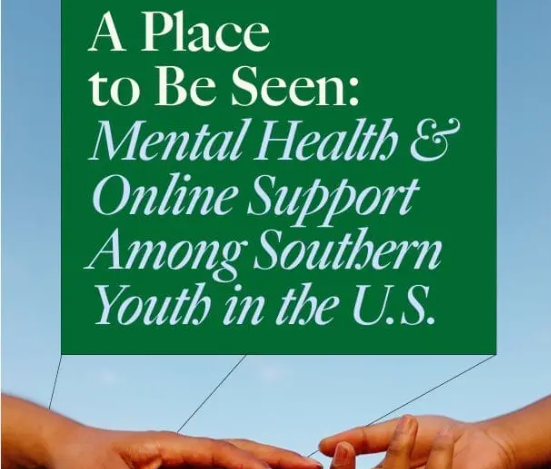
This is among the reasons I was so glad to see a new report from Hopelab focusing on Southern youth. As one young, white bisexual man told Hopelab: “It may seem like the South is a big conservative bubble. But there are people here who are scared, people here who are depressed and have anxiety and need help just as much as young people anywhere else. We’re all people.”
Hopelab, whose mission is to advance the mental health and well-being outcomes of young people through uncovering knowledge and evidence, investing in innovators, and funding youth-centered solutions, underscores the need for nuanced understanding of the South. Noting that young people are growing in an era where social platforms greatly influence how they “communicate, learn and thrive,” those spaces also interact with cultural factors that influence their mental health.
Online environments can be a lifelife, but they can also intensify some challenges, the researchers note: “By grounding solutions in evidence rather than bias and regional stereotypes, we can build more effective support systems for the mental health and well-being of young people.” And that’s something that I, as a Southerner, entirely agree with.
Another key finding was that Southern young people are less likely to see affirming content on social media. A straight Latina interviewed said that “There is a big community of people in the South who donʼt enjoy the inclusion of other people. They tend to say things that might be hurtful or might be less affirming or they donʼt affirm at all. And social media is kind of localized where you live, so you see that non-inclusive content.”
The report also found that Southern youth experience anxiety and depression and seek out online therapy at rates similar to their peers in other states, but they are less likely to search for mental health information online. They are also more pessimistic about the potential of generative AI.
Finally, as one respondent said, “There’s a culture in the South that I have to deal with (my mental health problems) myself because I’m strong” – although from talks with my cousins in the Deep South, there is now much more openness about discussing mental health issues, medications and alternative therapies than there was when I was growing up. I’m grateful to Hopelab for interviewing Southern youth and calling for a more nuanced understanding of the region, something that’s perhaps more important than ever.
–Diana Hembree
The name “MindSite News” is used with the express permission of Mindsight Institute, an educational organization offering online learning and in-person workshops in the field of mental health and wellbeing. MindSite News and Mindsight Institute are separate, unaffiliated entities that are aligned in making science accessible and promoting mental health globally.


Author

Related Articles
Does Contemporary “McMindfulness” Reinforce Our Suffering?
A Buddhist teacher and professor argues that a commodified mindfulness solely focused on the self is only a stopgap fix.
“No Beds”: Despite Improvements, Detroit’s Shelter System Continues to Let Families Down
When a Detroit mom and her two sons faced homelessness last year, she spent months calling the city daily for beds – in vain.
988 call responses plummet in Georgia after insurer cutbacks
After an insurance company made cutbacks, Georgia’s 988 response rate to mental health crisis calls “fell off a cliff.”
