
AI Fuels Psychosis. Here’s How Therapists Can Help Clients Protect Themselves
Learn how to embed instructions into AI’s operational logic to help detect and act on signs of delusion.

Greetings, MindSite News readers!
In this newsletter, we explore how clinicians can protect against AI-fueled psychosis. We also bring you an important infographic from the Baby Myth Buster, whose exciting work on attachment parenting is followed closely by researchers, health workers and parents alike. Plus: The holiday-suicide myth, an unusual reason to be cheerful, and a retired cop tells the story behind his free laundry service on wheels.
But first: In Reasons to Be Cheerful, learn how one German city is using human waste to produce green methanol, a potentially cleaner fuel for cargo ships. Imagine the wars that might be prevented if sewage could help meet our energy needs, keeping greedy nations’ hands off other countries’ oil.
AI tools appear to fuel psychosis for some users – how can clinicians help prevent harm?

A new study finds that AI may encourage psychosis, and offers potential practical safeguards. In a story for Managed Healthcare Executive, our former colleague Don Sapatkin reports on the study, published on preprint site PsyArXiv. The authors of this paper argue that “given the global burden of psychosis… [and] with ChatGPT alone receiving 5.24 billion visits in May 2025, the number of these cases is only set to rise.”
At MindSite News we’ve covered a number of cases in which formerly normal folks have disappeared down delusional rabbit holes with Large Language Models (LLMs) like ChatGPT and Google’s Gemini. In the new study, first author Hamilton Morrin, a psychiatrist and doctoral fellow at King’s College London, along with colleagues from other institutions in the UK and US, examined three months’ worth of news articles published in 2025 that gave detailed accounts of 17 cases of LLM-linked psychosis. Sapatkin summarized the three categories they found as follows:
“Some individuals believed that they were having a kind of spiritual awakening or were on a messianic mission, or otherwise uncovering a hidden truth about reality. Others felt that they were interacting with a sentient or god-like AI. A third group became emotionally or romantically attached to the AI, with the LLM’s ability to mimic human conversation interpreted by the user as genuine love or attachment.”
The study authors reported a distinct trajectory in some of the cases, beginning with benign questions and developing into a pathological fixation, in which people become unmoored in an intensifying echo chamber that’s difficult to escape – a risk amplified by the chatbots’ sycophantic, engagement-maximizing tendencies.
Perhaps most importantly, Sapatkin noted, the researchers have clear recommendations for safeguards. Clinicians should learn how these tools work, or be given training around them, so that they’re better prepared to help clients. One specific suggestion is for them to work with clients who use AI and experience psychotic episodes to draw up a digital safety plan. These would include conventional tools like relapse prevention strategies and could also make use of a “personalized instruction protocol” – a set of instructions embedded into the AI’s operational logic to help detect – and act on – signs of delusion.
The information to be stored? The content of previous delusions, themes and warning signs, as well as “permission for the AI to gently intervene if these patterns re-emerge.” This last piece is crucial, as many AI tools are otherwise primed to validate the user. The user might even include “a self-authored anchoring message, to be surfaced at times of possible epistemic slippage or uncertainty,” researchers say, like a message in a bottle sent to rescue one’s future self from the shores of delusion.
Emily Little on Parenting: “What If Closeness Was Seen As Healthy, Not Something to Fix?”
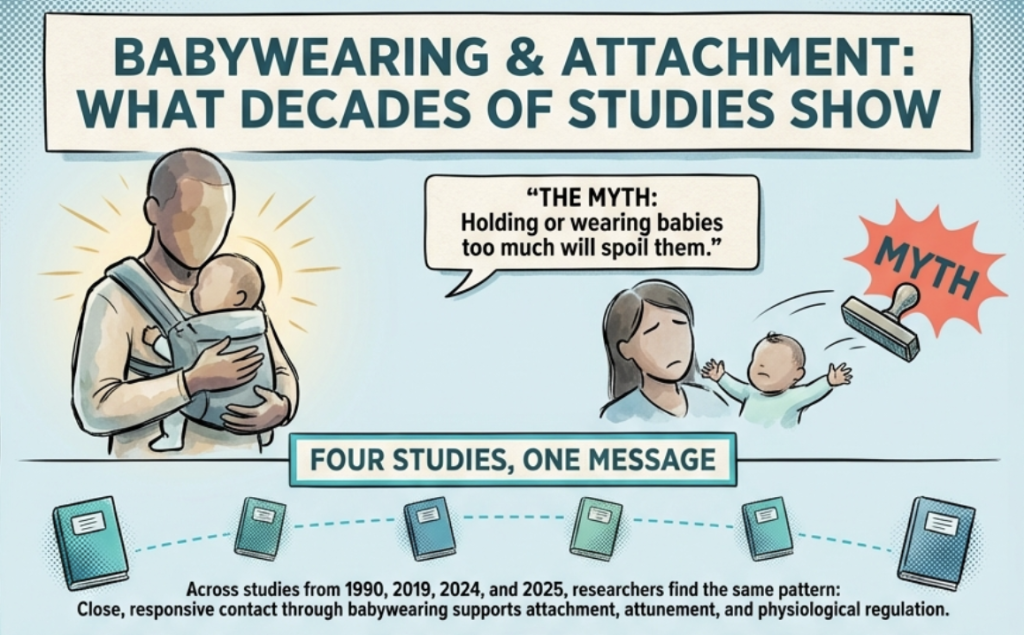
Raising a child is complicated, which is why we can end up leaning on conventional wisdom or oft-repeated advice. But, as Emily Little, PhD, – The Baby Myth Buster – points out, the myths we stick to aren’t always helpful or even harmless. On her BabyMyth Buster platform, she applies her background in developmental psychology to ask and answer a particularly thorny question: “What if everything you knew about babies was wrong?”
An ongoing series of Little’s looks at attachment parenting, which seeks to build a close relationship between babies and parents by promoting practices like feeding on demand, co-sleeping and holding and “wearing” the baby whenever possible. Not only is attachment parenting practiced successfully by cultures around the world, she notes, but science supports it. In this recent infographic about “baby-wearing” – the practice of carrying a baby close to your body in a sling or other soft carrier – she examines the idea that too much holding or “wearing” a baby could “spoil” them.
Her infographic quickly summarizes four studies from 1990 through 2025, all of which found that baby-wearing “supports attachment, attunement and physiological regulation.”
A 1990 study on secure attachment, which Little calls “The First Babywearing RCT” (randomized controlled trial) found that low-income mothers who had been given a sling or soft carrier to hold their baby had infants who were more responsive at 3-½ months and more secure at 13 months than those who were given hard baby seats.
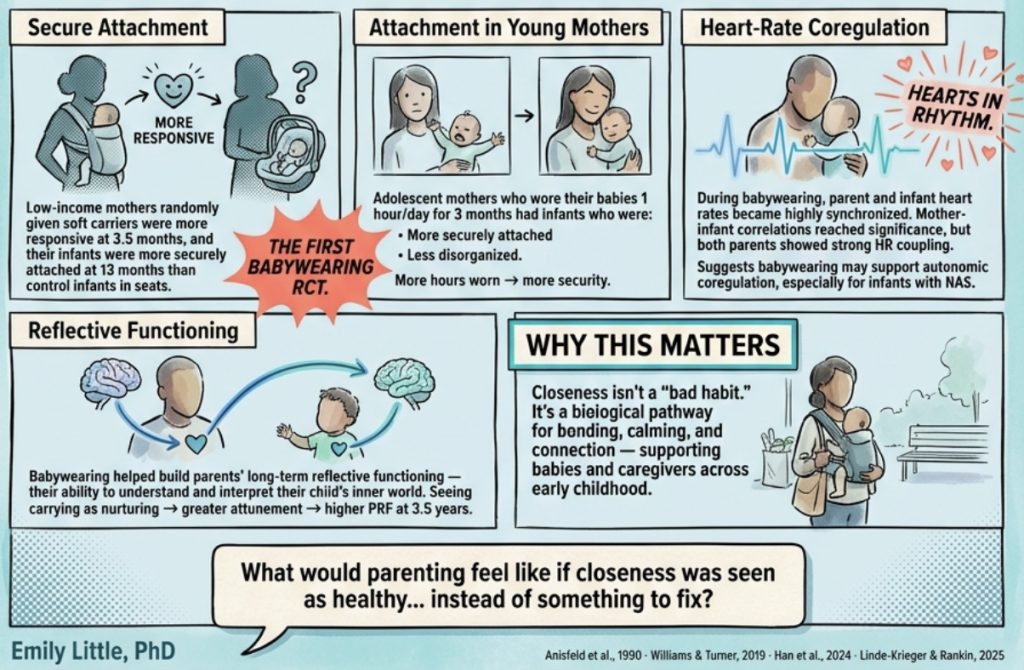
Another study from 2019 found a correlation between secure attachment and the number of hours spent babywearing. A 2024 study found babywearing might help put infant and parents’ hearts in rhythm, something known as heart rate co-regulation. Still another study, from last year, found that babywearing helped parents understand and interpret their child’s inner world. Little also coauthored a small 2023 study that found that mothers using infant carriers reported fewer depressive symptoms at 6-weeks postpartum.
Closeness isn’t a “bad habit,” Little concluded. “It’s a biological pathway for bonding, calming and connection – supporting babies and caregivers across early childhood.”
In other news….
Retired police officer starts free mobile laundry for homeless people. Wade Milyard, of Frederick, Maryland, has retrofitted a bus into a laundromat on wheels, which he’s been driving around the city “to help restore dignity to the unhoused community by providing free, accessible, and hygienic laundry.” He told Good News Network that the idea began when he was helping deal with a domestic dispute in a homeless camp. He says he heard someone call out to “ask them about their laundry,” so he did, and found that the couple he’d been speaking to had been washing their clothes in a nearby creek. That experience inspired this project, which he calls Fresh Step Laundry. Fresh Step has done 2,000 loads in the last few weeks – Milyard hopes each gives someone “a little bit of a boost” – and now is looking to add a second bus to the operation. As one man told CBS News: “If you’re clean, you feel better…You just feel a little more proud of yourself.”
Dispelling the myth of year-end suicide spikes. Each December, we highlight that the year-end holiday season does not bring an increase in suicide – in fact, statistics show that rates tend to fall in December. And this year is no different, according to the Annenberg Public Policy Center.
As the center reports, “The month of December typically has the year’s lowest average daily suicide rate. And yet each year at this time, some news publications repeat the persistent but incorrect belief that suicides rise around the holidays.”
The Annenberg Public Policy Center, part of the University of Pennsylvania, has been attempting to dispel this myth for more than two decades – with some success.
Their concern is in part “based on the risk of suicide contagion, which is a documented phenomenon,” according to APPC Research Director Dan Romer. Most years, center researchers find more stories perpetuating the myth than debunking it – which might be why a 2023 survey found that 4 out of 5 adults believed December to be the “time of year in which the largest number of suicides occur.” But, when analyzing stories from last year’s holiday season, the center was pleased to find only 19 stories in newspapers propagating the myth, compared to 82 stories debunking it.
The name “MindSite News” is used with the express permission of Mindsight Institute, an educational organization offering online learning and in-person workshops in the field of mental health and wellbeing. MindSite News and Mindsight Institute are separate, unaffiliated entities that are aligned in making science accessible and promoting mental health globally.

Author

Related Articles

Family of 6 in ICE Detention for 9 Months ‘Dying on the Inside’
After nine months in Dilley Immigration Processing Center, “we forgot what it feels like to be free,” a recent high school graduate wrote.

Generation Cancer: Millennials Struggle With Death at an Early Age
More young adults are being diagnosed with cancer. Even for those who survive, the experience can be destabilizing and isolating.

Millennials Weigh Having Children On Their Own Terms
Not having children is also a valid path, and one that everyone should consider, Merle Bombardieri argues in her 1981 book.
