
Pilots with Mental Health Issues Often Suffer in Silence
Stringent FAA certification requirements are leading commercial pilots to hide mental health issues like depression..

Greetings, MindSite News Readers.
In today’s Daily, a look at how mental health stigma impacts aviation safety, why experts say a neurodiversity coach may help your office, and a look at the psychological rollercoaster of a near-death experience.
Plus: What is going wrong with young men’s mental health?
But first, Dawnita Brown told NPR that while being able to care for both of her parents is a gift, it can also be difficult. So she started Binti Circle to create, in Brown’s words, “the community I needed and did not have.” The intergenerational support network is designed to give Black daughters who are former or current caregivers the mental, emotional, and practical nurturing they need – without judgment – from others who truly, deeply understand. In addition to monthly support meetups, members can access a virtual group chat for real-time help, wherever they are.
Stringent FAA certification is leading many pilots to hide mental distress
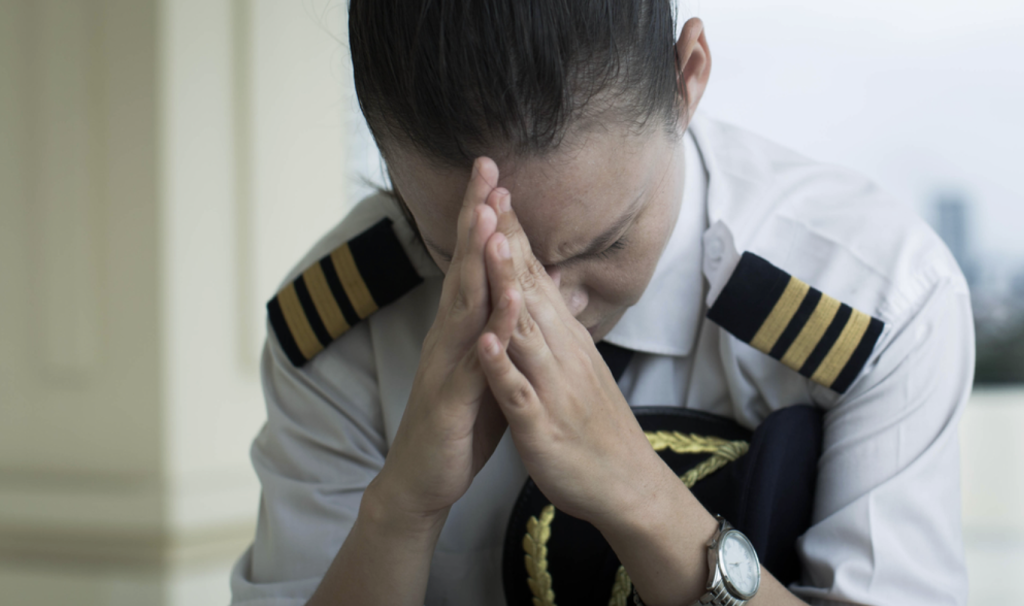
“If you aren’t lying, you aren’t flying.” This has become a troubling proverb among pilots. Speaking to Reuters, more than two dozen commercial airline pilots said they held back from discussing mental health issues. It’s part of a culture that punishes rather than supports pilots who seek mental health treatment, placing them – and the passengers they fly – at risk, the author suggests.
Annie Vargas knows the cost all too well: She lost her son, Delta Air Lines pilot Brian Wittke, to suicide just a few years ago. She’d noticed him struggling and urged him to get help, but the father of three was fearful to do so, worrying that it would cost him his career. Vargas now shares his story in the hopes that it can inspire a new culture; that Wittke’s death might not be in vain. “Real people have real problems,” she said. “And they shouldn’t be penalized for dealing with it.”
For its part, Delta agrees that a stigma against mental health treatment exists within the pilot community, and expressed an intent to “deliver additional solutions” for staff in need of mental health support. The airline, like many other major US carriers, offers peer support programs and counseling, in addition to a new employee assistance program specifically for pilots, which provides therapy and coaching conscious of the aviation industry’s strict medical certification requirements.
The inflexibility of those requirements, more than anything else, is what disincentivizes pilots from getting help. While workers in most industries may privately access mental health care, it’s tougher to do so in aviation. The Federal Aviation Administration requires that pilots meet stringent physical and psychological standards, requiring some to undergo medical exams every six months to maintain their ability to fly. Reporting mental health concerns like depression or anxiety could mean being grounded, triggering a review period as long as a year or more in which a pilot can’t work.
It’s all in the interests of safety. Ten years ago, a Germanwings pilot with a history of severe depression was suspected of intentionally crashing a plane into the French mountainside, killing all 150 people onboard, including himself. But if regulations incentivize pilots to keep quiet and even sidestep treatment in order to earn a living, such tragedies are perhaps even more likely.
“Avoiding mental health care opens up the door to pilots who avoid taking care of their health. And that’s when problems can arise in the cockpit,” said Troy Merritt, a commercial airline pilot who self-grounded in 2022 when he grew concerned that the depression and anxiety were impeding his ability to fly safely. As we covered in a newsletter earlier this year, his return to flight meant six full months of stable medication and a battery of tests, some of which insurance didn’t cover – it took him 18 months to get back in the air, and he says it cost him $11,000.
Earlier this year, the US House of Representatives gave the FAA two years to adopt the recommendations of its Aviation Rulemaking Committee, which would make it easier and faster for pilots who disclose mental health conditions to get back to work. In the meantime, the FAA has expanded its list of approved medications for the treatment of mental health and created a path to the cockpit for pilots who disclose a diagnosis of ADHD. Just last week it shortened its antidepressant stabilization period from six months to three.
Maybe one day, we in the U.S. will be on par with our Australian counterparts. Down under, case-by-case review means some pilots with depression and anxiety are allowed to continue to fly, even while in treatment, and their aviation authority’s medical officer says certification reviews generally take just 20 days.
Employers, it’s time to embrace neurodiversity

To say Justine Capelle Collis is a high achiever would be an understatement. Her advertising career spanned across three continents, and her clients included government bodies and Fortune 500 corporations. She didn’t realize she’d done it all with undiagnosed ADHD until helping her two sons navigate their diagnoses.
Parenting children with ADHD required “a different kind of parenting,” Collis told Fast Company, challenging her in ways she didn’t expect. “I couldn’t make sense of it,” Collis said. “I can have a successful career, I can achieve all of these incredible things. Why am I failing at this thing that I’m biologically wired to do: which is to have kids?” Collis has since retrained as a neurodiversity coach, and got an ADHD diagnosis of her own.
She’s come to understand that she’d had the autonomy and freedom to customize her professional life to suit her strengths – an option too many neurodiverse people don’t get. Many of them are left to navigate environments designed for others, held back from being their best selves.
As awareness of neurodiversity grows, a change advocates credit in part to social media, major corporations like Microsoft and EY are beginning to introduce accommodations to support neurodiverse staff. These include changes to work arrangements and spaces as well as simply providing educational resources. Gijo Matthew, chief product officer at Spring Health, said his company launched a neurodiversity hub because “traditional mental health benefits often fall short for this community.”
Standardized solutions can only go so far, though – neurodiversity exists on a spectrum, and no two people are identical. A dedicated neurodiversity coach can help each employee with their needs and strengths, tailoring work environments to boost performance, motivation, and overall well-being. This might look like designing inclusive roles, sensory-friendly workspaces, and a culture that minimizes interruptions and keeps expectations clear.
“If your job is repetitive admin in an open-plan office with Slack on fire all day, no amount of coaching will turn that into a good fit for an ADHD brain,” explained Roman Peskin, CEO and co-founder of ed-tech startup ELVTR, who was diagnosed with ADHD in adulthood. Ultimately, Peskin believes that when given the proper tools, neurodiverse employees can be a “competitive advantage.”
“We don’t need ‘fixing,’” Peskin added. “We need the rules of the game adjusted so our strengths actually count.” That chimes with Collis’s thoughts – now that we’re better recognizing the different ways neurodivergent people operate, we can help them “function in a way that harnesses that capability, rather than forcing it into a box.”
In other news…
The psychological whiplash of a near-death experience: People often report being forever changed by near-death experiences (NDEs); coming out with huge mental and emotional shifts. Experts told The Washington Post that getting the right support can be vital to recovery, especially for those who’ve had the most intense experiences. “The majority of people want to talk about (their NDEs), but they may be worried about sharing it because they may be labeled crazy or not believed, and that can be isolating,” explained Marieta Pehlivanova, a professor of psychiatry and neurobehavioral sciences who has studied NDEs. It can be hard returning to “normal.”
“You became one with the universe, but the next day you still have to deal with regular life,” in the words of Christof Koch, a neuroscientist who also studies NDEs. “How do you integrate that?” Some feel conflicted about coming back, with many people reporting having felt unconditional love in those moments, only to return to a world and body they see as deeply broken.
Mercedes Somich, whose NDE took place during an emergency C-section, felt isolated in the other direction: “It seemed like so many people’s experience was positive and mine had been so deeply terrifying.” She found talk therapy from a trauma-informed provider helpful, combined with community support, and now says that the NDE helped her become more empathetic.
What’s going wrong with young men’s mental health – and how can we fix it? Amidst what researchers call a male loneliness epidemic, as many as 69% of young men think “no one cares if men are OK.” To help remedy this troubling state of affairs, Futures Without Violence is convening a panel of experts to discuss research-backed strategies to improve young men’s mental health.
The conversation – . Panelists include, Dr. Elizabeth Miller of the University of Pittsburgh School of Medicine, Bernie Colbert of the Coaching Boys Into Men program and Pittsburgh Action Against Rape, and Olando Dulin, also of the Coaching Boys Into Men program and the Steel Valley School District.
The name “MindSite News” is used with the express permission of Mindsight Institute, an educational organization offering online learning and in-person workshops in the field of mental health and wellbeing. MindSite News and Mindsight Institute are separate, unaffiliated entities that are aligned in making science accessible and promoting mental health globally.

Author

Related Articles

Family of 6 in ICE Detention for 9 Months ‘Dying on the Inside’
After nine months in Dilley Immigration Processing Center, “we forgot what it feels like to be free,” a recent high school graduate wrote.
Generation Cancer: Millennials Struggle With Death at an Early Age
More young adults are being diagnosed with cancer. Even for those who survive, the experience can be destabilizing and isolating.

Millennials Weigh Having Children On Their Own Terms
Not having children is also a valid path, and one that everyone should consider, Merle Bombardieri argues in her 1981 book.
