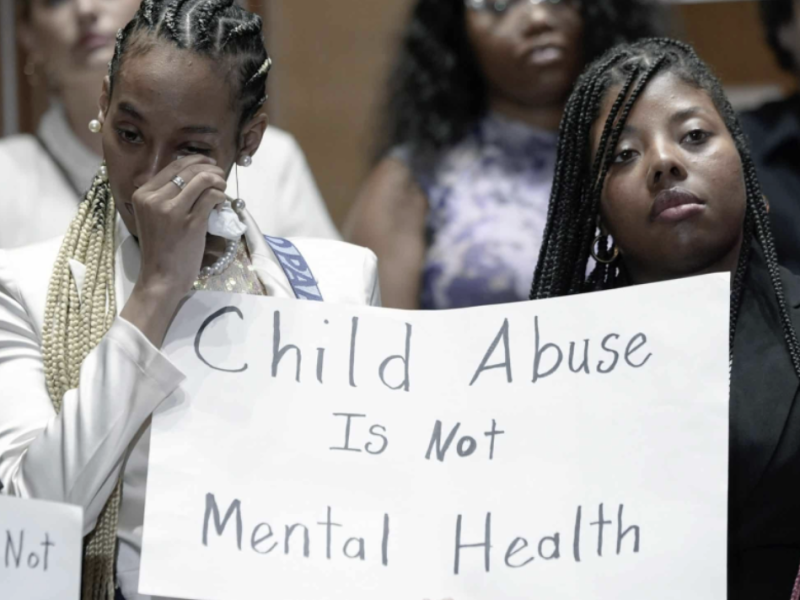
Brown University Student Survives Her Second School Shooting
A Brown University student’s account of surviving her second mass shooting highlights the profound trauma of school shootings and the compounding psychological toll of gun violence on American students.

Greetings MindSite News Readers.
In today’s Daily, a look at our national nightmares: reflections of an American college student who just survived her second school shooting and the ripple effect of such catastrophes on kids and ourselves. Also in this edition: the power of chosen pronouns, why we should be telling kids to use their words, and how staff at one restaurant very likely saved a loyal customer’s life. Plus, a look at “Trump Derangement Syndrome.”
But first, check out this story about how doulas are adapting their work to our changing climate by anticipating the impact severe weather events might have on their clients. Houston-based doula Sierra Sankofa has started offering disaster planning workshops – teaching families how to determine if stored breast milk is still safe after a power outage, and how to sanitize bottles without electricity. Esther Louis helped one client, then nine months pregnant, safely escape south Florida before Hurricane Irma hit, supporting her through Braxton-Hicks contractions along the way.
“Where else should we start, other than with pregnant folks? That’s two lives, the next generation,” Sankofa told The 19th. “And if we can’t learn lessons to save the newborn, the unborn, and the mom, how are we in society going to do anything?”
There are so many school shootings in the US, she just survived her second one
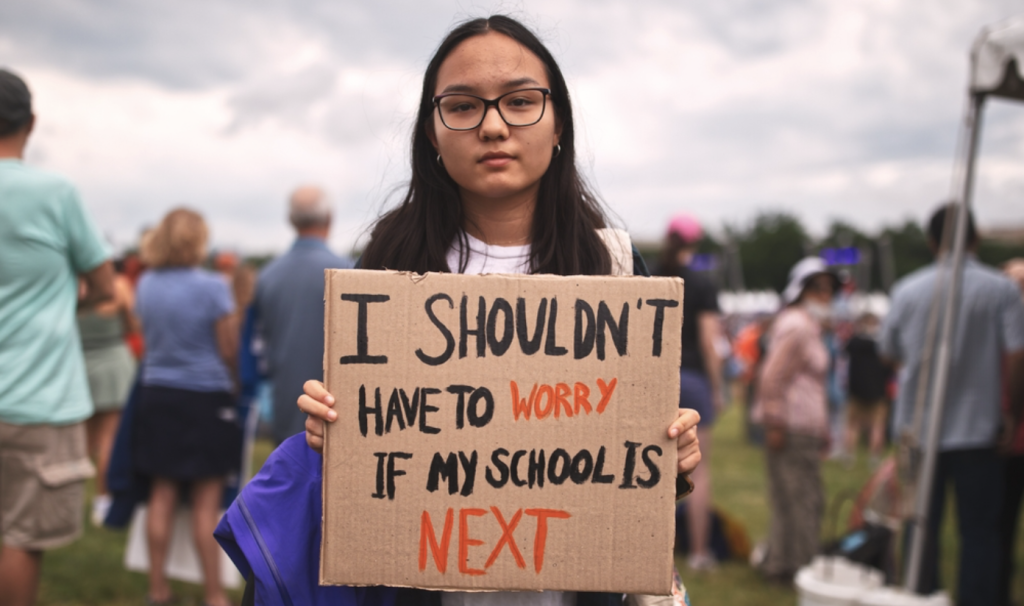
Our nation’s total disregard for gun control is mass-producing young adults with PTSD: children who survived shootings at their schools in elementary, middle, and high school are now having to contend with shootings on their college campuses.
Seven years ago, Zoe Weissman survived the massacre in Parkland, Florida that killed 17 people and injured 18 others at Marjory Stoneman Douglas High School. She was a 12-year-old student at West Glades Middle School, which feeds into Marjory Stoneman Douglas just 1,000 feet away and has an outdoor campus. Weissman was working on a project with friends outdoors when the shooting started, she said in a first-person narrative in New York Magazine. Just beyond their teacher’s line of sight and hearing no alarm, she and her friends were locked out of the building as they heard bullets fire off in quick succession followed by screams. They found refuge, helped by a security guard at the middle school who heard them. Though she escaped physical harm, having been exposed to the shooting, Weissman developed PTSD.
“Over the past seven years, I have done a lot of work to get myself to a place where I can function normally, but it has changed my life,” Weissman said. Part of that includes working for change as an activist for gun-violence prevention. Still, she finds herself scanning public spaces for swift exit paths upon, her senses constantly on alert, afraid of sudden noises and people walking up behind her.
Now a sophomore at Brown University, her dream school, Weissman says she began to let her guard down a bit. “I felt really safe on campus…It helped that Rhode Island has good gun laws on the books and some of the lowest rates of gun violence in the country…On paper, it was perfect for me” – until last weekend, when a gunman fired throughout the university’s School of Engineering, killing two people and injuring nine others.
She figured out there was a shooting when a friend kept trying to call her. Here’s how she experienced it:
I was in my dorm, thinking of going to a library when I got a call from my friend. I was on the phone with someone else, so I messaged her, “Can you text?” Instead she just kept calling me. I thought, That’s not good. When I answered, she asked me if I was at Barus & Holley. She sounded like she was crying. I told her, “I’m in my dorm. Was there a shooting?
Being in her dorm at the time, a five-minute walk from the building where the shooting occurred, Weissman was able to calm her body. Still, she’s angry that her university schoolmates have now joined the growing number of young people navigating the mental and emotional trauma of a crisis that our lawmakers refuse to address – and that she lives “in a country where this happens basically every day.”
“In America, a school shooting is the most rational explanation for if someone calls you crying and asks what building you’re in,” she said.
The ripple effect of mass shootings
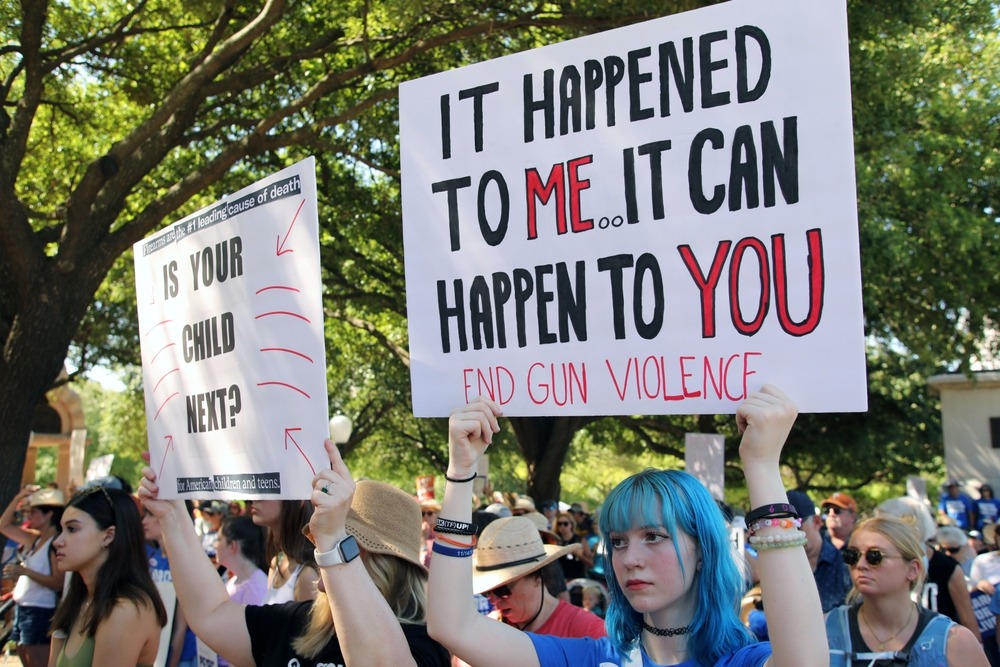
Austin, TX, USA – June 11, 2022: A young female student victim of a school shooting attends a rally protesting the Uvalde shooting and gun laws outside the capitol/Vic Hinterlang.
In The Atlantic, emergency room physician and firearm injury prevention researcher Megan Ranney reflected on the Brown University shooting in a haunting first-person piece called “First We Grieve.”
Although she has trained herself, when confronted with horror, to use data for “actionable hope,” she says the December 13 shooting at Brown has been “remarkably difficult for me to navigate. I know the Brown community intimately, having spent most of my career there. The people who were present are not abstractions. They are my friends, my mentees, my former students, my friends’ kids. The first responders, doctors and nurses were my longtime colleagues. I am heartbroken, in a particularly personal way.”
The effects of mass shootings, Ranney says, “ripple out in concentric circles. So we must hold space for those who were present in the classroom, but not shot; for those who were in the building, or an adjacent one; for those who were elsewhere on campus, or who were in close-by buildings, and who remained on lockdown for hours; for the family and friends of faculty, students, and staff; for the first responders, law-enforcement officers, doctors, nurses, and techs, each of whom had to witness the unthinkable. And we must also think of the professors and staff and elected officials who had hoped to never have to confront the unthinkable.
“These groups are all more likely to experience PTSD, depression, anxiety, increased rates of substance use, and headaches than they were before Saturday’s shooting.
“And we must grieve for those present Saturday who had previously been exposed to this American rite of passage – whether at another university or a high school, a place of worship in their hometown, at a bar or festival or theater. According to a recent survey, more than half of American adults have an immediate family member who has been threatened with a gun, has been shot, or has been present at a shooting.”
“…. I take inspiration from my colleague Nelba Marquez-Greene, mother of a child killed at Sandy Hook. By neither retreating into anger nor giving up in sadness, she writes, this work ‘is hope.’”
What Is Trump Derangement Syndrome?
It may sound like a new psychological diagnosis for someone who is out of touch with reality, but it’s not – it’s a term Donald Trump and his allies are using to deride his opponents.
The term finds its roots in the presidency of George W. Bush, when conservative columnist Charles Krauthammer claimed in 2003 that Bush’s opponents were repelled by him not for rational reasons – such as the enormous loss of life in his administration’s deadly, wrong-headed war on Iraq – but because of “Bush Derangement Syndrome,” which Krauthammer defined as “the acute onset of paranoia in otherwise normal people in reaction to the policies, the presidency – nay – the very existence of George W. Bush.”
In a similar vein, Trump’s use of the term asserts that people who oppose immoral policies – from ICE secret police and mass deportation to tearing down the West Wing of the White House – have been driven insane by his presidency.
However, critics say that however repellent Trump’s policies are, it is the president himself who is suffering from immense cognitive decline, amounting to derangement. This came up most recently when Trump commented on the death of beloved Hollywood director Rob Reiner, accusing him of having had Trump Derangement Syndrome, and that making him somehow responsible for his own brutal killing – comments condemned on both sides of the aisle.
Trump’s abnormal, hateful language and behavior is grave cause for concern, according to psychologist and former Johns Hopkins professor and psychologist John Gartner, whom we interviewed this April about Trump’s apparent dementia and psychopathology. “We really have reason to be utterly terrified,” he told BTL Online, a weekly radio newsmagazine, commenting on Trump’s Reiner comments, his racist attacks on Somalians and other actions. “This really is kind of the worst case scenario. We have a mad king, but a mad king with dementia, the absolute power to destroy the world and kind of the temperament to do it. We’re seeing now because of the dementia and because he has so much power, the combination of the two is he’s acting out in all of these incredibly destructive ways.” – Diana Hembree
Why “use your words” is good advice – for kids and grown-ups
If you’ve ever told a frustrated child “use your words,” I bring you some great news! Writing or speaking one’s feelings is a research-backed tool for better mental health in the short and long term. In his column on the practice for Scientific American, psychologist J. David Creswell recalls how just telling his young children, who were fighting over a stuffed animal, to use their words forced them – and him – to pause, giving everyone a moment to think about their emotions.
Using our words has real neurological effects. Naming our emotions – known scientifically as affect labelling – triggers regulatory circuits in the brain’s prefrontal cortex and can reduce the intensity of emotional reactions. Decades of research point to the mental and physical health benefits of “expressive disclosure,” when we verbalize emotions, helping anything from immune function to arthritis.
In the longer term, recalling difficult memories allows us to reconsolidate them – to add meaning and context to heavy feelings, and to reflect on whatever resolution we found. Repeating the process regularly lowers the stress associated with painful memories, making them easier to hold.
“Sometimes, as research shows, the words we choose to describe our lives can shape our mental health for months and years to come,” Creswell writes. Research has found that talk therapy helps so much in part because it offers people a space to not only speak about their experiences, but to recognize and name themselves as active agents in their lives – revealing our autonomy to make things happen.
Though research has mostly focused on adults, more recent work outlines how the principles might also be helpful for children, helping them square their emotional world with their daily routine. Note, however, there’s a sweet spot for how long anyone should spend putting words to feelings: at least 15 minutes. Shorter sessions aren’t as effective and can sometimes make things worse. It’s also good to group reflections close together – reflecting more than twice a week seems to be better than waiting. But the medium doesn’t matter so much – not everyone can or wants to write for 15 minutes a day; young children especially might want to draw; and you can’t go wrong with old-fashioned conversation.
A restaurant’s adopted grandfather and the life-saving power of connection
Retired Air Force veteran Charles Hicks, 78, visited his local Shrimp Basket in Pensacola, Florida every day for 10 years – always ordering a cup of gumbo, staying to watch baseball and chat. Until one day, he didn’t. When restaurant workers called him, they learned he was sick, and delivered some gumbo to his door. But, calling again a couple of days later, they received no answer. The phone went straight to voicemail. “I just grabbed my keys and walked out,” chef Donell Stallworth told The Washington Post. Stallworth had become close with Hicks over the years. “He grew on me, and I grew on him.”
When he got to Hicks’ apartment, Stallworth found Hicks on the floor with two broken ribs and severe dehydration; he hadn’t been able to get up after a fall. “I don’t know what would have happened if Donell hadn’t showed up,” Hicks said. After he spent roughly two months recovering in hospital and rehab, with frequent, delicious visits from the staff of the Shrimp Basket, the restaurant recently awarded Hicks free gumbo for life. Staff at his branch even helped him secure a new, affordable apartment within walking distance of the restaurant, and helped renovate the new place, working with his niece to move his belongings.
Connections like these are important, but troublingly rare. In a recent American Psychological Association poll, 54% of US adults said they felt isolated often or some of the time, and a recently accepted study found a causal link between social isolation and cognitive decline in US adults, based on data from more than 30,000 people between 2004 and 2018.
Hicks remains surprised by all the fanfare. “It’s not like I found the cure for cancer or something,” he said. “I just fell in my apartment.” But Casey Corbin, general manager of the Pensacola Shrimp Basket, said he’s like the restaurant’s adopted grandpa, a VIP among VIPs, so to speak. Besides, Corbin said, “people matter,” and she hopes Hicks’ story will help people look out for one another.
In other news…
911 callers in Phoenix now asked if they need mental health help: This week kicked off a change for dispatchers in Phoenix, Arizona. On December 15, they began asking callers if they need “police, fire, or behavioral health.” Calls that don’t also require police or fire are then transferred to a special dispatcher at the fire department, who’ll send a team from the city’s Community Assistance Program, which has mental health and crisis response units. “This new option to request behavioral health help during a moment of crisis will help make Phoenix a safer community,” Mayor Kate Gallego said in a statement. “This will help 911 dispatchers send the right people with the right training when it matters most.”
Respect for young people’s pronouns might make suicide less likely: Data from The Trevor Project’s latest research brief – Pronoun Usage and Mental Health Impacts of Pronoun Respect in Transgender and Nonbinary Young People – documents the range or pronouns young people (ages 13-24) use, as well as how usage might affect them.
Young people surveyed by the Trevor Project whose pronouns were binary, such as he/him or she/her, were more likely to have their pronouns respected (62%) than their peers using nonbinary pronouns – they/them. But the majority of trans and nonbinary youth (68%) use nonbinary pronouns either partially or exclusively, according to the Trevor research brief. Fewer than half of young people surveyed (46%) said their pronoun choice was respected by most or all people in their life – and they reported lower rates of suicide attempts in the past year – 11%, compared to 17% for those reporting their pronouns weren’t respected.
After controlling for relevant factors, pronoun respect was associated with 31% lower odds of a past-year attempt, and suicide attempt rates improved with the level of respect – ie, from ‘None of the people I know’, to ‘A few’, up to ‘All or most of the people I know.’
The findings underscore the difference small, daily recognition can make for TGNB youth. If caregivers, educators, peers, and others honor a person’s pronouns, even when they’re unfamiliar, they can help support the sound mental health of TGNB youth by making them feel seen, safe, and respected.
Mental health can't wait.
America is in a mental health crisis — but too often, the media overlooks this urgent issue. MindSite News is different. We’re the only national newsroom dedicated exclusively to mental health journalism, exposing systemic failures and spotlighting lifesaving solutions. And as a nonprofit, we depend on reader support to stay independent and focused on the truth.

It takes less than one minute to make a difference. No amount is too small.
The name “MindSite News” is used with the express permission of Mindsight Institute, an educational organization offering online learning and in-person workshops in the field of mental health and wellbeing. MindSite News and Mindsight Institute are separate, unaffiliated entities that are aligned in making science accessible and promoting mental health globally.

Author

Related Articles
The News From Minneapolis That Makes It Hard To Breathe
Minneapolis residents are reeling after the January 7 killing of Renee Nicole Good by a masked ICE agent.

Care for Dogs While Their People Are in Recovery
Pawsitive Recovery is a Denver-based program that places pets with foster caregivers while their guardians recover from mental health problems.