
Years After an Infamous Death, a Pennsylvania Jail Ups Use of Restraint Chairs
Prisoners with mental illness are most commonly subjected to use of these devices, which the United Nations calls a form of torture.
This story was reported and first published by The Appeal, a nonprofit news organization that investigates the criminal- legal system and efforts to transform it.
On April 7, 2018, Everett Palmer, Jr. was picked up on an old DUI charge and booked into Pennsylvania’s York County Prison (YCP).
Over the next two days, Palmer’s mental health deteriorated, much of which was captured on surveillance video, according to a report by the York County Investigating Grand Jury. He was hallucinating and screaming. He repeatedly put his blanket in the toilet and wrapped himself in it.
In the early morning hours of April 9, Palmer began to slam his head and fists into the cell door, according to the Grand Jury’s report. A unit supervisor tased him twice and correctional officers stormed his cell. They tackled him and placed a spit hood over his head.
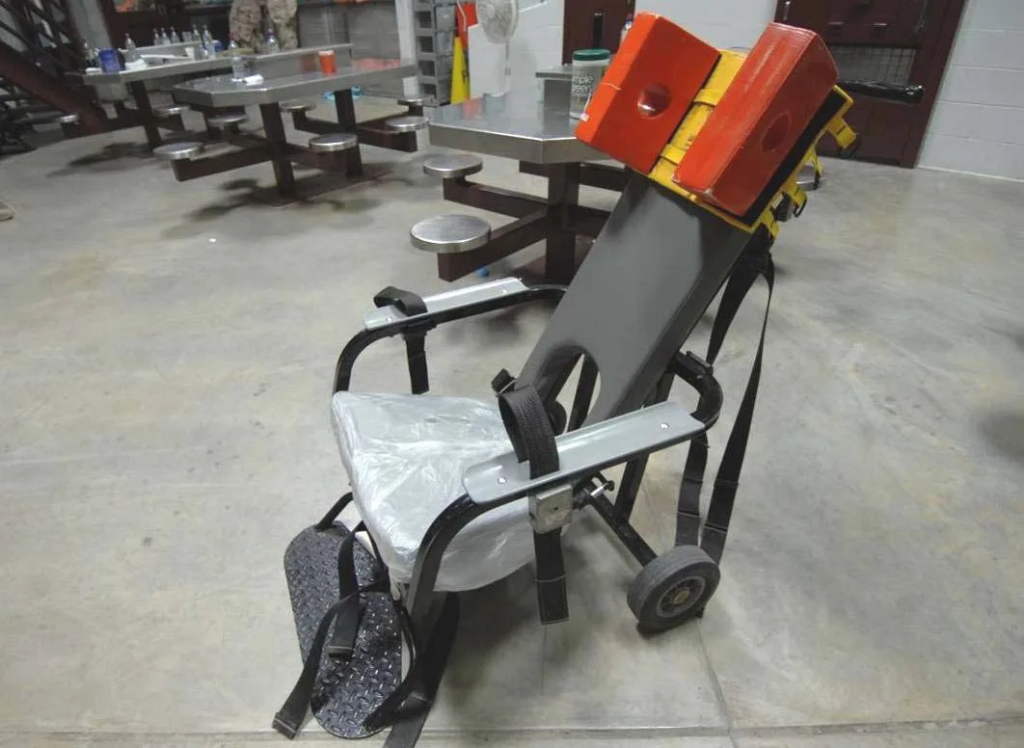
Five officers carried him out of the cell and strapped him into a restraint chair. He was breathing heavily and appeared to be gasping for breath, according to the report. While he was still in the restraint chair, the guards took him to the medical unit. An ambulance was called and he was declared dead at the hospital. Palmer, an Army veteran, was 41 years old.
In the wake of his death, local and national reporters wrote about the harrowing last days of Palmer’s life. The U.S. Attorney’s Office for the Middle District of Pennsylvania opened an investigation into his case, but no charges were filed by local or federal prosecutors.
In the years since his death, York County has ramped up its use of restraint chairs. In 2018, the restraint chair was used a total of 148 times. Six years later, in 2024, the restraint chair was used 191 times—an increase of almost 30 percent—even though the population of the jail was about half of what it had been in 2018, according to The Appeal’s analysis of county data from 2018 to 2024. (The data for 2025 has not yet been published.)
As required by state law, counties report data on use-of-force incidents, including use of restraints, each month to the state Department of Corrections, but the data is not validated by outside sources.
According to The Appeal’s analysis, from 2018 through 2024, York County used restraint chairs a total of 1,295 times—more than any other county in the state.
Most people detained at YCP are awaiting trial and presumed innocent. Others are serving short sentences or waiting to be transferred to a state prison. YCP is one of the largest jails in the state, with an average daily population of about 1,000 people. However, several of Pennsylvania’s most populous jails did not use restraint chairs at all from 2018 to 2024. The Delaware County jail, which had a monthly population of about 1,200, and Philadelphia’s Curran-Fromhold Correctional Facility, which had a monthly population of about 2,200, reported zero uses of the restraint chair.
The Appeal also found:
- York County’s use of restraint chairs peaked in 2023. That year they were used 224 times, making up almost 20 percent of all uses statewide.
- In each year from 2021–2024, York County used restraint chairs more times than any other county in the state.
- For each year studied, approximately twenty jails, or about 30 percent of the state’s jails, reported zero uses of restraint chairs.
The Appeal shared its data analysis with York County’s interim warden, commissioners, sheriff, controller, and District Attorney, all of whom are members of the York County Prison Board, and asked if they are considering a ban on restraint chairs. They did not respond by the time of publication.
Restraint Chair Use as a Form of Torture
For decades, human rights organizations have condemned restraint chairs as a form of torture. More than twenty-five years ago, the United Nations Committee Against Torture called for the abolition of restraint chairs, concluding that their use ”almost invariably leads to breaches” of the international treaty against torture.
Some prison and jail officials have confined people to restraint chairs for hours or days at a time, with their legs, arms, and chest strapped down, sometimes with a mesh bag called a spit hood, placed over their head. Restraint chairs have been used on people with mental illness and children as young as 14. One company advertises that its chairs “have been used with people as small as 45 lbs.”
Noah Barth, the Prison Monitoring Director at the Pennsylvania Prison Society, told The Appeal that restraint chairs are disproportionately used on people in the midst of a mental health crisis. Recently, while on a tour of a county jail he says he saw a restraint chair in a housing unit for people with “serious mental health diagnoses.”
“The share of people in jails with serious mental health diagnoses is disproportionately high due to a lack of other resources and structures to support them in the community,” Barth said. “Officers are not equipped or trained to provide the right kind of therapeutic interventions, and so what we see is in some localities, they disproportionately fall back on overly physical measures such as restraint chairs.”
Restraint chairs have been linked to numerous deaths, although an exact figure is unknown. According to a nationwide KMBC 9 News investigation published last year, at least 54 people died between 2014 and 2024 after they were placed in restraint chairs or other full-body restraints.
In York County alone, at least two people died during the past ten years shortly after they were confined to restraint chairs in YCP—Everett Palmer and Haywood Dixon. Just a few months after Dixon’s death, York County settled a suit with Palmer’s family for $1.5 million dollars.
Dixon was booked into YCP in July of 2023. He repeatedly told guards that he felt ill, according to a complaint filed by Dixon’s mother last year. The lawsuit alleges that when Dixon was unable to comply with the officers’ demands to remove his shoes, telling them that he felt sick and couldn’t bend down, the guards tased and shackled him, placed a spit hood over his head, and forced him into a restraint chair.
While in the restraint chair, the guards cut off his clothes. At some point they removed him from the restraint chair and left him in a cell, naked, according to the complaint. A couple hours later, he was dead.
The lawsuit filed by Dixon’s family says that YCP failed to implement any of the 24 recommendations made by the grand jury that investigated Palmer’s death several years earlier. The grand jury didn’t call for a ban on restraint chairs, but they urged the jail to adopt policies aimed at preventing similar deaths in the future, like using a negotiator during cell extractions, limits on the use of tasers, and the presence of medical staff during cell extractions.
While many jails do not use restraint chairs, Allegheny County voters made history in 2021 when they passed a referendum that ushered in several reforms, including bans on restraint chairs and solitary confinement. Prior to the ban, from 2018 to 2020, Allegheny County used restraint chairs more times than any other county, topping out at about 340 times in 2019, according to The Appeal’s analysis. York County has had the top spot since 2021.
“It was important to get the restraint chair in the referendum because we’ve seen firsthand what our clients have gone through,” Tanisha Long, the Allegheny County community organizer for the Abolitionist Law Center, told The Appeal. “We have stories of people who have defecated on themselves, thrown up on themselves, been denied access to toilets, food, water.”
The correctional officers union has filed suit to overturn the referendum; the case is pending before the state Supreme Court.
“There’s no identifiable physical or mental health benefit to using restraint chairs,” Long said. “Restraint chairs are sadistic.”
Mental health can't wait.
America is in a mental health crisis — but too often, the media overlooks this urgent issue. MindSite News is different. We’re the only national newsroom dedicated exclusively to mental health journalism, exposing systemic failures and spotlighting lifesaving solutions. And as a nonprofit, we depend on reader support to stay independent and focused on the truth.

It takes less than one minute to make a difference. No amount is too small.
The name “MindSite News” is used with the express permission of Mindsight Institute, an educational organization offering online learning and in-person workshops in the field of mental health and wellbeing. MindSite News and Mindsight Institute are separate, unaffiliated entities that are aligned in making science accessible and promoting mental health globally.


Author

Related Articles

When Insurance Says No, Children Pay the Price
A proposed California law would force insurers to publicly disclose how often they deny care.

How Minecraft Therapy Is Transforming Child and Teen Mental Health Care
Two leading practitioners discuss how they do individual and group therapy that children want to take part in, using Minecraft, the most popular video game in the world. A MindSite News webinar.

Homeless Camp Sweeps Can Harm Health. Some Cities Are Trying a New Way
Several cities and counties are addressing street homelessness with a new approach, which experts say can clear encampments while protecting the health of people who are forced to move.
