Antidepressants During Pregnancy Don’t Cause Autism or ADHD, Study Finds
Researchers studying antidepressant use during pregnancy found the risk of autism went away when they controlled for underlying conditions.
Greetings, MindSite News readers.
In today’s Daily, untreated depression during pregnancy can carry severe risks, but now mothers can let go of one concern — a new study finds evidence that antidepressant use during pregnancy does not adversely affect fetal neurodevelopment. The U.S. makes only slight progress in maternal mental health this year. And California lawmakers lobby for legislation to cover the cost of therapy for youth survivors of gun violence.
But first, a love letter to aging women. Rock on.
New evidence that antidepressant use during pregnancy is not linked to autism

One of the more surprising findings in a major new study on prenatal antidepressant use had nothing to do with mothers at all. Children were more likely to be diagnosed with autism or attention-deficit/hyperactivity disorder when their fathers took antidepressants during gestation — even when their mothers took nothing.
That detail, which the researchers discussed with the Los Angeles Times, confirms that antidepressant use during pregnancy does not appear to impact a child’s neurodevelopment.
If the father’s medication use also increases the child’s likelihood to have those conditions, then the medication isn’t the story. Instead, genetic factors seem most likely.
Published this month in The Lancet, researchers at the University of Hong Kong reviewed 37 separate studies involving 25 million pregnancies. They found that, while children born to mothers who took antidepressants did show higher rates of autism and ADHD diagnoses, the association disappeared once researchers accounted for family histories of neurodevelopmental conditions and mothers’ preexisting mental health.
“Our findings do not provide strong evidence that prenatal antidepressant exposure causes neurodevelopmental disorders,” said Dr. Wing-Chung Chang, the paper’s senior author and a psychiatry professor at the University of Hong Kong.
Dr. Kathryn Erickson-Ridout, a senior psychiatrist at Permanente Medical Group and research scientist with the Kaiser Permanente Division of Research, made the results even more plain: “While there does, at face value, appear to be an association of slightly increased risk of autism in mothers who take antidepressant medications,” she said, “when you control for the underlying depressive disorder that risk goes away.”
Most young survivors of gun violence never get therapy. California wants to change that.
On what should have been an ordinary teenage sleepover with friends, 16-year-old Jazelle Eastman’s life changed in an instant. A boy she’d invited believing he was her friend shot her in the face.
Two years later, she’s still working through the trauma. “PTSD is so real,” she told CalMatters. “I feel like I’m always looking over my shoulder.”
Though the incident remains excruciating for Eastman to discuss, she’s able to do so because a social worker connected her to a counselor during her hospital stay — help she says she never would have sought on her own. “Talking to someone made it a lot better,” she said.
Swift access to counseling made a difference for Eastman, but it’s far from a common experience for most youth survivors of gun violence. Only 37% of children received mental health care within six months after a firearm injury, according to 2023 data from the American Academy of Pediatrics.
Others receive no help at all. They languish on waitlists, their families distrust the health system or lack insurance, without which they simply can’t afford care.
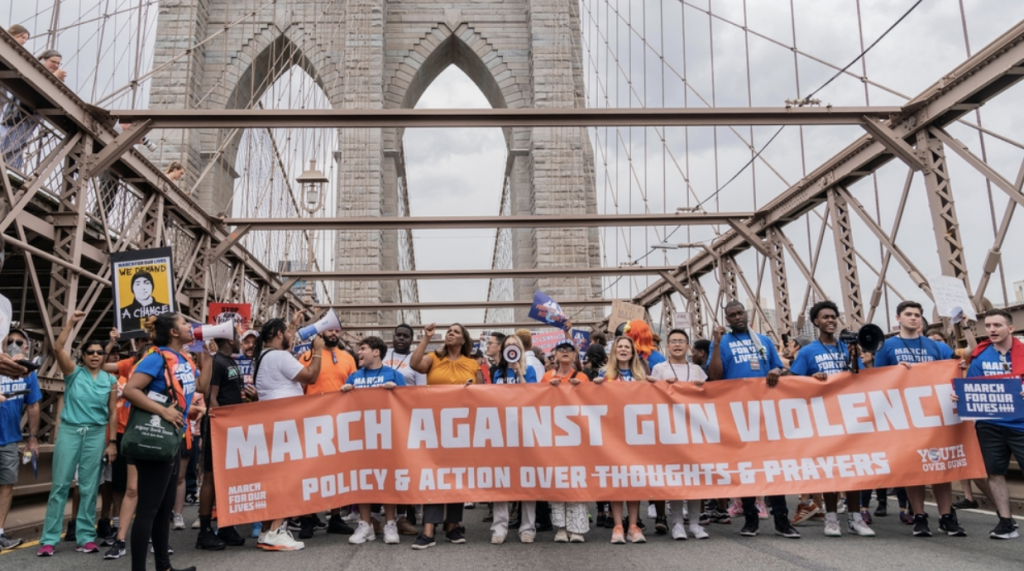
Lawmakers in California are determined to change that. Grappling with a staggering 2,000 youth aged 25 and younger impacted by gun violence in California each year since 2016, Democratic Assemblymember Sade Elhawary introduced Assembly Bill 2247.
If passed, it would require counties to provide free mental health and counseling services to youth survivors — whether they were shot, witnessed a shooting or lost someone to it — up to age 25, regardless of insurance status. The bill would launch a pilot program in four counties: Alameda, Los Angeles, San Bernardino, and Solano.
Youth Alive!, the Bay Area nonprofit that helped Eastman, models what wraparound care can look like: connecting survivors to counselors before they even leave the hospital and bringing therapy directly into their homes.
Their waitlist, however, is always full, underscoring the need for a larger architecture of support. Assembly Bill 2247 passed in the California Assembly this week and is now headed to the Senate, although Elhawary’s office is still working to secure funding to make its goals a reality.
This will be especially helpful to Black and Latino youth, who face the sharpest disparities — both in experiencing harm and accessing follow-up support. According to state data, 78% of California youth killed or hospitalized due to firearm injuries between 2016 and 2024 were Black or Hispanic.
Tinisch Hollins, executive director of Californians for Safety and Justice, an advocacy nonprofit sponsoring the bill, said too many families have been forced to “give up on the process” when navigating an inaccessible system.
In other news…
The U.S. earned a C in maternal mental health this year…and that’s the good news: Each year, roughly one in five mothers in the U.S. experience a maternal mental health condition like postpartum depression. Most never get the help they need — and that gap costs the country an estimated $14.2 billion annually.
But what’s the status across individual states? According to the 2026 Maternal Mental Health State Report Cards, released by the Policy Center for Maternal Mental Health in partnership with George Washington University’s Milken Institute of Public Health, states have marginally improved but are nowhere near good enough. On average, the nation made minute progress, rising from a C- in 2025 to a C in 2026.
No states failed this year (two, Mississippi and Alabama, failed in 2025, and both received Ds this year), and ten earned B grades. But no state earned an A, and the picture gets more grim when you look at paid leave and childcare. On that measure, included in this year’s report card for the first time, the U.S. scored the equivalent of an F, with 31 states earning less than one star out of five.
“While we applaud the progress states are making, the U.S. is providing mediocre maternal mental health care at best,” said Joy Burkhard, CEO of the Policy Center for Maternal Mental Health. There’s still a long way to go.
We’re all overwhelmed; joining in community is our only hope: In Detroit, where I live, “teen takeovers” in which adolescents gather in swarms to wreak havoc are becoming popular. Just a week ago, a 14-year-old boy at one such gathering was nearly killed, spared because the bullet that hit his chest missed his heart by millimeters. The incidents have sparked many adults to call for stricter curfews and harsher police enforcement.
I’m still in the camp that feels like kids are seriously bored — and totally unsure of how to help them in this post-pandemic, digital device-dominated timeline. In a recent op-ed published by the Milwaukee Journal Sentinel, Milwaukee parent, MPS Parent Coordinator and youth purpose and mindset coach Rubie Mizell isn’t mincing words about what the similarities she’s seeing in her hometown. Children are in crisis — and the adults around them feel lost about what to do.
“Parents are trying to navigate addiction, mental health crises, peer pressure, violence, and emotional instability while often lacking resources, support, and guidance themselves,” Mizell writes. For her, this isn’t a failure unique to any one household. Such conversations, she says, are becoming more common throughout Milwaukee, as they are in Detroit.
But reaching beyond the obvious difficulties, Mizell names something nefarious that many are reluctant to say out loud: A number of adults actively exploit vulnerable youth, introducing them to drugs, crime and environments that lead to trafficking and violence. With that revelation, she makes a fervent call to action.
“This is not just a parenting issue. This is not just a school issue. This is not just a police issue. This is a community issue,” Mizells says. There are enough organizations and nonprofits in place to get the work done, she argues, but as members of the same community, we’ve got to be willing to use them.
Stricter curfews and greater police presence isn’t the answer, but rather collaboration between schools, churches, nonprofits, law enforcement, mental health professionals, parents and community leaders. Glory, funding and credit can be shared, rather than disputed, if everyone gathers together to do the work of saving lives.
The name “MindSite News” is used with the express permission of Mindsight Institute, an educational organization offering online learning and in-person workshops in the field of mental health and wellbeing. MindSite News and Mindsight Institute are separate, unaffiliated entities that are aligned in making science accessible and promoting mental health globally.

Author

Related Articles

Chicago Launches its First Psychiatric Street Team
Meet Chicago’s first Street Psychiatrist, a student of the street medicine pioneer Jim Withers. Plus, a look at the American Penal Press Contest.

Trump’s Student Loan Changes Cause Anxiety and Panic
Borrowers face rising payments under the Trump administration’s student loan changes. Plus: teaching emotional literacy to teen girls, and why the new CDC youth mental health report is facing criticism.
Rumors of Kids Quitting College En Masse Are Exaggerated
This week: what the data says about Gen Z students quitting college, and why postpartum mental illness is more than depression.