
How to Move a Prison: Former Prisoners Give Their Tips on Avoiding a “Sh*t Show”
As Illinois plans to move Logan Correctional Center, women who’ve been inside offer their thoughts on the least harmful solution.
Nine years, nine months and 21 days — that’s how long Ana Navarro was detained at the notorious Logan Correctional Center in Southern Illinois.
When she looks back, nothing was quite as dehumanizing as her move there from Dwight Correctional Center when it closed in early 2013. Now, a free woman living on the other side of the walls, she fears the “shit show” — when she spent months without soap, deodorant and toothpaste — is about to repeat for the women still inside. That’s because the Illinois Department of Corrections plans to close Logan and open two new prisons outside Chicago.
“They made us pack up our stuff, made us strip search in front of everybody where men and women can see you. They put us on a bus, handcuffed us. We were there for hours. They wouldn’t let us use the bathroom. They didn’t give us nothing to eat and when they did it was moldy bologna,” she told MindSite News. “When we got to Logan they acted like they didn’t know we were going to arrive. It sounded like a really bad custody battle, where one parent dropped off the kids at the other parent’s house without warning and the other parent was mad, then didn’t know what to do with us.”
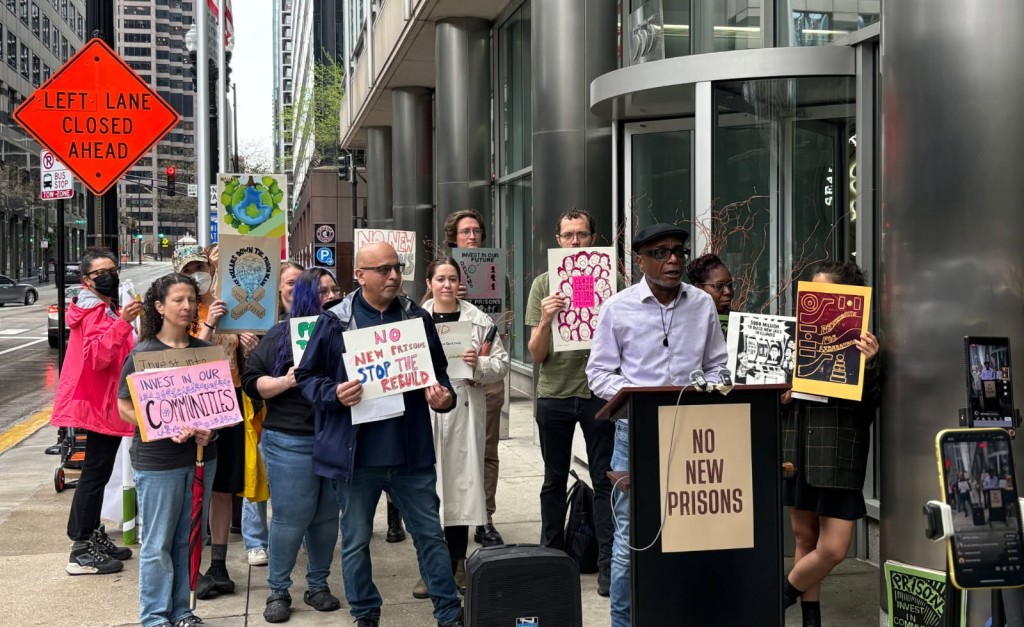
Navarro is one of many previously incarcerated individuals and prison abolitionists who formed No New Prisons Illinois, which has spent the last year opposing the move on the grounds that building more prisons is inhumane, transferring prisoners is cruel and the nearly billion-dollar price tag is too high. The funds should go towards life-affirming things like childcare, healthcare and community centers that keep people out of prison, instead of building more prisons, they argue.
She and her fellow abolitionists are part of a national movement to get rid of prisons and replace them with a system of education and rehabilitation – a campaign that grew out of the civil rights struggles in the 1960s. Leaders such as Angela Davis linked the roots of the U.S. prison system to slavery and racism, including the notorious “chain gangs” of the South during the post-Civil War era in which unemployed Black males were arrested for “vagrancy,” imprisoned and forced to do backbreaking work on roads or in the fields, often working for their former enslavers. Although convict “leasing” was outlawed in 1923, highway chain gangs persisted in some places until 1996, and some prisons today are sending prison volunteers to fight wildfires or do other work for low pay. In California, prisoners were paid about $1 an hour until they began receiving minimum wage in 2025.
On the other side is the prison reform movement, which cycles between rehabilitation and working to improve prison conditions to dealing with conservative backlash, which has led some prisons to cut out classes designed to prepare prisoners for life outside.The U.S. continues to lead all industrialized countries in incarceration rates and imposes long sentences far more than any other country.
Despite opposition, the Illinois Department of Corrections is moving forward with the $900 million plan to build the two new prisons – one for men and one for women – in a suburban community southwest of Chicago.
“These investments will allow staff to work in modern and safe facilities, ensure those who are incarcerated can safely serve out their sentences, and save taxpayers hundreds of millions in deferred maintenance costs from years of neglect,” Governor JB Pritzker said in a press release announcing the facility.
Deferred Maintenance
The Illinois Department of Corrections has $2.5 billion in deferred maintenance costs, according to a master plan commissioned by the department.
Logan, which opened in the 1870s as the Illinois Asylum for Feeble-Minded Children, has an aging coal-fired power system, moldy housing units, and is on the verge of becoming “inoperable.” It is “inefficient, ineffective and unsuitable for any population,” according to the report, which recommended opening a new facility in a new location.
“The issue for the female population is not the quantity of the beds, but the quality of beds and facilities, especially as it relates to Logan Correctional Center,” according to the report.
The report found a need for more mental health treatment and staff across the state. The facilities weren’t built to handle the current mental health caseload or provide treatment. As a result, x-ray and exam rooms are often used as mental health offices.It also observed that the corrections department needed to improve and expand spaces for mental health, medical care and other programs, and improve housing and services for older prisoners and women.
A new mission
For years, prison officials across the country looking to reduce recidivism and make life better for staff and prisoners have looked to Norway and Sweden, the countries considered to have the most humane and effective prisons in the world. In those places, offenders are treated with humanity and granted rights and privileges rarely seen in American prisons.
In Chester, Pennsylvania, outside Philadelphia, prisoners at the “Little Scandinavia” prison can enjoy a fish tank with African cichlids, tetras and an angelfish located just inside its entrance. Modular furniture makes it easier to have conversations and meetings. Residents can even cook food they order in a community kitchen. Corrections officers have been renamed “contact staff” and retrained to support residents preparing for life after prison.
The Illinois initiative’s aim is to reimagine the future of correctional settings by expanding vocational training and creating therapeutic environments that support safer communities and lower recidivism, part of the vision of the Scandinavian model.
While the Norway prison model is a good one, it’s hard to imagine that model in the United States because of the societal differences, said Dr. Chez Rumpf, a University of Illinois Chicago gender studies researcher who studies gender-based violence and women’s incarceration as well as post-incarceration experiences.
“Norway has a social welfare state. Norway has a lot of resources and community-based supports that don’t exist here in this country, especially now with the current administration and the rolling back of benefits like SNAP and housing,” said Rumpf, who favors prison abolition. “That model isn’t a prison alone, it’s related to a whole society that has very different resources, structures and systems in place, as well as ideologies, that frankly we do not have here in the US. I don’t think it works to just import a ‘nicer prison model’ from a country that’s wildly different.”
Rumpf rejected the idea that the Stateville rebuild could be “modernized” and gender responsive as advertised. Instead, it serves as a distraction from the major problem — that prisons are inherently punitive and not rehabilitative, she said.
“That’s not going to change because there are lighter colors, soothing color palettes and more natural light,” she said. “This is like the new fad in prisons. It’s just a rebranding. It’s still prison. It’s still punishment. It’s still separating people from their families. It’s still severing relationships. It’s still stripping people of their freedom. It’s still restricting bodily autonomy. All of those things are antithetical to being trauma-informed.”
The John Howard Association is an independent nonpartisan prison oversight agency that monitors the treatment of those detained by collecting concerns people send them, conducting surveys and visiting prisons. The best use of resources would be shutting down the oldest, most decrepit prisons before building any more, said Jennifer Vollen-Katz, executive director of the John Howard Association.
“We are not proponents of prisons or expanding the carceral footprint. However, because we’re people who are inside all the prisons in the state of Illinois with some frequency, we’re well aware of the conditions people are living in and working in,” she told MindSite News.

“One thing we can do is reduce our carceral footprint and close prisons. However, to the extent that prisons will still exist and we will still need some of them, whether we agree with the policies that drive that or not, we do think there are benefits to facilities being new and safe and humane.”
While prisons are traumatic places that usually exacerbate any mental health conditions, creating facilities cognizant of the mental health needs of prisons such as space for programming and access to the outdoors and sunlight have to be better than current conditions. But, there’s no guarantee that some or all of those positive attributes will be included in the final design, said Vollen-Katz.
Another benefit of the move being touted is that the new location is closer to Chicago and the northern part of the state, where the detainees should have access to better programming and more community resources, she said.
While detainees from the Chicagoland area may benefit from being closer to their family, women from southern Illinois will be pushed further from theirs, meaning less connection and visits, said Monica Cosby, another member of No New Prisons Illinois who was released from Logan in 2015.
Since her release, it’s been hard to mentally balance her push to end all prisons with the realistic needs of those incarcerated, she said.
“I have people that are locked up and are like ‘well, at least we’re closer to our families.’ I understand that because I was there for 20 years so I know what it’s like to not be able to see anybody,” she told MindSite News. “While there is a feeling of a little bit of relief at being closer to their families, for the people that were closer to their family, you remove them from theirs.”
A call for clear communication
When then-prisoner Monica Cosby arrived at Logan after being transferred from Dwight, she was warned the officers didn’t want them there and were angry about the transfer. Since she only had two-and-a-half years left on her sentence, she was told to keep her head down and focus on getting home.
She remembers some people never received their property after the transfer. Others found theirs sitting in puddles of urine. Mattresses were cut up. Feces were on the walls, she said.
“I probably got called a bitch more times in the first 30 days or so at Logan than I had in almost my entire stay prior,” she said.
From the outside, Navarro and Cosby have worked with detainees who were previously transferred to create the Logan Transfer Rapid Response plan, which was designed to ensure none of the horrible things that happened during their transfer reoccur.
It calls for clear communication around the closure of Logan to the incarcerated, their families and their legal team. It also asks for detainees to be ensured uninterrupted access to the same programming and that mental health professionals are made available during the process. It calls for the John Howard Association to monitor the transfer and to ensure all property arrives with the detainees.
“It’s not going to mitigate all the harm, but it can mitigate a hell of a lot of it. It doesn’t have to be as traumatic as it’s going to be,” Cosby said. “Since IDOC is committed to doing this, they could adopt this statewide, not just for these transfers that are coming up, but for all transfers going forward.”
The name “MindSite News” is used with the express permission of Mindsight Institute, an educational organization offering online learning and in-person workshops in the field of mental health and wellbeing. MindSite News and Mindsight Institute are separate, unaffiliated entities that are aligned in making science accessible and promoting mental health globally.


Author

Related Articles

How 9/11’s firefighters began to heal from unspeakable trauma
‘At the FDNY, we lost 343 members…The devastation was so total that action seemed like the only antidote.’
As AI ‘Therapists’ Dish Out Advice, California Lawmakers Try to Set Some Limits
The use of chatbots has exploded over the last two years, and people are increasingly turning to them for mental health advice.

LA County Says a Program Meant to Help People with Serious Mental Illness is Gaining Traction
Gov. Gavin Newsom’s mental health court is gaining more participants in Los Angeles County. CARE Court treats people with serious mental health conditions.