
Journalist and Playwright Tackles Her Brother’s Life Sentence with a One-Woman Play
‘Puppets have a way of allowing people to talk about heavy topics without overwhelming them’
As a child, Amy Kraft spent hours in front of the TV watching cartoons like Bobby’s World, the 90s children’s comedy that follows the life of a 4-year-old boy with an overactive imagination.
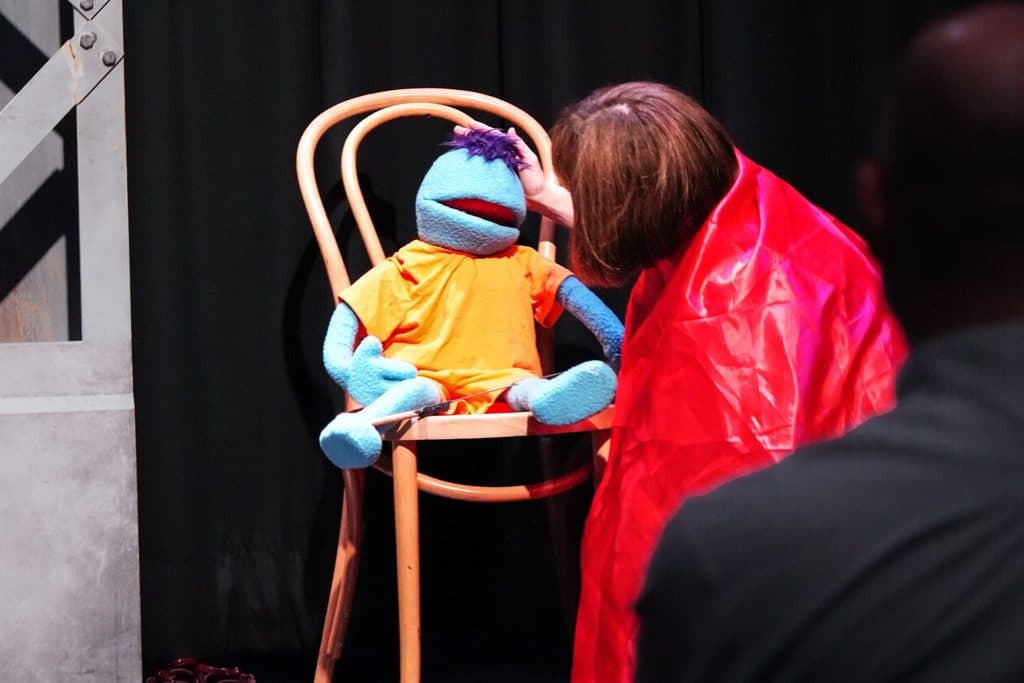
In her new one-woman play — Condemned to a Life — Kraft takes us back to her childhood to explore her life with her own youthful whimsy. The memories are often dark and serious, but the cast of puppets standing in for her family and friends give the audience a breath of humor during the arduous times.
“A lot of this is childhood memory so I wanted to show this childlike imagination,” she told MindSite News. “Puppets have this way of allowing people to talk about these heavy topics without overwhelming people.”
The heavy topics show up almost immediately when we find ourselves in a courtroom, where we slowly learn something horrible has occurred. Though never fully discussed, it hangs over the 45-minute play as Kraft cycles through her memories to find out how her brother ended up there, on trial.
And how she — an award-winning health and science journalist — didn’t meet a similar fate.
“I have wanted to tell this story for a while, even before stuff happened with my brother,” she said. “I was writing a lot of humor stories, but they were coming from shameful places that I was now able to look at differently. I wrote a story about my dad and I in China. It was supposed to be a funny story about him losing his insulin, but there was an element of rage in that humorous essay that I felt needed to be justified.”
That story makes it onto the stage, as well as the justification. Her childhood bedroom, which did not have a bed in it, served as a cell that she was locked in for hours. Her parents are separated, lost in new lives and she is neglected.
While she’s eventually rescued from that hell, she finds herself in one bad predicament after another over the years. We learn about the traumatic brain injury she received after being hit by a car and the after-effects she still deals with now. Time after time, she emerges from the wreckage, scarred, but standing.
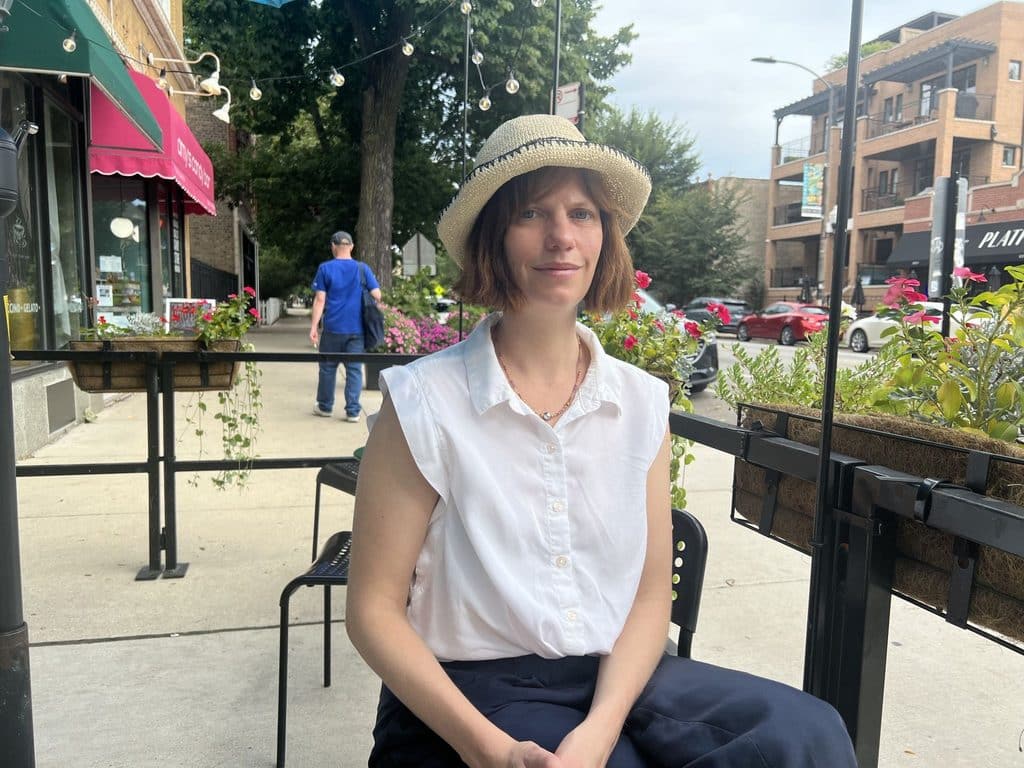
Earlier this month, MindSite News sat down for coffee with Kraft to peel back the curtain.
Josh McGhee: Who is Amy Kraft?
Amy Kraft: I’m a writer and an actress and I like to tell stories that expose what’s hidden underneath the surface of people. As an executive editor at Everyday Health, I covered a lot of invisible illnesses and chronic conditions so I worked with a lot of patient advocates. It helped me see that there’s more to people than meets the eye. I suppose it’s something I’ve always had because I’m a traumatic brain injury survivor. I was hit by a car when I was 16 and I did not want to be defined by that. So as quickly as possible I wanted to be like: ‘No, I’m normal. I’m my old self and I was unwilling to adapt to the necessary changes.’ Now, I’m almost 30 years post injury, but the marks are still there, the scars are there on my brain, on my body, and I still have to live with repercussions of these things.
I still live with chronic pain and I suppose for what I’m dealing with, I have more compassion for myself and that allows me to have more compassion for other people. Regarding my brother, he’s lived with mental illness most of his life. He was diagnosed with ADHD when he was younger. There’s research that suggests that a lot of young kids are misdiagnosed with ADHD and go on to develop schizoaffective disorder or schizophrenia. Does he fit in that bucket? I don’t know. He self-medicated because that’s what you do when you don’t have support or resources and that might have exacerbated any mental illness he had, rather than treat them.
He’s suffered in silence for so long, and for the show I wanted to give him a voice too. I was at his trial and I saw how he was portrayed and I felt it was unfair. I know him as a human being. I watched the same police footage videos as everyone else in the courtroom, and I saw an individual in a psychotic episode. I didn’t see a monster who purposely did this or thought about doing this beforehand. It just pains me that some people are stuck in a label. He was stuck in this label from a very young age and, now, it’s only being reinforced, and all people see is someone who’s bad. It’s painful to me because I see a human being there, and I don’t know if he’s ever going to know that he’s loved or that his life has value.
You start the play in the courtroom with your brother on trial, but we don’t go deep into what happened. What’s your story of what happened?
I can tell you, but it feels unfair because it’s just my own piecing together what I know of who he is and what I think might have happened in that moment. I don’t know how fair it is to my brother. There’s also a lot of unfairness to the victims. They lost a loved one. And they wanted someone to blame to make them feel better or they needed somebody to blame. I believe it was the fault of institutions.
He was in a state hospital and he was doing good. He had a job. He was working in a thrift store or something. He was talking to me regularly. He was medicated. He was going to support (services there) and they were like ‘We can’t keep you here. We’re going to discharge you.’ Then the police were informed of a warrant.
Six months prior, I petitioned the courts to have him Baker Acted in Florida because I was down there trying to help him – he was acting erratically and I was concerned for his well-being. When the police came to bring him to the institution, they found some substance on him.
They couldn’t arrest him at the time, so they gave him a court date that nobody knew about. When he didn’t show up, there was a warrant out for his arrest. It’s all these circumstances of ‘holy shit, how stupid is all of this.’ Then he gets driven two hours from the state hospital to be put in front of a judge, who says: ‘Come back in two weeks.’ They leave him in the lobby with no money, no medication, none of his IDs, nothing. Don’t you realize he’s coming from a mental institution?
We all scrambled to find something for him, which is how it always was. I can only imagine how hard it is for people that don’t have family or any support system. We got him into an inpatient facility that he could stay at for only 30 days. They helped him get IDs. They helped him get set up with government disability. Then the government decided to cut him a check for like $30,000 in back pay.
Putting that into the hands of an unstable individual is not a wise idea. He ends up in a halfway house where he’s living independently. He starts calling up me and my sister. He’s paranoid and people are after him again. He goes off the radar for two weeks. Then, my sister sees him on TV.
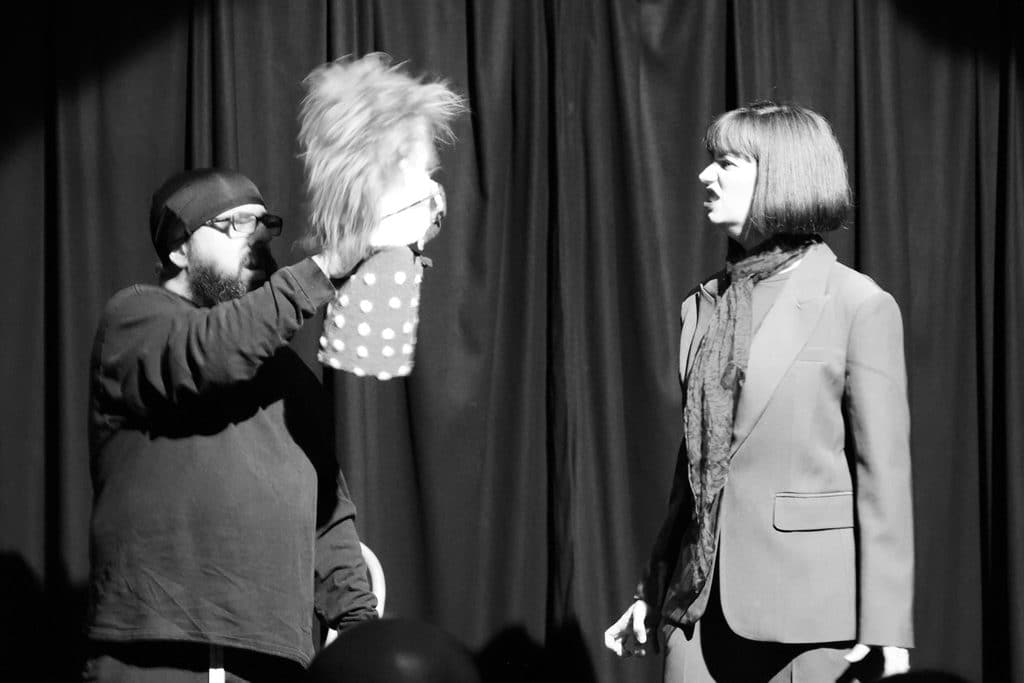
The play is bookended by the trial, then we get a larger narration of your life. Why did you choose to go about this story in that way?
There was only so much I could say about my brother from a loving yet neutral standpoint because I can’t get inside of his head. The show is focused on survivor’s guilt — how he and I were both labeled as bad kids when we were younger, which goes into that scene right after the courtroom. We both had our challenges growing up and I felt like I needed to focus on my own challenges because I know them best and there are similarities to my brother’s challenges. But, I don’t feel confident in making statements about (his).
It was basically to say, how can we? Who gets to say who is condemned to a label? Who has to live with that label? Who can overcome that label, and what does it take? I don’t know why I got a second chance. I don’t know why I was able to get the things that I needed to crawl out of being labeled as a bad person or being treated as someone who had no value. Luck has a lot to do with it. I don’t have a severe mental illness. That was another thing that my brother struggled with that I didn’t that made it all harder. I could share my story, I could talk about what was happening with me internally and find a way to connect that to my brother.
The play has some subtle hints about your brother’s condition early on. People joke about him being weird. Do you remember when you realized he had a serious mental illness? How did that affect you?
I don’t remember if he called or a sibling called, but he was arrested. He was living with his wife in my mom’s garage. I think they were doing drugs. I don’t know all the circumstances, but it was not a good life. There was a bedroom, but he was like: ‘No, I want to stay in the garage.’
When he was first arrested for whatever happened between him and his wife, that’s when he saw a doctor in jail and was diagnosed with schizophrenia first, then it was changed to schizoaffective disorder. It was that moment that I was able to have a level of empathy for him that I hadn’t had before because I didn’t understand who he was. Not to say that was right. People don’t need a label for you to have compassion for them. But, that was when I felt the need to make amends to him for how I didn’t show up for him in our youth.
I did my best to try and help him get services, help him get in a place. I was living in New York and he was in Florida, it was just chaos. There was the scene in the play where I’m on the phone and then flying back and forth. That’s really what I felt like –like this was what I have to do for him. Looking back, I probably would have done it the same. I would have been there for him that way because it mattered to me I could do that.
You decided to portray everyone else as puppets. What was the idea behind that?
When I presented my past history with my father to my (journalism) class at CUNY, they were all pretty silent. It made me think this was too much; it was too heavy…Then I was in an improv class, (one that gave me the idea of using puppets). It was like I wanted to capture that child-like imagination. It was also important to say this is coming from my point of view; other people may not see this the same way as me. In a sense, my experience was similar to my brother’s experience in that he saw things differently as they were unfolding that day he was arrested, from the people who lost a loved one, from the police officers, from the judge, from the jury. It was important to me to show that we all have different perspectives, then keep it fixed in my perspective. Puppets help me to do that.
The name “MindSite News” is used with the express permission of Mindsight Institute, an educational organization offering online learning and in-person workshops in the field of mental health and wellbeing. MindSite News and Mindsight Institute are separate, unaffiliated entities that are aligned in making science accessible and promoting mental health globally.


Author

Related Articles
Surviving Suicide Watch in a Missouri Prison
My only saving grace was my friend and mentor, Big Mama.

NAMI Director Explains New Laws to Keep People with Mental Illness out of Jail
The National Alliance on Mental Illness (NAMI) is advocating for state laws to divert people with mental illness from jail and into treatment, highlighting Florida’s Tristin Murphy Act as a national model.

Can ChatGPT Be Your Therapist? This Therapist Found Out for Herself
Can ChatGPT offer a viable alternative to traditional therapy? In this first-person essay, a licensed therapist explores that question.