
‘Going Into the Tunnel’: Doomscrolling Steals Sleep and Takes a Toll – But Prompts Some Youth to Action
New CDC and Hopelab reports show that late-night doomscrolling severely disrupts sleep and worsens mental health among young people.
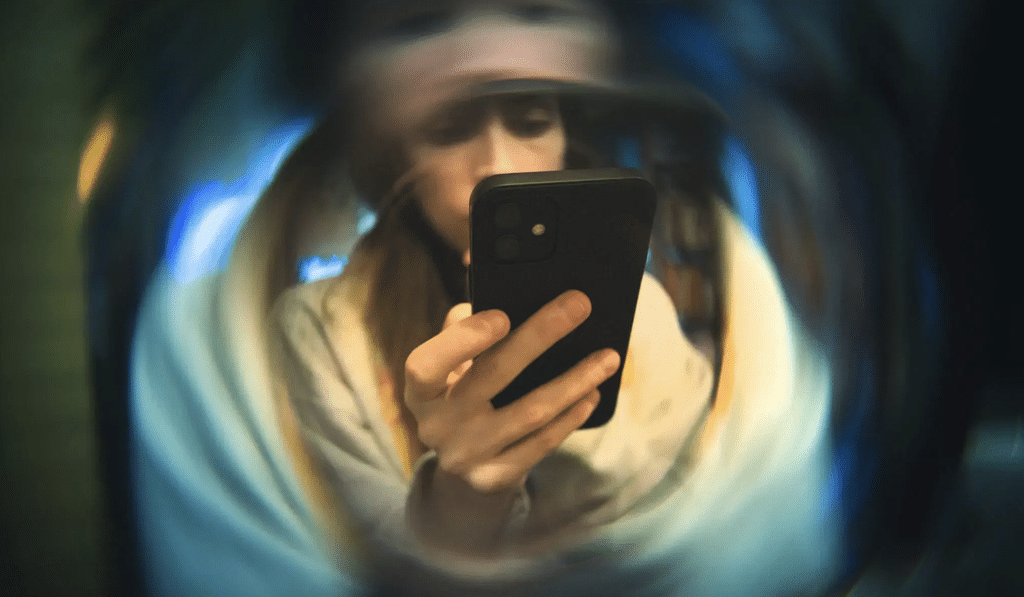
Last summer, Caitlynn Hauw found herself faced with an agonizing dilemma: She would spend up to eight hours per day scrolling on her phone – and then feel anxious when she couldn’t use the device during class.
Hauw likened the experience of obsessively using her phone to being a passenger on the subway who’s trying to get off but the train operator won’t stop.
“It feels like a hit in my chest or stomach,” said Hauw, a 21-year-old mental health advocate and psychology major at UCLA. “I know this isn’t what I shouldn’t be doing. I shouldn’t be on the subway, but I continue going deeper and deeper in the tunnel.”
She ended up establishing screen-time limits for herself after consulting with her therapist.
In recent weeks, two new reports have examined mental health among young people. One, a biannual survey by the Centers for Disease Control and Prevention, found that young people’s mental health has modestly improved since hitting a low point during the COVID-19 pandemic. Unlike previous reports, however, it didn’t explain data on the most vulnerable sub-groups — LGBTQ+ youth and people of color.
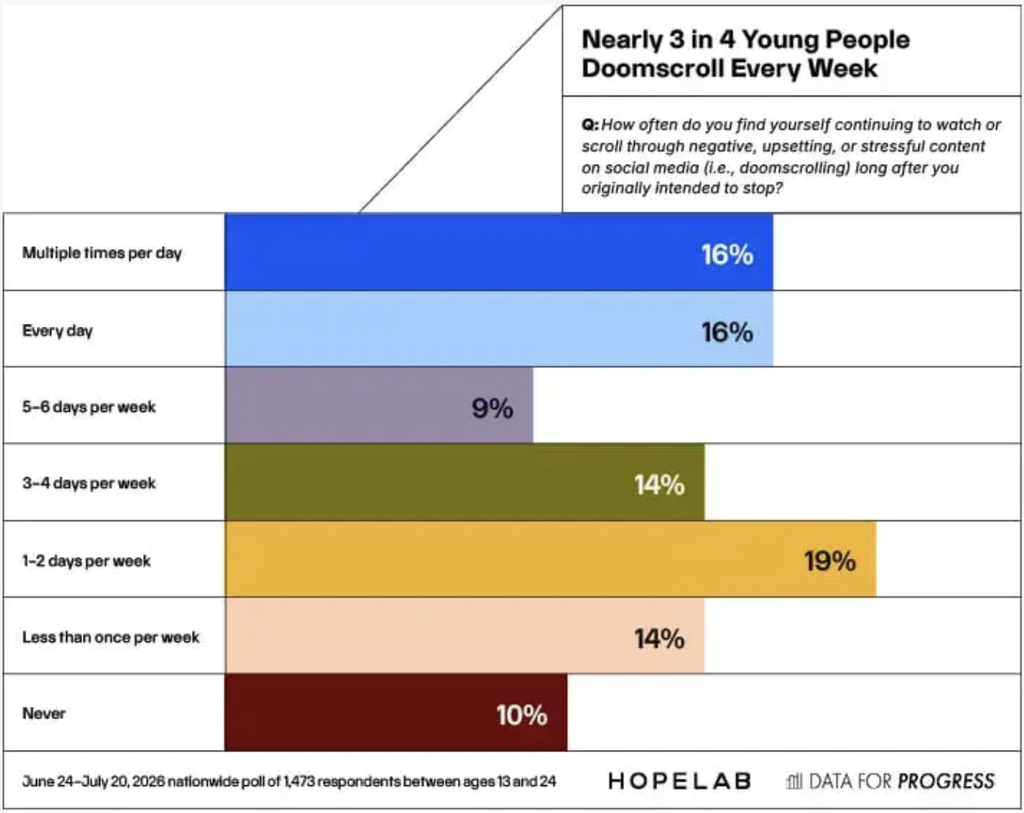
The other report, by San Francisco-based nonprofit HopeLab, found that doomscrolling behavior is virtually universal among young people and that the continuous processing of negative information fuels despair.
Hauw, a member of Hopelab’s youth policy cabinet, decided to advocate for youth mental health after surviving a suicide attempt during her sophomore year of high school. Her work has continued into college.
“I’ve lost two classmates at UCLA to suicide. Even though the CDC report says certain measures have improved, losing two classmates in a few years shouldn’t be normal,” she said. “I want to be a voice for the people who feel like they can’t speak up, or who are no longer around to advocate for themselves.”
The latest edition of the CDC’s Youth Risk Behavior Survey found that the number of youth who reported being in poor mental health or considered or attempted suicide declined over the past two years. Still, a third of high school students reported persistent feelings of hopelessness or sadness in 2025 – down from a peak of 42% during the pandemic, but similar to a decade ago. Female students were more likely to report mental distress and suicide risk than their male counterparts.
To Hauw, the despair felt by many young people is tied to uncertainty about their future. “The political climate in the United States and the state of the economy, the jobs, and the housing market is contributing to the feelings of hopelessness,” she said.
Still, after five years of relentless bad news about the mental health of young people, the progress is worth noting, said Hopelab’s Amy Green. “We should notice and celebrate when things are going better,” she said. “There’s a way to talk about the fact that we are seeing improvements, while acknowledging that we still need continued investments.”
Both reports also found that young people weren’t getting the recommended amount of sleep to support mental health and well-being.
“The concern isn’t just that young people feel tired the next morning,” said Green. “There is a strong body of research that connects insufficient or poor quality sleep deprivation to worsened mental health, including increased risk for suicidal thoughts, depression, and anxiety.”
From 2015-2025, the percentage of high school students who reported getting the recommended eight hours of sleep on school nights fell to less than one in four, according to the CDC survey.
Those findings dovetail with Hopelab’s report, which found that two-thirds of young people from 13 to 24 said they scroll through upsetting or negative content on social media platforms during free time or before bed. The result: nearly half reported losing an hour or more of sleep.
But there’s also a paradox: While most young people said doomscrolling made them feel anxious, exhausted, overwhelmed, angry, and hopeless about the future, 3 in 4 said it made them feel informed. Doomscrolling, most said, inspired them to take action.
“My generation inherited a world that can be very scary, ” Hauw said. “Looking at negative content on social media allows us to believe that we have some agency in our lives. We want agency because right now it seems like everything is out of our control.”
“The policymakers who are making these decisions are decades removed from the youth experience, and it’s really important that youth are ultimately included, and their voices are included in these decisions that are affecting them, ” she added.
The name “MindSite News” is used with the express permission of Mindsight Institute, an educational organization offering online learning and in-person workshops in the field of mental health and wellbeing. MindSite News and Mindsight Institute are separate, unaffiliated entities that are aligned in making science accessible and promoting mental health globally.


Author

Related Articles
After Deadly Oregon School Shooting, Experts Offer Advice to Grieving Families and Advocates Renew Call for Stronger Gun Laws
Following the tragic shooting in Bend, Oregon, grief experts share advice for families while the debate over federal and state gun laws re-emerges.
Superstar Athletes Open Up at Project Healthy Minds 5th Annual World Mental Health Day Festival
Bringing together athletes, entertainers, and mental health experts, the 5th Annual World Mental Health Day Festival featured candid conversations on identity, screen time, and emotional resilience.
The Salon Experience on Rikers Island That Some Hope Could Scale Across the Country
How the Beauty Beyond Bars salon brought renewed confidence and hope to three women preparing for release from Rikers Island.