
The Power of Protest – and Placebos
Millions of Americans protested peacefully at more than 2,000 demonstrations across the country. A tribute to Brian Wilson. And two books look at the potency of placebos.

Good Tuesday morning!
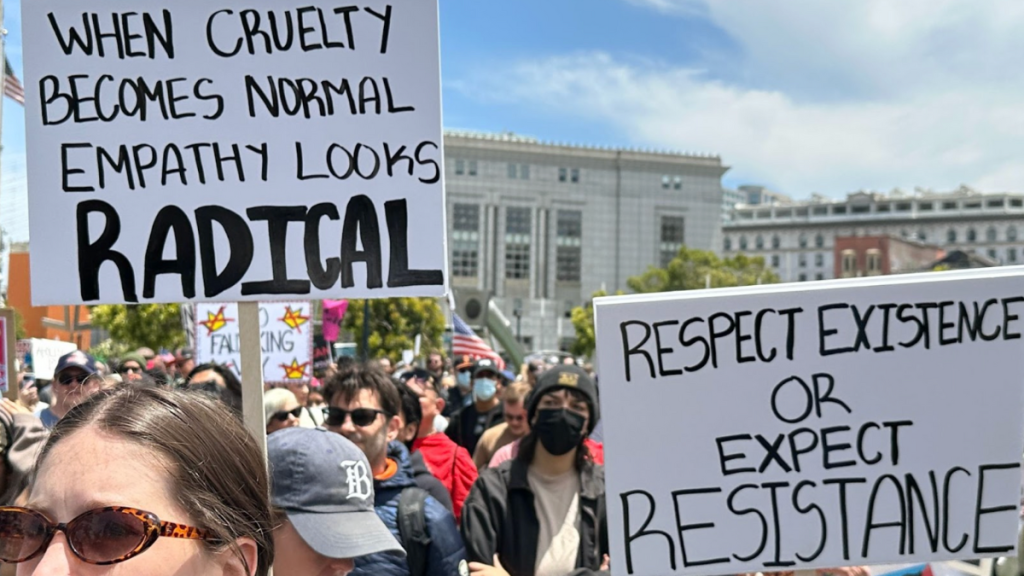
Millions of Americans protested peacefully – and lifted each other’s spirits – at more than 2,000 “No King’s Day“ demonstrations across the country, while the U.S. military paraded along the streets of Washington, feting President Donald Trump on his birthday. And speaking of surprising benefits, placebos also wield underappreciated power, as two new books reveal.
Plus: Medicaid cuts will disproportionately jeopardize mental health and addiction treatment in red states (and destabilize the job market nationwide). Overdose death rates began plummeting nearly a year earlier than previously thought. A new Texas law will fund research on ibogaine’s potential to treat addiction. And more.
And here’s an idea whose time seems to have arrived: (low-carb, ketogenic) food as medicine – for treating severe mental illness! Check out a new MindSite News Original story on the subject.
But first: MDMA, which has been shown to increase empathy, might eventually be used to treat pathological narcissism, according to an interview in The Microdose with a psychiatrist leading a clinical trial.
On “No King’s Day,” millions of commoners protest an imperial president
In a remarkable day of contrasts, a military parade sent tanks and weapons lumbering down the streets of Washington D.C, while around the country, as Fox News reported, “Millions of people across the U.S. marched in more than 2,000 cities.”

Participants reported that the event lifted their spirits because they joined together, peacefully, with fellow human beings – citizens, residents and visitors alike – to protest the policies of the Trump administration. Speakers and witty signs lambasted Trump for using the military against protesters in Los Angeles, for callously deporting immigrants, for gutting science, health and mental health programs and, as Pennsylvania resident Paul Newman put it in a collection of reader reflections published by the Washington Post, for “his policies of welfare for the rich, his disregard for the Constitution, his disdain for the underprivileged.”
Another Post reader noted the benefits of the communal protest gatherings, writing that “the mood was almost joyous as people drew comfort from the mass gathering of like-minded individuals, recognizing that they were not alone in their deep concern for the state of our democracy.”
In other Trump-related news:
Medicaid cuts would devastate mental health and addiction services – particularly in red states, according to a commentary in Stat+. The reason is simple, writes Miranda Yaver, an assistant professor of health policy and management at the University of Pittsburgh: States that voted for Trump have more behavioral health problems and higher rates of Medicaid use. Medicaid pays for most mental health and substance use treatment in the U.S., but would be cut by more than $700 billion in the Trump-backed bill passed by the House and now being considered by the Senate. States with the highest rates of depression, PTSD and opioid use disorder voted for Trump last November. The bill also threatens rural hospitals, 76% of which are in red states.
Slashing Medicaid “will destabilize the U.S. job market,” according to an analysis in Health Affairs Forefront. The House bill would cause around 16 million people to lose health insurance through Medicaid and the Obamacare marketplaces over a decade, the Congressional Budget Office estimates – and a lot of workers are involved in providing that coverage and care.
Some numbers:
- More than 2 million jobs have been added to “services for the elderly and persons with disabilities,” the biggest rise of any private-sector job category over the past 20 years.
- Medicaid is the single largest payer for “long term care services and supports” provided in nursing homes, community-based services or in homes.
- More than 2.6 million jobs in the home and community-based services category could be at risk, potentially slowing growth that had been projected at 39% from 2022 to 2037.
The budget bill would undermine efforts to help older Americans get care, according to a blog post by the Milbank Memorial Fund, a health policy and research foundation. The legislation includes a provision that would delay implementation of a regulation intended to streamline the red tape that keeps many older adults from accessing Medicaid and two other programs that increase access to care and reduce costs for older patients.
‘He wanted to make music that would make people smile, and will help them heal.’

Beach Boys co-founder Brian Wilson, rock’s poet laureate of surf-and-sun innocence – and a damaged genius who struggled for decades with mental illness and drugs – died last week at 82. The Beach Boys’ music stays in your head: During the group’s 1962 to 1966 heyday, three of their singles hit No. 1 on Billboard’s Top 10: “I Get Around,” “Help Me, Rhonda” and “Good Vibrations.”
Wilson suffered from a number of mental health challenges during his life – childhood trauma and abuse at the hands of his father, a nervous breakdown, depression, schizoaffective disorder and, in his later years, a neurocognitive disorder. He also spent years under the control of a manipulative psychotherapist, Eugene Landy.
Wilson was one of the earlier celebrities to share his mental health struggles with the public, helping pave the way for more open discussion about mental illness. His story of troubled brilliance entered rock mythology and was reenacted in a 2014 biopic, “Love & Mercy.” In 2018, Wilson and cast members of “Love and Mercy” were interviewed by Dr. Jeff Borenstein on his program, “Healthy Minds.” Borenstein asked Wilson how he pushes the voices in his head off to the side so he can concentrate on other things. “Sometimes I would yell, “Stop talking to me!” Wilson responded.
Paul Dano, the actor who portrayed a young Brian Wilson in the biopic, recalled something that Wilson once said: “He wanted to make music that would make people smile, and will help them heal.”
‘Placebo treatments are not just ethical; they are ethically required’
Placebo, in Latin, means “I will please.” Chaucer brought it into English, borrowing it from Jerome’s translation of the Psalms. (“Flatterers are the Devil’s chaplains, always singing Placebo,” says Chaucer’s Parson.) The first recorded medical usage of placebos (the treatments, not the words) may have been by the Scottish physician and obstetrician William Smellie, in 1752 – when few drugs were effective, and most were toxic.
Despite our late-20th century pharmaceutical (and profit-making) revolutions, placebos may still be one of the best tools in doctors’ medical kits, Gavin Francis, a primary care physician and prolific author in the UK, writes in The New York Review, digesting “Placebo” by Kathryn T. Hall (2022) and “The Power of Placebos” by Jeremy Howick (2023).
In a nutshell, Francis writes, both authors present overwhelming evidence for how and why the placebo effect not only works but works nearly as well – in some cases, just as well – as pharmaceuticals that cost $1 billion to bring to market. And even if you know that your doctor has given you a placebo and how the placebo effect works – mind over body via the power of belief and expectation, best prescribed with a dose of warmth from your physician – well, it’ll still work. “It is no modern talk but a dictum of old physicians that these diseases are not cured by the drug, but by the doctor, to wit, by the personality of the physician in so far as it exerts a psychic influence,” Freud wrote in “On Psychology” (1905).
Examples of the placebo effect – and its opposite, the nocebo effect (a negative outcome when the patient believes their treatment will cause harm) – can be found in medical journals and in punchy anecdotes alike. Parts of the brain respond similarly to taking an opioid for pain or taking a placebo. “Placebo effects could lead to the interception of incoming pain signals and exert ‘top-down’ control over the pain,” Hall speculates.
In one trial, men who were told that impotence was a potential side effect of a beta-blocker were much more likely to develop it than those who were not. And then there’s the 1995 case of a 29-year-old builder with a six-inch nail through his boot, who screamed in agony at any attempt to remove it. When a medical team finally pulled out the nail and removed the boot, they found that the nail had passed harmlessly between his toes. Another man, part of a clinical trial for antidepressants, took an overdose of them. His blood pressure crashed and he had to be carried to the ER – despite the fact that he’d been taking the placebo.
Evidence shows that expensive placebos work better than cheap ones, capsules work better than tablets, and colored capsules work better than white ones. Blues and greens work better as sedatives, while pinks and reds work better as stimulants and painkillers. (Unless you’re an Italian man: Howick notes that blue is stimulating for them, perhaps because Azzurri, Italy’s national soccer team, wears blue.) Still, Howick makes clear how little we understand about the placebo effect, although he does describe changes within the DNA of what some researchers are calling the “placebome”: genes that help us respond to placebos.
I was surprised to learn that the generally conservative American Medical Association permits placebo use with “the patient’s cooperation.” Howick points out that the American healthcare system spends $5 billion a year on a minimally invasive surgical procedure for osteoarthritis of the knee that is no better at reducing subsequent pain than simply anesthetizing the patient and giving them a scar on the knee. In light of all the evidence, he writes, “placebo treatments are not just ethical; they are ethically required.”
“It’s extraordinary that our culture has become so medicalized and reductionist that warm and empathetic care with its immense proven benefits…has been deprioritized to an optional extra rather than a core element of medicine,” Francis’s compelling review concludes.
In other news …
Overdose death rates in most of the country peaked in October 2022, nearly a year earlier than experts had gleaned from national figures. The overall drop took longer because deaths in the West – home to nearly a quarter of the country’s population and the last to experience fentanyl’s deadly arrival – didn’t peak until two years after other regions. The study in JAMA Network Open pinpoints when drug deaths began falling: August 2023.
The findings also showed a remarkable generation gap: For nearly a decade, 35-to-44 year-olds have had the highest death rates of any age group. The biggest contrasts were at either end of the age spectrum: 25-to-34-year-olds showed the steepest year-over-year improvement in the most recent data, while people 55 and older experienced a ninth consecutive year of worrisome increase. Perhaps the most interesting finding: Overdose mortality due to cocaine and meth followed the same general patterns as opioids, suggesting – to me, at least – that broader trends are likely behind the unprecedented overall decline.
How, exactly, does air quality connect to mental health? Do poorer people, who already have worse health outcomes, move to polluted areas because no one else wants to live there? Or do the places themselves make people ill? To answer the question, researchers examined health records of 14,800 people who relocated within Bradford, a post-industrial city of 522,000 in West Yorkshire, England, during early 2021. Their specific query, The Guardian reports: What happens to people’s mental and physical health when they move to an area with worse air pollution? Since pollution is associated with worse mental health, the researchers analyzed pre- and post-move prescriptions for drugs that treat depression and anxiety, taking into account areas’ socioeconomic characteristics.
The main result, published in Environmental Epidemiology: Those without a prescription at the start of the study who relocated to an area with more particle air pollution had an 11% greater risk of developing a new mental health problem compared with other movers. Moving close to high-quality green space tended to reduce prescription rates. Researchers flagged a potential vicious cycle: People experiencing mental health problems tend to move more often and to areas with worse environmental quality, which may then impact their ability to recover.
“It’s very insidious,” Melanie Haiken told Depth Perception, summing up her research for last month’s MindSite News series “Deadly Denials: When Insurers Fail to Cover Treatment for Eating Disorders, People Suffer. Sometimes They Die.” When she started reporting the four-part series, Haiken thought the story would be about outright insurance denials, but it morphed quickly – insurance companies have gotten craftier in evading the mental health parity law. She was aided by her personal knowledge, accumulated in the course of her own daughter’s many years in treatment for anorexia and bulimia. She knew, for example, that residential programs are structured on a 28-day basis – yet insurers typically approve only seven days at a time. “Then you’ve got to resubmit the whole thing to prove you still need it.” Your weight starts to improve, and they say, “Oh, you don’t need the treatment anymore,” Haiken adds. Insidious indeed.
Texas Gov. Greg Abbott signed the nation’s first bill to fund ibogaine research, The Microdose newsletter reports. Ibogaine, derived from plants, has hallucinogenic and oneirogenic (inducing dream-like states of consciousness) effects, and is traditionally used by Central African foragers. The U.S. classifies it as a Schedule I controlled substance, with no accepted medical use and a high (perceived) potential for abuse. Researchers have expressed concerns about possible serious risks in humans. HB 3717 creates a public-private partnership to fund clinical trials of the psychoactive compound to treat a number of “neurological or mental health conditions for which ibogaine demonstrates efficacy,” including opioid use disorder. The Washington Post explains why Texas is about to spend up to $50 million researching an illegal psychedelic.
The name “MindSite News” is used with the express permission of Mindsight Institute, an educational organization offering online learning and in-person workshops in the field of mental health and wellbeing. MindSite News and Mindsight Institute are separate, unaffiliated entities that are aligned in making science accessible and promoting mental health globally.


Author

Related Articles
LA County’s Homeless Shelter System Is a Revolving Door
A new report reveals the LA homeless shelter system is failing to meet its targets, with nearly 60% of residents returning to the streets.

College Sports Has an Emotional Abuse Problem
Two sisters were recruited from Croatia to play college basketball in the US. They say their coach derided and insulted them – and that there were few safeguards to protect them.
