
This ER Doc Has Been Surveying Public Attitudes on Authoritarianism. The Numbers Are Chilling
Research suggests a two-way dynamic: In the era of Donald Trump, anxiety, fear and uncertainty are leading to acceptance of authoritarianism and violence. This, in turn, provokes more anxiety and fear – and for some people, withdrawal.
Garen Wintemute is an emergency room physician who practices and teaches at UC Davis Medical Center near Sacramento, California. He also directs the university’s Violence Prevention Research Program. In that capacity, he conducts research in the fields of injury epidemiology and the prevention of firearm violence.
For the past several years, he and his team have surveyed in English and Spanish more than 8,000 adults who are part of the Ipsos Knowledge Panel about gun ownership and, more recently, about their attitudes toward authoritarianism and democracy. When gun purchases stayed high following the election of Joe Biden in 2020, Wintemute and his team wanted to know why.
In their most recent survey, published online August 13 as a preprint, Wintemute and his team found that nearly one third (32.5%) agree at least somewhat that “having a strong leader for America is more important than having a democracy,” and 15% agree strongly or very strongly. Wintemute spoke with MindSite News Founding Editor Rob Waters about the findings and his research. The interview has been edited for length and clarity.
Rob Waters: You’ve spent years treating gunshot wounds as an ER doc and also decided to start researching gun violence. Why?
Garen Wintemute: I started the two almost at the same time. Emergency medicine is the specialty that looks out into the community, and many of us seek to intervene in the flow of events that bring people through the door to the department. And for me, that work focused early on on firearm violence. They’re two sides of the same coin – treatment and prevention.

Research into gun violence was almost completely shut down for many years by federal restrictions on funding for that research. Since guns are used in more than half of all suicides, this research is important for mental health. What’s the status of those restrictions today – and what’s the overall funding environment for that work?
You’re right. Federal funding was largely shut down 30 years ago and except for a brief period roughly 10 years ago, remained off – particularly for research involving suicide – until the Biden administration, when it began again. During the current Trump administration, it has again been largely cut off. Existing grants terminated. Funding opportunities not made available. The staff who worked on violence prevention at the Centers for Disease Control and Prevention – that part of the CDC lost 85% of its positions in the last few months.
Traditionally, there has been a pipeline from research to policy, with policymakers wanting evidence to guide their actions. The situation we face now is that the pipeline is being cut off and policy – if it’s made – will not be made with current evidence. The private sector is stepping in to fill the gap, but there’s simply no substitute for the magnitude of funding the federal government can bring. There’s also no substitute for all the federal government employees who were working on violence prevention who are now out of jobs.
In 2020, after Biden defeated Trump, you were shocked by the high volume of gun sales. You began doing surveys on people’s support for civil war and people’s attitudes towards authoritarianism and political violence. What did you find then, and how have things changed with your most recent survey?
We got into this because gun purchasing, which took off in 2020 in response to the pandemic, did not decrease in 2021. That was unexpected and led us to the work on political violence. In brief, we found that in 2022, a third of American adults thought that violence – physical force – was justified, usually or always, to advance at least one of a series of specific political objectives that we presented to them.
That support actually went down as we continued the survey. In mid-2025, just two months ago, one in four American adults still thought violence was justified. Support for authoritarianism also went down slightly but it is still the case now that one adult in three agrees at least somewhat with the proposition that having a strong leader is more important for America than having a democracy.
Views on democracy and authoritarianism
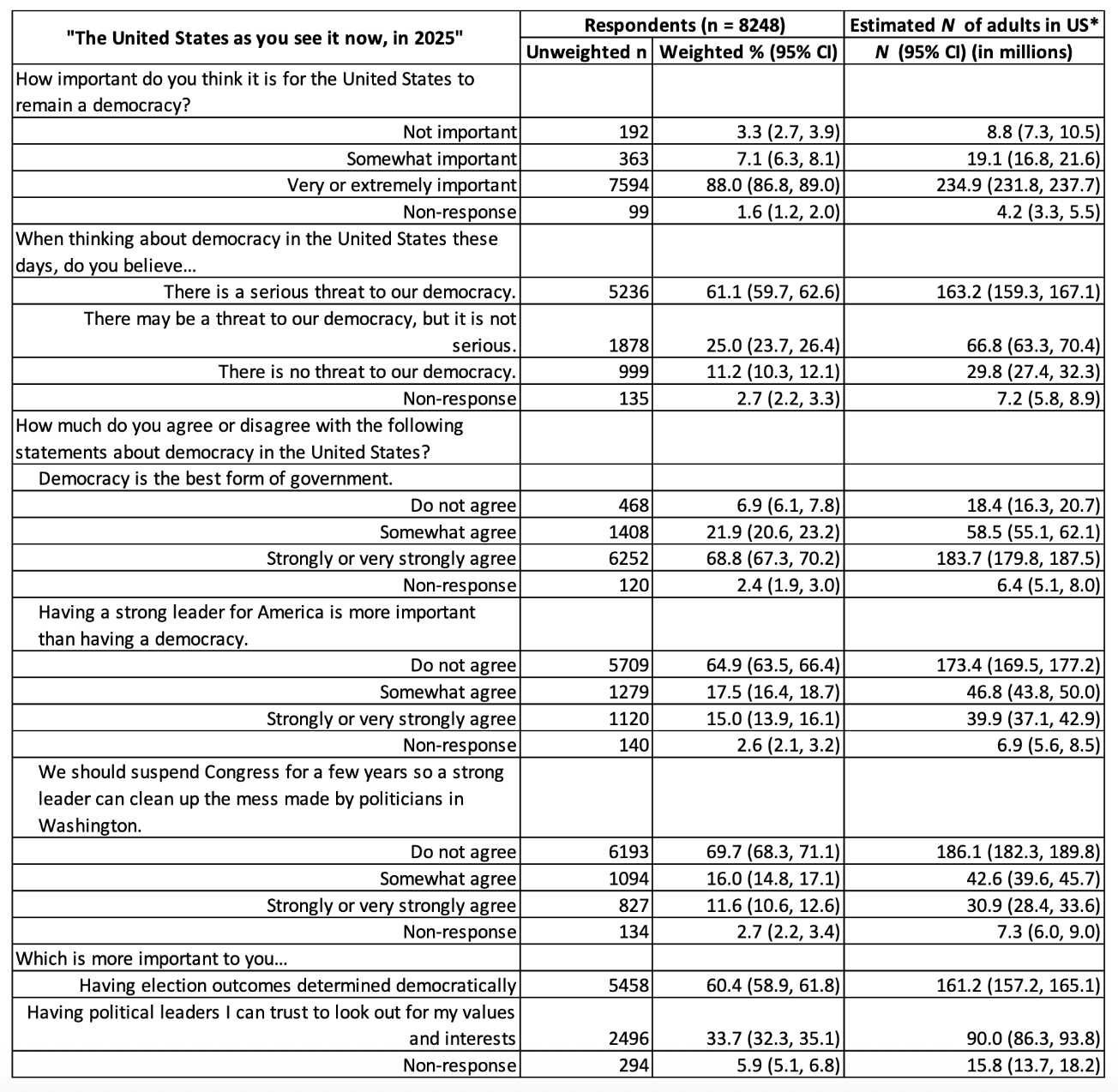
Also, about a third of respondents agreed – and 10% agreed strongly – that the federal government should use the military to help enforce its policies. And 15% to 20% agreed – and 6% strongly agreed – that the government should arrest people, including journalists, who oppose or criticize the president. As a citizen of this country, not an emergency room doc or researcher, how do those numbers make you feel?
They deepen my conviction that the people who have been saying for years that democracy faces a real threat are right, that there is a climate of acceptance for authoritarianism. There is a climate of acceptance for the forcible suppression of dissent that is much stronger than most people want to think it is. But you asked me how I feel.
How I feel is deeply concerned – not frightened, but on alert. I’m going to speak metaphorically here. I’m an ER doc. I’m a frontline person. There is a battle now among us for the future of the United States. We can recognize it or not as we see fit. Will we continue to evolve as a democracy? Or will we revert to some other form of government? I intend to be on the front line of that battle.
“I have friends and colleagues who say, for mental health reasons, I simply cannot afford to pay attention to the news anymore. And I feel for them. I believe them. And at the same time, I recognize that if the good guys tune out, the bad guys win.“
MindSite News reports on mental health policy and the forces that contribute to people’s mental and emotional health and well-being, for better and for worse. I realize you’re not a psychologist or a mental health professional, but I’m curious: What do you think these findings say about the state of our emotional and mental health as a nation and a culture? What do you think has happened in our country psychologically that allows so many people to have beliefs that include support for authoritarianism?
Thank you for that caveat. There are two sides to the coin. Support for authoritarianism itself – and I’m speaking from other people’s research – flows in part from anxiety and fear, lack of tolerance, uncertainty. Those sorts of things increase one’s potential for accepting authoritarian government. On the other side of the coin, the findings of support for authoritarianism and government-initiated violence provoke anxiety and fear and also withdrawal. I have friends and colleagues who say, for mental health reasons, I simply cannot afford to pay attention to the news anymore. And I feel for them. I believe them. And at the same time, I recognize that if the good guys tune out, the bad guys win.
So how can we not be demobilized by the news that fills our news streams or our social media? How do you think people who believe in civil discourse and democracy can kind of break through in this environment?
I really do think I know the answer to that or at least part of the answer.
Great!
First off, people do not need to doom-scroll more than they can tolerate because they’re not going to learn more. They’re just going to amp up that feeling, those negative emotions. Second, the flip side of what you and I have been talking about is that the vast majority of us reject political violence. The vast majority of us reject authoritarianism.
What’s missing from the current national conversation is the vast majority making those opinions known – our rejection of uncivil discourse, our rejection of violence as a means of solving the nation’s problems. We don’t all have to speak in public arenas. What we’ve learned is that the people most likely to talk a would-be violent, would-be authoritarian, person back from the cliff are that person’s family and friends or respected community leaders or religious leaders. All of us who reject violence and authoritarianism can have those conversations privately with our family and friends – and from our research I say this with conviction: Those conversations will make a difference.
Let me give you an example. At the extreme end of our survey research in 2024, we asked a bunch of questions about civil war, the possibility of it coming, including what would you do? In our survey population, there were people who said, “I would be a combatant. I would pick up a weapon.” For the people who said that, we asked, “What might change your mind about that?” And almost half those people said that they would change their minds, they would revert to a nonviolent stance – if urged by their family and friends. We might not change a person’s views, but we could get them to walk away from violence. And that’s a goal worth going after. That’s something that people are going to accomplish with their families and friends, one at a time.
And what do you think you and I can accomplish? What is the role of researchers and the media in this environment? How does the research you’re doing break through?
Again, I think the answer is pretty clear. There combatants, 20% of them said they would change their minds if media sources that they respected urged them not to engage in violence. This conversation that you and I are having is an effort to build that climate in the media. Our responsibility is to do that with the expectation that we’ll make a difference. We’re not whistling into the wind.
Good to hear. What’s the next step in this research for you? Where do you go from here? And by the way, how do you keep supporting this research?
We get funds from both public and private sources. We have a number of private foundations who fund this work. We are also funded by the state of California. What’s next is we’re updating our findings. One of the strong features of our work is we collect this information from the same population of people year after year. So we can track changes in individuals over time. We are now tracking the people whose support for political violence has decreased substantially and the people whose support has increased substantially. We want to look with all the data we have at this question: What distinguishes the people whose support is increasing from those whose support is decreasing.
We are seeing radicalization happen in our cohort and we’re going to be able to identify factors associated with radicalization in the general population. This has never been done before. We’re going to be working on that as quickly as we can because that can help identify people who have those risk factors but have not yet radicalized so that we can craft interventions to prevent people at risk from radicalizing.
Do you have any initial learnings in terms of what those factors are?
I do. The study that made it clear to us that we were on the right track is publicly available as a preprint as of last week. We wondered if there were specific life events that might increase or decrease a person’s support for political violence. We drew a list of life events from the scientific literature on gang violence and terrorist violence – things like I got a good new job, I got married, I had a kid. Those things are known to reduce risk for violence.
We built a list from that literature, and we added some more of our own. What we learned was this: On balance, life events had relatively little to do with support for political violence, but there were some exceptions. “My economic conditions got better” was strongly associated with a decrease in support for political violence. That’s not surprising, but it’s not nothing. It suggests that if we can help people feel that the economy is on their side, we can prevent violence. On the other side, we found – and this won’t surprise anybody – that being incarcerated was associated with an increase in support for political violence. It’s not the first time that a research study has shown that incarceration makes things worse and not better. And there were some others, but those were among the strongest associations that we saw.
One of the significant economic forces now is AI – artificial intelligence – and the potential for AI to eliminate a lot of jobs. How might that impact things?
Probably not qualified to comment on that. We did ask the mirror question, and “my economic situation improved” decreased support. So “my economic situation got worse“ increased support for political violence. If, in fact, artificial intelligence makes a lot of people’s economic situations either better or worse and there are no other effects involved, we might see changes in support for political violence. But we have to remember that things like AI and tariffs and economic policy in general don’t occur in a vacuum.
I assume that among the people who are radicalized and are potential or actual supporters of political violence are people who experience economic dislocation as a result of global trade policy, job closings, AI and that’s accompanied by sort of a disconnection from social involvement and people going down rabbit holes.
Let me take the social network side of it. Here, the findings are nuanced and we’re not the first people to come up with this. Going back to Robert Putnam’s Bowling Alone, which I think people will remember. Putnam differentiated between what he called bridging social capital and bonding social capital. When we all talk about social capital in general, we’re thinking of bridging social capital – a diversified network, different points of view, knowing people of different kinds, ending isolation. That is associated with a decrease in support for all kinds of bad things, political violence among them. But there is also bonding social capital. Putnam’s example for that was the Michigan militia, which is right on topic for us today. A social network where everybody thinks the same way is isolating from broader society. In our work, when we asked people about their social networks, we found there were two kinds that were associated with increased support for political violence.
One was I don’t have a social network. I’m on my own. But the other one was I have a very large social network, but we’re all the same, we all think the same way on social issues. That’s kind of the situation we face at the moment. The trick for all of us is not just to acquire social capital, it’s to acquire bridging social capital, to open ourselves up to the broader world to recognize that there are valid points of view beyond our own.
The name “MindSite News” is used with the express permission of Mindsight Institute, an educational organization offering online learning and in-person workshops in the field of mental health and wellbeing. MindSite News and Mindsight Institute are separate, unaffiliated entities that are aligned in making science accessible and promoting mental health globally.


Author

Related Articles

Surviving Suicide Watch in a Missouri Prison
My only saving grace was my friend and mentor, Big Mama.

NAMI Director Explains New Laws to Keep People with Mental Illness out of Jail
The National Alliance on Mental Illness (NAMI) is advocating for state laws to divert people with mental illness from jail and into treatment, highlighting Florida’s Tristin Murphy Act as a national model.

Can ChatGPT Be Your Therapist? This Therapist Found Out for Herself
Can ChatGPT offer a viable alternative to traditional therapy? In this first-person essay, a licensed therapist explores that question.