
Why Are Opioid Settlement Funds Not Poured Into Addiction Treatment?
Families of overdose victims in Oklahoma call for transparency in how opioid settlement funds are spent.

Greetings, MindSite News Readers.
In today’s Daily, Oklahomans want to know how opioid settlement funds are being distributed. The plight of Gazans two years into the Israel-Hamas war. And psychiatrists call for RFK Jr.’s resignation.
But first, a glimpse of Anxiety Club, a documentary featuring roughly a half dozen stand-up comics sharing their struggles with anxiety. “Viewers will discover why Hollywood’s Laugh Factory took the groundbreaking step of hiring a psychologist-in-residence to support its comics,” the film’s synopsis reads. By renting the film at this link, they can also support two nonprofits – Comedy Gives Back, which looks out for comedians in need, and the Anxiety and Depression Association of America.
Families of opioid overdose victims in Oklahoma want transparency on the spending of settlement funds

Across Oklahoma, families who’ve lost loved ones to opioids are now asking what happened to the hundreds of millions of dollars meant to fight the addiction crisis that took their children. The state has received more than $900 million in opioid settlement money, part of payouts totalling $50 billion nationwide payout. But years later, several families told reporters at KOSU they have no idea where that money is going.
Diane Searle is among them. Her 19-year-old daughter, Jillian, died from an overdose in 2018. “She’s absolutely beautiful and she never really thought she was,” Searle said. “She had a great sense of humor… She loved animals. She loved her siblings.”
After Jillian’s passing, Searle founded Families Supporting Families, to help other moms in Tulsa cope with the loss of their children to addiction. Beyond offering members emotional and legal support, the group distributes harm-reduction supplies and raises overdose awareness through education at local schools and with billboards.
Advocates like Searle believe that opioid settlement funds should only be used to raise awareness, support addiction prevention, and provide rehabilitative treatment. A first step would be transparency from the state as to how opioid settlement funds are being spent. “It should be public knowledge,” Searle said. “My kid died from opiates… so we should have public knowledge of what you’re spending it on.”
So far, it’s known that $68.5 million has been paid to private attorneys working on the state’s litigation, and nearly $200 million earmarked for Oklahoma State University’s National Center for Wellness and Recovery. Lawmakers also used tens of millions to fill state budget gaps, including $24,000 in unrestricted funds to the Oklahoma Health Care Authority, which the agency applied to Medicaid expenditures. But Searle said that communities need “better rehabs that people can stay in for a longer time to get the help they need.” Trying to find treatment for Jillian, in Searle’s telling, was a heartbreaking cycle of waitlists and confusion.
Only adding to frustration is knowledge of Oklahoma’s Opioid Abatement Board. The body has the authority to distribute settlement funds, but was candidly described as “a do-nothing board” by Oklahoma Attorney General Gentner Drummond, in the wake of years of inactivity and swath of resignations. But last year, the board finally began awarding grants, roughly $12 million worth, though a full list of recipients is still not available. In August, the board approved another round of grants, totalling $16.6 million, to be distributed to Oklahoma’s schools, cities, counties, and public trusts. The board has also partnered with Steadman Group, a Colorado-based consulting firm, to help track grantee performance.
“It became the natural next thing to make sure we had a good way to track everything and track long-term outcomes,” said Kelly Dunn, a member of the Opioid Abatement Board. One of the directors at Steadman Group, JK Costello, went on to explain how the firm will launch public dashboards to increase transparency and accountability. They are due to be online by later this fall. “There will be reports for each grantee,” Costello said, as well as “an overall report that collates all that data to a more public-facing report that summarizes everything from what’s been reported, what hasn’t been reported, what we [still] need.”
The board doesn’t give to nonprofits like FSF, but Searle continues to meet other parents to advocate and grieve together. “It’s one of those groups that you don’t want to see grow,” she said. “But we’re there for the families and we do whatever we can for them.”
After two years of bombardment, traumatized Gazans struggle to survive
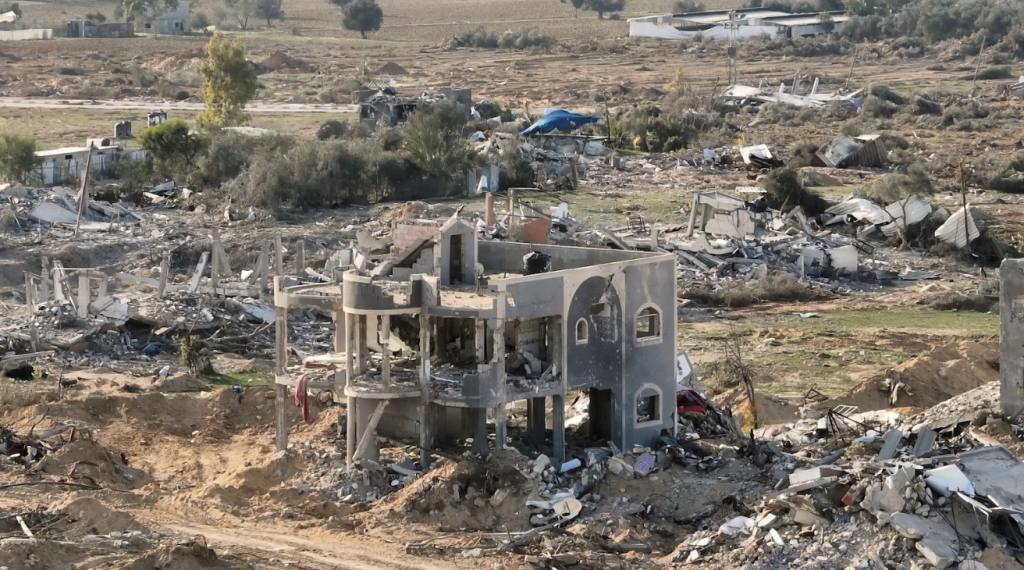
Since Hamas’ deadly attack on October 7th, 2023, in which 1200 people were killed and 251 taken as hostages, Israel has been relentless in its attacks on Gaza, making life for Palestinians living there about surviving from one day to the next. There is no room for dreaming about the future: Two years of near-nonstop bombardment and displacement have left them permanently wounded — physically, mentally, and emotionally.
“The thinking about life after the war comes only when the war ends,” said Hamza Salem, who lost both of his legs in an Israeli strike. His five-year-old daughter, Rital, lost her arm in a different blast, one that Israeli officials claimed struck Hamas military infrastructure. But in some ways the family has been more fortunate than the thousands drifting between ruins and tents – the family told the New York Times they were now sheltering in Hamza’s sister’s house in central Gaza after a long journey on foot, with Hamza’s wheelchair pushed by his father and sons. But with no tent and little money, they hope to not have to flee again. “We have no other place to go,” Hamza said.
According to the United Nations, nearly 80% of Gaza’s buildings have been damaged or destroyed, leaving 50 million tons of rubble as of December. Ninety percent of its schools have been destroyed or damaged, and almost all universities severely damaged or closed. Fewer than half of Gaza’s hospitals remain even partially functional, having been repeatedly evacuated, raided, and attacked by the Israeli military, which accuses Hamas of using them for protection.
Death, war trauma and psychological exhaustion affect everyone in Gaza. Parents, children, extended families and even entire neighborhoods have been obliterated. More than 67,000 Palestinians have been killed in the Israeli offensive, a third of them under 18. Local health officials say that one in every 34 Gazans, or more than 67,000 people, have been killed in what an independent UN Commission declared a genocide committed by Israel against Palestinians. Of the over 167,000 Gazans wounded physically, more than a quarter carry what the World Health Organization defines as “life-changing injuries.” More than 5,000 have sustained severe damage to limbs, including amputation, or injuries to the spinal cord.
Tess Ingram, the UNICEF spokeswoman in Gaza, told them, “There is an ever-present threat of illness and death which children are having to battle with every day. This creates a level of toxic stress that is not just harmful, but potentially life-threatening long term.” The Palestinian Central Bureau of Statistics found that more than 39,000 children have lost at least one parent in the war, and that nearly half of those children have lost both. Makeshift tent schools offer minor relief, and an opportunity to play a bit and feel like children. Their next hope – like everyone else’s – is unclear. According to UNICEF, almost all of Gaza’s schools need refurbishment or reconstruction.
Before the war, Mona al-Ghalayini was already an anomaly – a woman who had worked her way into Gaza’s business elite. She co-owned a grocery store, and owned and managed an eatery and upscale hotel on Gaza City’s Mediterranean coast. She’s even built a new business, the restaurant Jouzoor, in Cairo, Egypt, where she’s found refuge. But imagining a return to Gaza in its current state is impossible, al-Ghalayini says, without the “components of life” – stability, running water, and electricity. “There is no clear vision for anything that you can build on,” she says. “The future is not clear for anyone.”
Any potential future depends upon Israel and Gaza recognizing their fates as intertwined, says Hassan Shehada, who once employed more than 200 people manufacturing clothing – their products were in large part sold on to Israel. “Israel can’t give up on us, and we can’t give up on Israel,” he said. “If there is no real peace built on solid foundations between us, nothing will work.”
“The numbers do not capture all that is lost,” Times reporters Ben Hubbard, Bilal Shbair, and Iyad Abuheweila write. “Erase enough of the landmarks in someone’s daily life – the shop where they bought tomatoes, the cafe where they met with friends – and that life fades away.”
Psychiatry organizations call for RFK Jr. to be replaced as national health secretary
The Southern California Psychiatry Society and the Committee to Protect Public Mental Health have called for the removal of Robert F. Kennedy, Jr. as Secretary of Health and Human Services, NPR reports. They say that his actions have led to increased stigma, fear, and obstacles in mental health and addiction care. Prior to his appointment, the federal government had been more aggressively funding research and programs to address mental illness and addiction through the Substance Abuse and Mental Health Administrations (SAMHSA).
Dr. Stephen Sharfstein, former president of the American Psychiatric Association credits those initiatives with reducing overdose deaths, but warns that RFK Jr.’s attacks on the agency threaten that progress.
Dr. Eric Rafla-Yuan, a San Diego-based psychiatrist and a member of the Committee to Protect Public Mental Health, agreed, adding that “RFK Jr. is trying to eliminate the federal agency that is responsible for supporting states and localities with overdose prevention.” He warned that “this is exactly opposite of the direction that we need to be going.”
In other news…
Current and future state bans on conversion therapy for minors at risk: In 2012, California became the first state to ban licensed mental health professionals from offering conversion therapy to minors – that is,counseling aimed at changing the sexual orientation or gender identity of LGBTQIA+ youth. Fairly quickly, other locales followed, with 23 states and dozens of cities enacting similar laws between then and now – with bipartisan support. However, since the shift in political power marked by the second Trump administration, some have been invigorated to reverse or cease enforcement on such bans. Critics of the band cite free speech and religious freedom concerns, the New York Times reports, though religious practitioners were exempt from the bans.
Bans in Kentucky, Columbia, South Carolina, and Virginia were all lifted earlier this year. And federal appeals courts have issued conflicting rulings – upholding bans in California and New Jersey while striking two down in Florida – setting the stage for the US Supreme Court to consider the legality of Colorado’s existing ban. Their decision will determine the future of conversion therapy restrictions nationwide.
The name “MindSite News” is used with the express permission of Mindsight Institute, an educational organization offering online learning and in-person workshops in the field of mental health and wellbeing. MindSite News and Mindsight Institute are separate, unaffiliated entities that are aligned in making science accessible and promoting mental health globally.

Author

Related Articles

The Lindsey Clancy Murder Trial
Women nationwide watch the Lindsay Clancy trial and see themselves in her story, plus an investigation into hospitals that fail patients with addiction.
Grief and Rehabilitation in a California Prison
This month: a DUI offender’s path to rehabilitation, Lindsay Clancy revisited, Illinois prison protests, a fatal cell fire, and Missouri’s competency crisis.

Meta Pays $17 Billion Settlement for Lawsuit Over Child Harm
Meta will pay up to $17.1 billion and reshape how its platforms operate after 47 states argued that they are harmful and also addictive to children by design.