
Two Years of Bombardment Leaves Gazans Struggling to Survive
Since Hamas’ deadly attack on October 7th, 2023, in which 1200 people were killed and 251 taken as hostages, Israel has relentlessly pressed its attack on Gaza, making life for Palestinians living there about surviving from one day to the next. There is no room for dreaming about the future: Two years of near-nonstop bombardment and displacement have left them permanently wounded — physically, mentally, and emotionally.
“The thinking about life after the war comes only when the war ends,” said Hamza Salem, who lost both of his legs in an Israeli strike. His five-year-old daughter, Rital, lost her arm in a different blast, one that Israeli officials claimed struck Hamas military infrastructure. But in some ways the family has been more fortunate than the thousands drifting between ruins and tents – the family told the New York Times they were now sheltering in Hamza’s sister’s house in central Gaza after a long journey on foot, with Hamza’s wheelchair pushed by his father and sons. But with no tent and little money, they hope to not have to flee again. “We have no other place to go,” Hamza said.
Tess Ingram, the UNICEF spokeswoman in Gaza, told the Times, “There is an ever-present threat of illness and death which children are having to battle with every day. This creates a level of toxic stress that is not just harmful, but potentially life-threatening long term.”
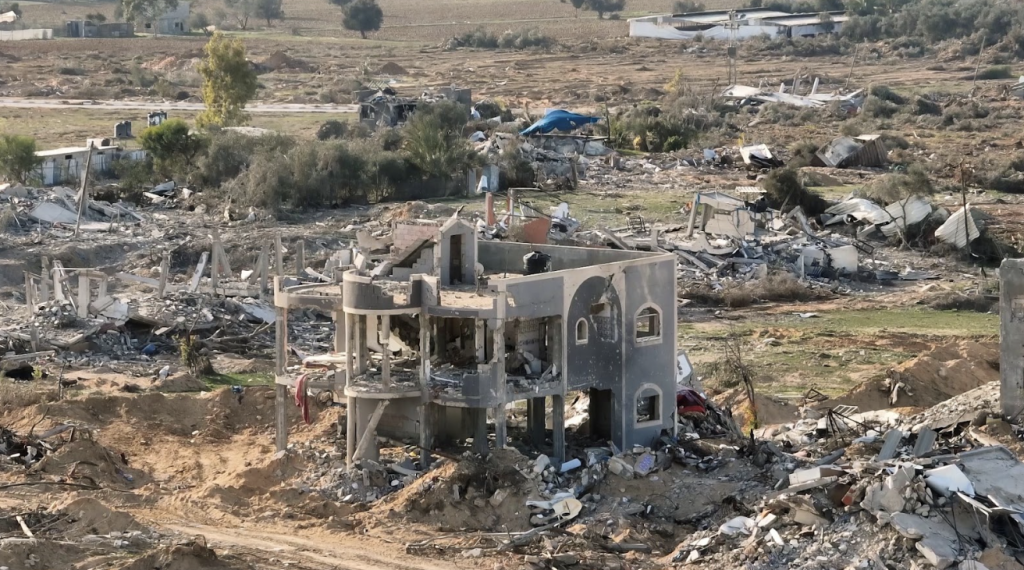
According to the United Nations, nearly 80% of Gaza’s buildings have been damaged or destroyed, leaving 50 million tons of rubble as of December. Ninety percent of its schools have been destroyed or damaged, and almost all universities severely damaged or closed. Fewer than half of Gaza’s hospitals remain even partially functional, having been repeatedly evacuated, raided, and attacked by the Israeli military, which accuses Hamas of using them for protection.
Death, war trauma and psychological exhaustion affect everyone in Gaza. Parents, children, extended families and even entire neighborhoods have been obliterated. More than 67,000 Palestinians have been killed in the Israeli offensive, a third of them under 18. Local health officials say that one in every 34 Gazans, or more than 67,000 people, have been killed in what an independent UN Commission declared a genocide committed by Israel against Palestinians. Of the over 167,000 Gazans wounded physically, more than a quarter carry what the World Health Organization defines as “life-changing injuries.” More than 5,000 have sustained severe damage to limbs, including amputation, or injuries to the spinal cord.
The Palestinian Central Bureau of Statistics found that more than 39,000 children have lost at least one parent in the war, and that nearly half of those children have lost both. Makeshift tent schools offer minor relief, and an opportunity to play a bit and feel like children. Their next hope – like everyone else’s – is unclear. According to UNICEF, almost all of Gaza’s schools need refurbishment or reconstruction.
Before the war, Mona al-Ghalayini was already an anomaly – a woman who had worked her way into Gaza’s business elite. She co-owned a grocery store, and owned and managed an eatery and upscale hotel on Gaza City’s Mediterranean coast. She’s even built a new business, the restaurant Jouzoor, in Cairo, Egypt, where she’s found refuge. But imagining a return to Gaza in its current state is impossible, al-Ghalayini says, without the “components of life” – stability, running water, and electricity. “There is no clear vision for anything that you can build on,” she says. “The future is not clear for anyone.”
Any potential future depends upon Israel and Gaza recognizing their fates as intertwined, says Hassan Shehada, who once employed more than 200 people manufacturing clothing – their products were in large part sold on to Israel. “Israel can’t give up on us, and we can’t give up on Israel,” he said. “If there is no real peace built on solid foundations between us, nothing will work.”
“The numbers do not capture all that is lost,” Times reporters Ben Hubbard, Bilal Shbair, and Iyad Abuheweila write. “Erase enough of the landmarks in someone’s daily life – the shop where they bought tomatoes, the cafe where they met with friends – and that life fades away.”
The name “MindSite News” is used with the express permission of Mindsight Institute, an educational organization offering online learning and in-person workshops in the field of mental health and wellbeing. MindSite News and Mindsight Institute are separate, unaffiliated entities that are aligned in making science accessible and promoting mental health globally.

Author

Related Articles

Does Contemporary “McMindfulness” Reinforce Our Suffering?
A Buddhist teacher and professor argues that a commodified mindfulness solely focused on the self is only a stopgap fix.
“No Beds”: Despite Improvements, Detroit’s Shelter System Continues to Let Families Down
When a Detroit mom and her two sons faced homelessness last year, she spent months calling the city daily for beds – in vain.

988 call responses plummet in Georgia after insurer cutbacks
After an insurance company made cutbacks, Georgia’s 988 response rate to mental health crisis calls “fell off a cliff.”
