
For People Leaving Jail and Prison in California, Programs to Support Their Reentry Are a Lifeline
People in the reentry program can receive housing, job training and substance use treatment.

Incarcerated people, especially those with mental illness or addiction issues, benefit from reentry programs, which offer housing, job training, substance use treatment and other crucial support.
When 30-year-old Guillermo was in the county jail for nine months in San Diego County in 2024 for violating probation, he was coping with withdrawal from the heroin and methamphetamines he used to help ease the pain of a trail of losses.
The young laborer had never gotten over the deaths of his mother and aunt, killed in a car crash when he was 3 years old. He was also mourning the more recent deaths of his father and stepmom, and being in jail had pushed him to the brink.
“I was very stressed and having these anxiety attacks,” said Guillermo in a Zoom interview. Like other formerly incarcerated people interviewed for this story, he is identified only by his first name to protect his privacy.
He was prescribed medication to manage his moods and to help him sleep. He was kept awake by racing thoughts and would try to push himself “to be strong,” but his anxiety grew as his release date was approaching because he had no home to return to, no job and no support. Then he got a visit in jail from a clinical case manager from the Neighborhood House Association, (NHA), a San Diego-based nonprofit that employs many people with lived experience to provide education and wellness services across the lifespan for low-income people.
“She took all my stress away,” marvels Guillermo. He was told that he’d receive assistance with housing in a sober living environment, help in connecting to an outpatient rehab program to manage his addiction and assistance getting health insurance through Medi-Cal.
And on the day Guillermo left jail, two case workers from the Neighborhood House Association were waiting for him at the gate. The pair treated Guillermo to a combo at Jack-in-the Box, accompanied him to a pharmacy and bought him a month’s prescription of suboxone – a medication that reduces craving for opioids – and took him to a sober living house, telling him they’d check back in a week “and if I didn’t like it there, they’d find another place for me.”
Providing choices and support from day one for people preparing for life outside of the walls of jail and prison is what can set the stage for mental well-being, according to Mona Minton, PhD, a psychologist and general manager of programs and clinics for the Neighborhood House Association (NHA), which coordinates and manages pre-and post-release services for people in jails in San Diego County.
Every year, more than 600,000 people in the United States are released from state and federal prisons. Another 9 million cycle out of local jails each year – many with nothing but a plastic bag of their belongings and no transportation to get them to their next home. But when Guillermo left the lockup facility, he was already enrolled in a year-long process overseen by the NHA to help reintegrate him back into the community. The goal: To prevent recidivism and help returning citizens live a healthy and productive life.
Things tend to fall apart if you leave jail or prison “without knowing that you have someone who’s got your back, who’s going to check on you, who’s going to hold your hand, pick up your phone call when you’re about to relapse,” noted Minton, pointing her finger for emphasis. “You’re going to deteriorate, you’re going to become homeless, you’re going to use, you might overdose, you can go back to jail.”
Indeed, a retrospective study in the New England Journal of Medicine of 30,000 people released from prison in the state of Washington over a four-year period found that during the first two weeks after gaining their freedom, those newly released were more than 12.7 times as likely to die as other state residents of the same sex, age and race. The most common cause of death was drug overdose. The study concluded that the release process itself was contributing to the high suicide rate, and “interventions are necessary to reduce the risk of death after release from prison.”
Similarly grim statistics plague Californians released from incarceration. The number of people in jail with an active mental health case rose by 63% in the last decade, and some 66% of incarcerated Californians struggle with substance use disorders. Overdose was the leading cause of death among individuals recently released from jail or prison – higher than incarcerated individuals anywhere in the country, according to a brief by the California Department of Health Care Services.
How reentry programs are helping
Through its reentry program, the Neighborhood House Association tries to reduce these kinds of outcomes by helping incarcerated people get ready to return to the outside world. In California, they can begin that process by sending a counselor into the facility to meet with people as early as six months before they are slated to be released and can continue to provide an array of services for up to four months after they’re released (and sometimes longer if they need extra help). These services are available to everyone leaving the justice system, but they’re particularly important for those in the criminal justice system who have serious mental health issues and/or struggle with substance use.
The reentry program also covers payment for housing for an average of 90 days, provides transportation and helps connect those leaving jail with substance use programs, health providers and mental health support, including faith-based counseling. It receives funding from the Mental Health Services Act, the San Diego County Sheriff’s Department, and the state’s PATH/Justice Involved initiative, among other places.
Neighborhood House Association is one of more than a thousand nonprofits or other agencies across the country that offer reentry programs. Since the passage of the Second Chance Act in 2008, all 50 states have made some investment to improve the outcomes for people leaving jail and prison. In 2024 there were nearly 1,200 grantees from 48 states and three territories serving more than 400,000 people.
The NHA’s programs – Project In-Reach and Project In-Reach Ministries – served 309 people in San Diego County who were released from jail between July 2024 and June 30 2025. Most were linked to services at the time they finished the program (91% before release, 83% after their release). The majority (69%) had not been rearrested in the six months since their release, according to the group’s annual report.
Guillermo, for example, was matched with an outpatient medication addiction treatment program, including counseling, through the Episcopal Community Services, which continued his suboxone prescription and helped him understand how to reframe his thinking whenever he is flooded with despair or anger and had the urge to use.
“I think about the good things I want in my life and have to remind myself that I have the power to control myself and that I have to hold myself accountable,” he said. Now sober for a year and off suboxone, he also helps run the twice-weekly Narcotics Anonymous meetings at the group home where he lives, making coffee and welcoming everyone. ”I feel good. I feel healthy,” he says. It’s something he doesn’t take for granted.
Minton says the organization’s success in helping people stay out of jail begins with the programs’ staff members’ abilities to build trust. Everyone working for the program, including Minton, has had experiences with addiction or the justice system that mirror the struggles of their clients.
“I myself am in recovery,” says Minton, who has worked as a clinical psychologist for 18 years. “I’ve been clean and sober for four years. I relapsed four years ago and then hopped back on the journey.”
A Neighborhood House Association peer support specialist who goes by the name Story shed her full name to distance herself from the addiction identity it carried for her. She has herself spent time in jail and has gone through the Sheriff Department’s Peer Reentry Leadership Academy, also run by the NHA, which teaches students motivational speaking skills and how to connect people up with the many services they need when they come out. She is one of the support specialists who meet people on the day they’re getting out of jail.
Story highlights how her own experience with incarceration makes a difference. A person she was picking up recognized her from the inside. “She said, ‘Obviously, you’re doing good now,’ and I said, ‘Good enough so that they let me come and pick you guys up!’” “My role,” she continues, “is to provide hope, showing the clients if you want it, you can do it — it’s possible.”

NHA’s clients include some affluent Californians who’ve clashed with the law as well as low-income, middle class and working-class residents.
Isaac, for example, doesn’t fit the usual profile of someone who ends up in jail – he has a PhD in biology and describes himself as coming from an upper-middle-class background. The people and program at NHA, he says, “helped me more than anyone helped me in my entire life.” Prior to being arrested and going to jail last year, he was homeless and ravaged by mood swings from bipolar disorder, a serious mental illness that affects 66% of those in jails in California. While in jail, he badly wanted to get out, but he was haunted by his experience of homelessness and feared what was in store for him.
“It’s really scary, you can just get killed any time,” he says of his time on the streets. “I got beat up a couple of times. One time, a guy did a flying knee into my ribcage and broke my rib.”
Research confirms that Isaac’s fears are backed up by data. A retrospective study of more than 22,000 people in 22 different localities who died while homeless over a 10-year period found that deaths related to homicide were among the “largest increases” in homeless mortality rates where the cause of death was known.
Isaac remembers his day of release from jail as being surreal: The outreach workers from NHA were there to meet him. “They brought me underwear! Clothes! Food! I had a milk shake!” he says, beaming on our Zoom call. “If you’ve never experienced that situation, you can’t appreciate what it’s like to not have anything, even clothes.”
Isaac, who has intense brown eyes whose gaze softens when he speaks, says that NHA staff brought him to all his appointments, enrolled him in MediCal and connected him to a psychiatrist, who prescribed medication to stabilize his moods. NHA also gave him a free place to stay when he got out of jail, clothes and plenty to eat.
But what really stands out were the check-in calls from Samantha, a clinical case manager. “Just something as simple as someone checking in on me and wanting to know how I am doing — even if I’m too down to talk to them — knowing someone actually cares to check in on me is nice,” he said. “Whenever I talk to Samantha, I just feel better.”
Isaac also has support from a close friend and a brother living in the area. While it may seem obvious, emotional support – along with the practical, logistical support programs like NHA also provide – “can significantly influence mental health, employment opportunities, family relationships and recidivism,” according to a study of 150 formerly incarcerated individuals.
Anthony Ammons, who now works as a special projects coordinator for the California Department of Justice, spent 20 years in prison and credits the Ahimsa Collective, a reentry program based in Oakland, California, with creating an emotionally supportive environment to help him settle back into civilian life. The collective was founded in 2016 by formerly incarcerated individuals.
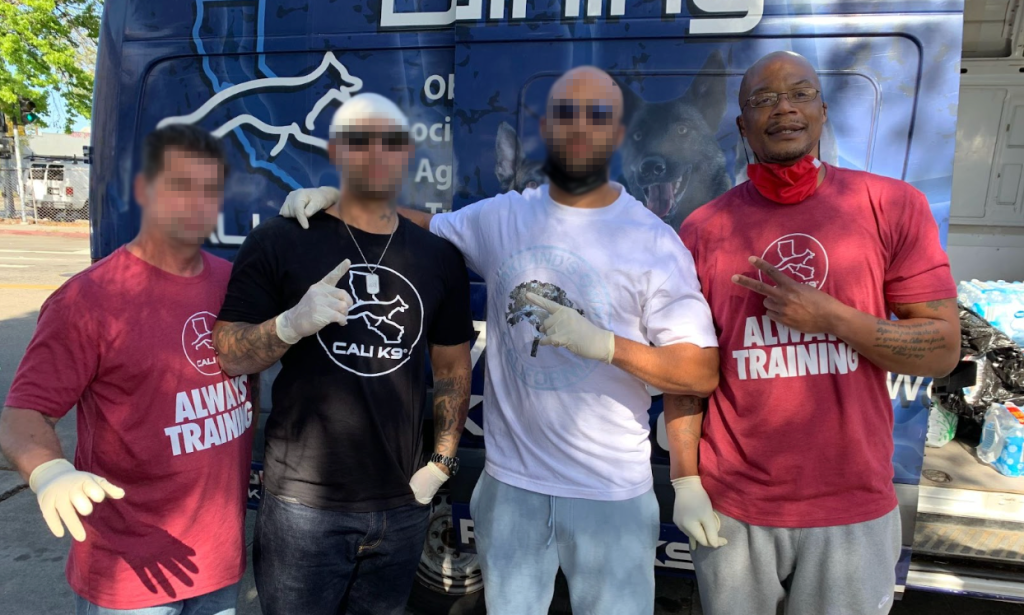
When he was picked up by an Ahimsa Collective staff person and brought to the house where he’d be staying in April 2021, his mother, father and brother were waiting there to greet him. “Words can’t even describe my feelings. They’d come to visit me every three months, but seeing them outside and just sitting in their presence was huge,” said Ammons, who also works as a case manager for another reentry program ReEvolution.
Ammons recalls Richard Cruz, Ahimsa Collective’s executive director, telling him that whenever Ammons’ family came for a visit there was a room for them to stay in at the house set aside for them “because we have to build those ties again.”
This approach differs from that of some sober living homes and other reentry housing that prohibit visits from family and old friends – even talking with friends who have been incarcerated is verboten. Many formerly incarcerated people say this is like being in jail again.
For Ammons, things like getting a refillable mass transit card so he could ride around on the bus helped him feel like he’d regained some control over his own life, a core value of the group’s approach.
“To just get on a bus and go find me, find my freedom, just figure out what’s around me,” he said, “gave me agency as a person who’s been locked up for 20 years since I was 16.” Without the freedom to explore and reexperience life on the outside, he would still feel “incarcerated mentally,” he said, “I’d be right back in that box of being incarcerated mentally again.”
All the members of Ammons’ Ahimsa household “circled up” on a weekly basis, explains Ammons, to support one another. Out of one of those discussions, Ammons and his fellow housemates decided to volunteer at a nearby church to help bag up produce for community members in need. “To see people smile when they got the bag of produce gave me a sense of purpose,” he said.
He also remembers the time he offered to wash Cruz’s van. Cruz asked him how much he wanted to be paid, and Ammons felt uncomfortable naming a price. Cruz told him that he would be making money renting out the van and pressed him with an important message: “It’s not up to me to tell you what you’re worth. It’s up to you to tell me what you’re worth” And that, said Ammons, “helped me understand that I’m worth something, that I’m valuable, that I’m human.
The Ahimsa Collective’s “people first” approach is critical to empowering people who’ve spent decades behind bars.
“They have been told what to do, when to eat, when to go to sleep, when to go outside,” Cruz said. “And so all of that has impacted their behavior and their beliefs about themselves,” he says. “When they come out, that sense of agency has to be worked back into them. So we keep asking, ‘How can we support you?’”
While reentry programs are a lifeline for formerly incarcerated people, NHA realizes that some could benefit from additional aid as they struggle to get their life back together before their source of support dries up. That’s one reason the nonprofit links clients up with community-based organizations that provide longer-term services, according to Minton.
Isaac, who graduated from NHA’s Project In-Reach, has submitted over 100 job applications since May and has not been able to find anything yet. He is grateful to his brother for helping him remain in the house that he’s been in since leaving jail, he says, and is just looking for the chance to work again.
Guillermo tried to join the military but was rejected because of his criminal convictions. For months, he applied for everything from house painting and warehouse work to a job at a moving company before he was hired again as a construction worker. While the housing subsidy typically lasts up to 90 days, he has been allowed to remain in the sober living house where he’s been since leaving jail.
“Some clients need additional support, and when that happens, they can request it from us,” said Minton. NHA then makes a request to the county for an extension.
Back at the house, Guillermo enjoys co-leading the Narcotics Anonymous meetings and cooking for his housemates. Just the other day, a housemate gave him shredded beef and rice and asked if he could prepare it. Guillermo whipped up a sumptuous dinner of shredded beef with green peppers, mushrooms and spices in a teriyaki sauce.
They ate together and talked about their day – an easy camaraderie and warmth that Guillermo never takes for granted. Even though the future is unknown, he said, “I feel like I’m doing something positive for somebody and for myself.”
The name “MindSite News” is used with the express permission of Mindsight Institute, an educational organization offering online learning and in-person workshops in the field of mental health and wellbeing. MindSite News and Mindsight Institute are separate, unaffiliated entities that are aligned in making science accessible and promoting mental health globally.


Author

Related Articles
As AI ‘Therapists’ Dish Out Advice, California Lawmakers Try to Set Some Limits
The use of chatbots has exploded over the last two years, and people are increasingly turning to them for mental health advice.

LA County Says a Program Meant to Help People with Serious Mental Illness is Gaining Traction
Gov. Gavin Newsom’s mental health court is gaining more participants in Los Angeles County. CARE Court treats people with serious mental health conditions.
Silent Cry: The Unseen Toll of Infant Loss on Black Families in California
Across the United States, Black parents experience infant loss at rates twice as high as their white counterparts. In California, Black infants die at nearly three times the rate of white babies, a disparity that persists in Kern County, where socioeconomic challenges leave infants dying at triple the rate of white babies as well.