
With SNAP Benefits Delayed, Fountain House Clubhouses Scramble to Feed Hungry Members
From New York City to Salt Lake City, Fountain House and affiliated clubhouses have created plans to feed members impacted by cutoff of SNAP funds
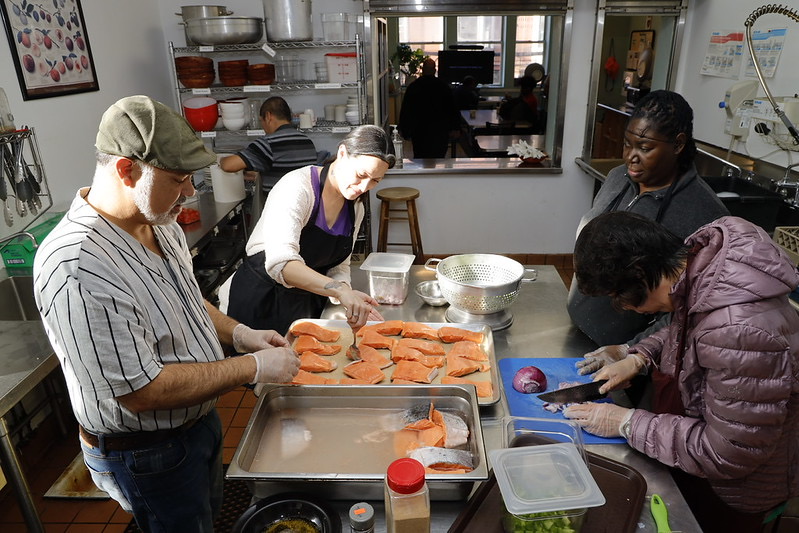
A MindSite News interview with Fountain House members and staffers
This story has been updated with links where donations can be made to support the efforts of Fountain House and affiliated clubhouses to feed their members.
Starting this week, some 42 million Americans were faced with an existential dilemma: How would they feed themselves and their families while the federal SNAP benefits they use to buy groceries are cut off by the Trump administration?
As of Monday afternoon, the White House, in response to court orders that SNAP benefits be reinstated, said people should expect to receive only partial benefits this month and that those payments would be significantly delayed.
The problem is particularly grave for the estimated 20% of SNAP beneficiaries who are grappling with mental illness. For this group of people – already struggling to cope with uncertainty and stress – losing the ability to pay for food adds another huge stressor to their lives.
One group stepping up to help is the members and staff of Fountain House, an organization founded 77 years ago to provide a place where people with serious mental illness gather together at a “clubhouse” and provide mutual support to each other.
That mutual support is now being focused on a critical task: ensuring that all members get the food they need. Members from the original Fountain House, in Manhattan’s Hell’s Kitchen neighborhood, and those in Harlem, the South Bronx and the Hollywood neighborhood of Los Angeles – along with affiliated clubhouses in other states – are stepping up their efforts to provide meals and food to members who need it.
Fountain House is accepting donations at this link to help it feed its members, and also released a directory of affiliated clubhouses around the country that are seeking support for their food programs.
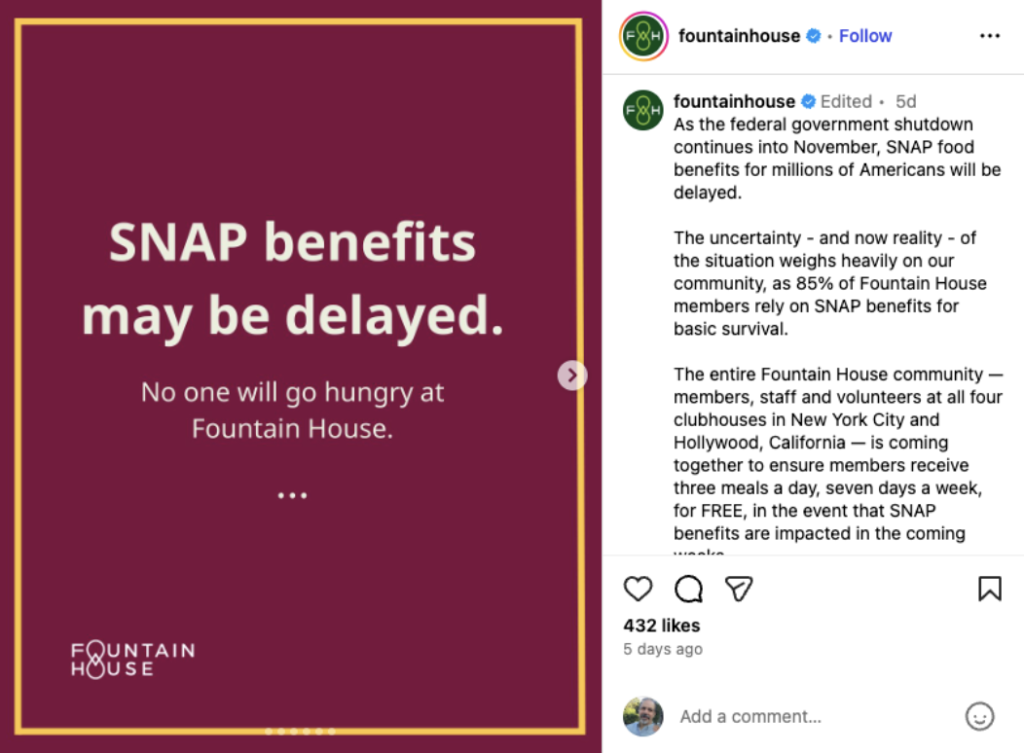
MindSite News Editor Rob Waters spoke with members and staff of Fountain House programs and affiliates to learn more about how they are caring for each other. As member Shawn Guffey said: “Once it became clear that SNAP benefits were going to be cut off, the question was never will we make sure that the members of our community have food to eat. It was, how will we?”
“Fountain House has been around since 1948,” he added, “and we’ve been through wars and pandemics and terrorist attacks and there’s never been a question that we are not going to take care of one another.”
Here are edited excerpts from that conversation.
Safi Chaudry, communications team member:
I came to Fountain House six months ago. I was very hesitant at first to join – my therapist had recommended that I take a hard look at it – and it took me a year to go through those green doors. And then I finally did, and it’s been mind-blowing – the change in my mood, the change in my health, the positive effects it’s had.
I find community, I find belonging. I find a sense of cohesiveness which was lacking before, and being able to see other people struggle and still make through their day is inspiring.
Shawn Guffey, member, education employment unit and community programming and facilities team, responsible for direct services in the clubhouse and programming.
I was a high school teacher in the Bronx, and then I did an all-but-dissertation PhD program in developmental psychology. But as I was getting worse and going into the hospital more and more, I was never able to finish. And then I spent about seven years basically completely alone, never leaving the house except to walk my dog and going in and out of the hospital.
I came directly from an inpatient psychiatric unit – that’s one of our biggest referrers, along with post-incarceration programs and housing programs for people who were unhoused. The requirement is that you have a serious mental illness and not be a danger to the community. So I came from an inpatient program. I used to say that I spent my summers at Columbia Presbyterian.
As I had gotten older, my illness had gotten worse and worse. I’ve had over 200 electroconvulsive therapy treatments. At one point, I was having a treatment every month, because nothing worked for my illness. At one point I thought my life was – that I would never have any kind of meaningful role in society, and that has changed as a result of Fountain House. I found a sense of belonging, a sense of purpose. I’m one of 12 people who work together to run the place. And this is four club houses with 1600 members. That’s a lot of work.
So tell me about how your SNAP benefits. How much have you been getting? How far does it go — and what’s going to happen now?
Shawn Guffey: I get around $180 a month in SNAP benefits, which is not a lot when you think about the cost of groceries. Our best guess is about 80% of our members receive SNAP benefits. Many of our members get the majority of their meals from the clubhouse, and now many of them will be getting all of their meals at the clubhouse.
Safi Chaudry: I get around $177 per month, which isn’t much, but it does help bolster my budget throughout the month. I’ve just been trying to figure out where I can make cuts, or where I could dip into my savings, or what the next steps look like.
Shawn Guffey: People are going to have to make choices between, you know, buying food and paying the utilities or paying a copay on a medication or paying for a metro card, right? If you can’t afford a metro card, you can’t get to the clubhouse, which means you can’t eat the meal that’s being provided by the clubhouse.
Once it became clear that SNAP benefits were going to be cut off, the question was never will we make sure that the members of our community have food to eat. It was, how will we? How can we ramp up? How can we order the food?
Every single day, the members make lunch for one another and make breakfast for one another, and some days we make dinner for one another. All of this is being done by members, from ordering the food to serving the meals to cooking the meals to serving the meals to cleaning up afterwards.
One thing I’ve been impressed by when I’ve visited Fountain House is the diversity of people that are there – where you are and what you’ve done in life, as well as racial and ethnic diversity. How do all those different kinds of diversity sort of bring themselves together at Fountain House?
Safi Chaudry: It’s like a tapestry in a way – everyone is threaded together from these different backgrounds, these different beliefs, different races, different educational levels. I mean, I’ve met people that haven’t finished high school, and then I’ve met people with three PhDs, all in the same room trying to figure out what’s next, trying to find community. That cohesiveness is very much on display every day in Fountain House.
Shawn Guffey: I don’t think there is a more diverse place on Earth – you name it, we’ve got it, and they are a part of the community. Human beings need community. They need to be needed. They need to be with one another. When you’re together in community, that’s more important than your differences, it’s more important than your diagnosis, and that’s how we hold one another together.
Turning back to SNAP, when did the members and leadership team start to think about how you would address this problem, and what have members been saying in terms of their fears about losing this life-saving benefit that they depend on?
Shawn Guffey: I think our members have been very afraid, but also confident, knowing that we would take care of one another. I don’t think anyone was afraid that they were just going to be left hanging with no assistance whatsoever. Fountain House has been around since 1948 and we’ve been through wars and pandemics and terrorist attacks and there’s never been a question that we are not going to take care of one another.
Tell me about the planning and fundraising and logistics of increasing the amount of meal preparation that you all are doing.
Shawn Guffey: We found out early last week that this was definitely going to happen. We knew this was a possibility from the beginning of the year, when the current administration came in, so we knew essentially what elements needed to be put in place: We’ve got to find ways to store more food. We’ve got to find ways to raise more money. We are reaching very deeply into our operating funds right now and hoping our supporters will come through to assist us. There’s talk that the SNAP benefits will begin again soon, but money talks; we’ll wait and see.
We have a SNAP delay contingency plan. There’s one for every clubhouse. And so every meal will be free in Hell’s Kitchen – breakfast, lunch and dinner will be served Monday through Friday. For the weekends, people will get a weekend pack, which is groceries, in a box, like subscription services that send you food. It’s a box of food that’s fruits and vegetables, healthy and hearty. It also has instructions and recipes.
For people who can’t leave their home, they will be delivered. If a member can’t come in during the day, they can pick up in the evening. They can pick up meals for the next day. Every day of the week, we have vans going out to deliver meals.
Thanksgiving is our big holiday at Fountain House. It’s a huge tradition – we have a gigantic Thanksgiving dinner. During the pandemic, we had Thanksgiving dinner delivered to every single member of Fountain House, and everybody ate their Thanksgiving dinner looking at the screen. So we have some experience scrambling to deal with emergencies. Our members are tremendously resilient. They are tough. They have been through a lot, and they can survive through a lot, especially together. There’s a line from an early member of Fountain House, Michael Obaleski, who says, “All we have is one another, and that’s more than enough.” We just buckle down and get it done.
Safi Chaudry: I’ve been talking to a lot of folks in the clubhouse, and they are frustrated and anxious. There’s a general sense of worry about how long the delay will last, and members are talking about how it’s affecting their ability to stay healthy and focused. At the same time, there’s also a feeling of support, since everyone understands what others are going through.
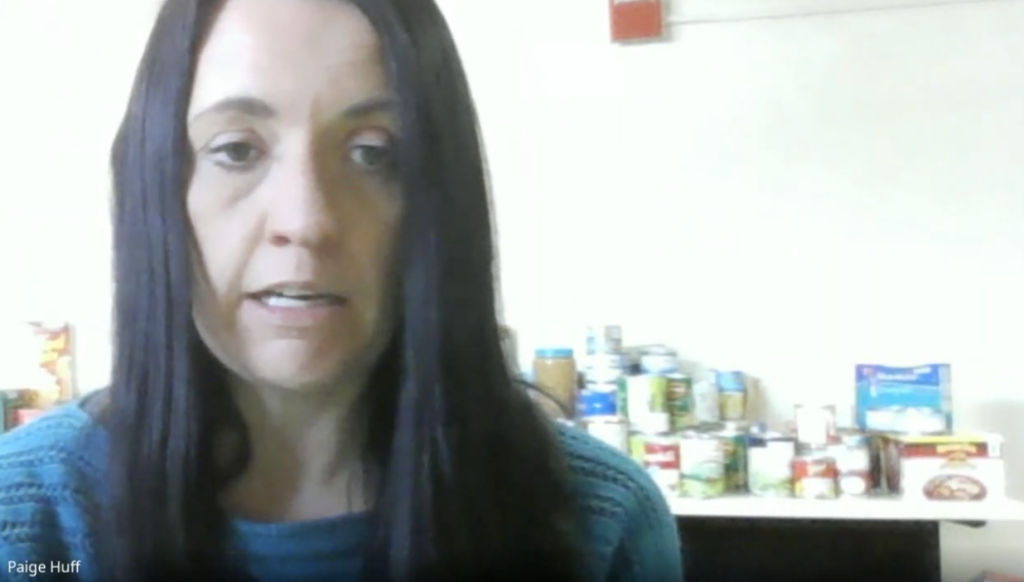
Paige Huff, director of Alliance House in Salt Lake City, Utah: Alliance house has 370 active members, but I would say 90% of those are going to be impacted by this, because those that don’t utilize snap or don’t receive SNAP, are utilizing the food banks. In Utah, a lot of people utilize the food banks, and as of last weekend, the food banks are turning people away because they no longer have food.
We have committed to do a food drive. Members can come and get a box, and then they can take that with them. One thing that we’re struggling with is that a lot of our members are unhoused, and therefore having a large box of food is not going to be conducive for them, whereas on the SNAP benefits, they could just go get food for that day. So we’re trying to coordinate for people to come in daily, rather than getting a box, because they don’t have anywhere to take that box. Those are kind of the nuances that we’re trying to figure out. But I’m also here with my colleague, Trudy, and I will let her speak to her perspective.
Trudy Moser, Alliance House member: I’ve been a member of Alliance House for almost eight years. I’m trying to come to the clubhouse every two days a week at least. I help in the cooking, I help in the graphics, I help in the food behind us. I’m affected because I have $70 that I usually get on the 11th and not getting it is just stressful. It adds to my anxiety and depression, makes me worry, but Alliance House – having their help right now makes me feel like I can breathe a little more. It makes me happy. A lot of the people around here are shocked and confused and don’t know what to do, but we’re working our way through it.
Jillian Santoro, clubhouse director of Fountain House Hollywood:
We’re providing 21 meals a week to each of 140 members. We serve breakfast and lunch Monday through Friday. For the month of November, breakfast and lunch will be free for members who come into the clubhouse, and then every day, they’ll be able to take a bag home with a meal. For example, tonight they can take home a bag with spaghetti and sauce and a can of mushrooms that they can cook at home if they have a kitchen. But if they don’t have a kitchen, they have nowhere to cook. And so many of our unhoused members don’t have access to cooking or even a microwave, so we’re doing that. On the weekends, we’re providing three meals on Saturday and three meals on Sunday, because the clubhouse isn’t open.
We also have Thanksgiving this month, and that’s kind of a big deal. If our members don’t have their SNAP, their Thanksgiving dinner is not going to exist. We do have Thanksgiving in the clubhouse, and we offer that. It usually costs the members a couple dollars, but we’re going to have Thanksgiving be free for our members this year. But you this is coming out of our emergency fund, and that’s going to affect our programming in the future and down the line. I spent $2,000 on groceries this week to give food to our members, and I can’t do that forever. I’m going to run out of money. And so that’s something we haven’t even brought up, that I’m sure Paige is also nervous about – we’re taking money from other places, other bucket items in our budget, to try and make sure that our members can eat.
The name “MindSite News” is used with the express permission of Mindsight Institute, an educational organization offering online learning and in-person workshops in the field of mental health and wellbeing. MindSite News and Mindsight Institute are separate, unaffiliated entities that are aligned in making science accessible and promoting mental health globally.


Author

Related Articles
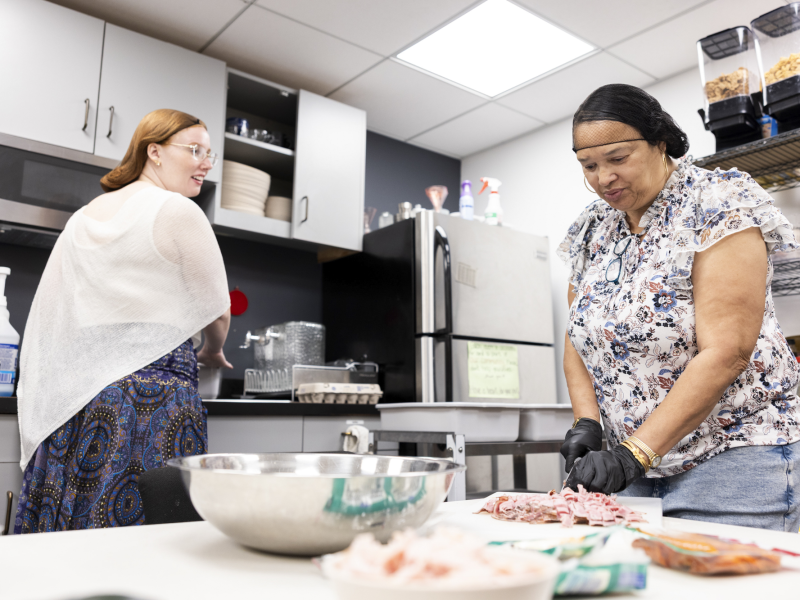
An L.A. Woman Was Feeling Lost. Fountain House Hollywood Gave Her a Sense of Purpose
Fountain House aims to build connection by operating “clubhouses” where people with serious mental illness can connect with and support each other. The Hollywood program opened two years ago.

Trapped and Alone: Fear of ICE Is Deepening Postpartum Isolation for Immigrant Mothers
Doctors say newly postpartum people need medical care, sleep and the ability to rely on friends and family for help. Immigration crackdowns have made that support impossible.

Supreme Court says Colorado can’t ban conversion therapy for LGBTQ+ youth
The case was brought by a Christian counselor who argued that Colorado’s ban violated her free speech rights.
