
Developmental Psychologist Debunks Myths About Attachment Parenting and Babywearing
Developmental psychologist Emily Little argues that babywearing promotes secure attachment and better parental mental health.
Raising a child is complicated, which is why we can end up leaning on conventional wisdom or oft-repeated advice. But, as Emily Little, PhD, – The Baby Myth Buster – points out, the myths we stick to aren’t always helpful or even harmless. On her BabyMyth Buster platform, she applies her background in developmental psychology to ask and answer a particularly thorny question: “What if everything you knew about babies was wrong?”
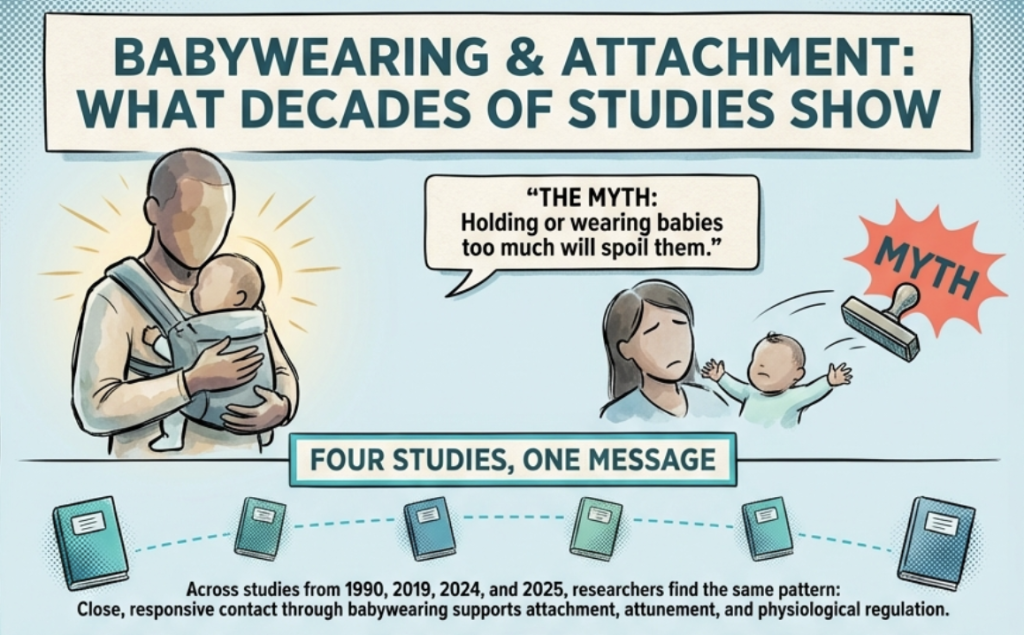
An ongoing series of Little’s looks at attachment parenting, which seeks to build a close relationship between babies and parents by promoting practices like feeding on demand, co-sleeping and holding and “wearing” the baby whenever possible. Not only is attachment parenting practiced successfully by cultures around the world, she notes, but science supports it. In this recent infographic about “baby-wearing” – the practice of carrying a baby close to your body in a sling or other soft carrier – she examines the idea that too much holding or “wearing” a baby could “spoil” them.
Her infographic quickly summarizes four studies from 1990 through 2025, all of which found that baby-wearing “supports attachment, attunement and physiological regulation.”
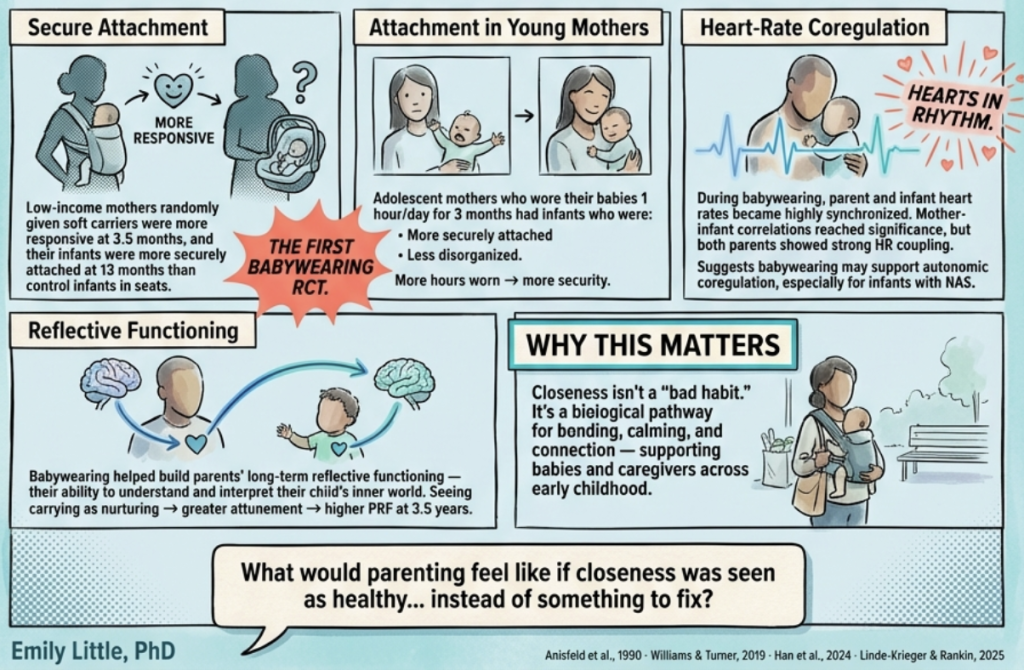
A 1990 study on secure attachment, which Little calls “The First Babywearing RCT” (randomized controlled trial) found that low-income mothers who had been given a sling or soft carrier to hold their baby had infants who were more responsive at 3-½ months and more secure at 13 months than those who were given hard baby seats.
Another study from 2019 found a correlation between secure attachment and the number of hours spent babywearing. A 2024 study found babywearing might help put infant and parents’ hearts in rhythm, something known as heart rate co-regulation. Still another study, from last year, found that babywearing helped parents understand and interpret their child’s inner world. Little also coauthored a small 2023 study that found that mothers using infant carriers reported fewer depressive symptoms at 6-weeks postpartum.
Closeness isn’t a “bad habit,” Little concluded. “It’s a biological pathway for bonding, calming and connection – supporting babies and caregivers across early childhood.”
evs/Shutterstock
The name “MindSite News” is used with the express permission of Mindsight Institute, an educational organization offering online learning and in-person workshops in the field of mental health and wellbeing. MindSite News and Mindsight Institute are separate, unaffiliated entities that are aligned in making science accessible and promoting mental health globally.

Author

Related Articles



Did Multiple USS Abraham Lincoln Sailors Try to Jump Overboard? Families and a Senator Press for Answers
Multiple sailors aboard the USS Abraham Lincoln have attempted to jump overboard in recent months, Military Times reports.