
Health Organizations Condemn Traumatic ICE Raids, Family Separation
According to letters from children living in an ICE detention facility, living conditions are inhumane and their mental health is suffering.

Greetings, MindSite News Readers.
In today’s Daily, children in ICE detention share their experiences – colored by confusion, anxiety, and fear – in their own words and illustrations, through letters and their voices.
Mental health, pediatric, and parenting organizations have been outspoken in calling for an end to the violent and traumatic raids unleashed by federal immigration authorities, in particular out of a concern for children and immigrant families.
The Committee to Protect Public Mental Health is one of more than 430 health, civil rights, and community organizations urging Congress to restrict ICE activity in sensitive settings, including clinics and hospitals, via passage of the Protecting Sensitive Locations Act. These locations had been protected, but President Donald Trump revoked that status early in his second term.
Not restoring that protection is a hazard to public health. ICE actions in clinics, hospitals, and similar locations spark widespread fear across entire communities, delaying important care and weakening trust in vital institutions. The additional stress of unchecked, unaccountable ICE presence could potentially increase the risk of serious conditions including anxiety, depression, hypervigilance, and substance use.
As of this morning, the Trump administration has said it will end its surge in immigration enforcement in Minnesota.
‘All you will feel is sadness and mostly depression.’ Children Held in Immigration Detention Describe their Experiences
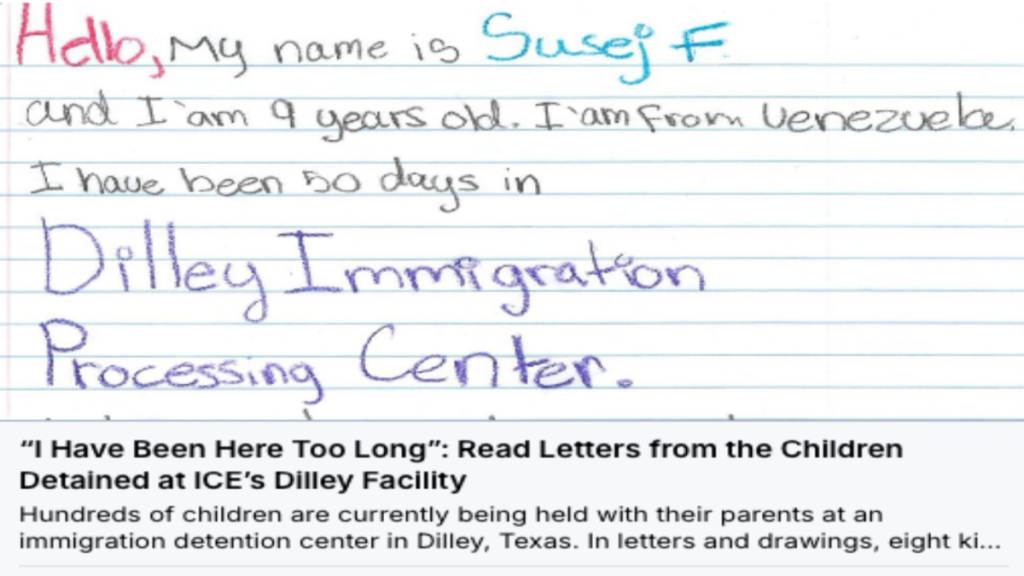
The facility is dirty, the children write. They suspect the water is making them sick, and they don’t trust the food after finding worms and mold on it. Officers in charge treat residents inhumanely and deny them medical care. And many children have languished there for months, leading some to thoughts of suicide.
These are the conditions described by children living in ICE detention at the Dilley Immigration Processing Center in South Texas. Their accounts took the form of handwritten letters and drawings one adult detainee gathered and forwarded to ProPublica upon their release from Dilley in late January. The children also spoke to ProPublica over the phone and in person, with their parents’ consent.
Several themes come up again and again. The mental health of child detainees is suffering, and they’re confused as to why they’ve been locked up. Of the youth whose status could be traced, all but one had been held far longer than the 20 day legal maximum.
A government statement claims that children have access to teaching and resources, but children say support is incredibly limited. Spaces are overcrowded, with a minimum of three families per room, according to one 12-year-old. Two children wrote that they feel sad and depressed, and all of them were distraught at their detention.
Some mothers told reporter Mica Rosenberg that their children were so distressed they’d started to cut themselves or talk about suicide.
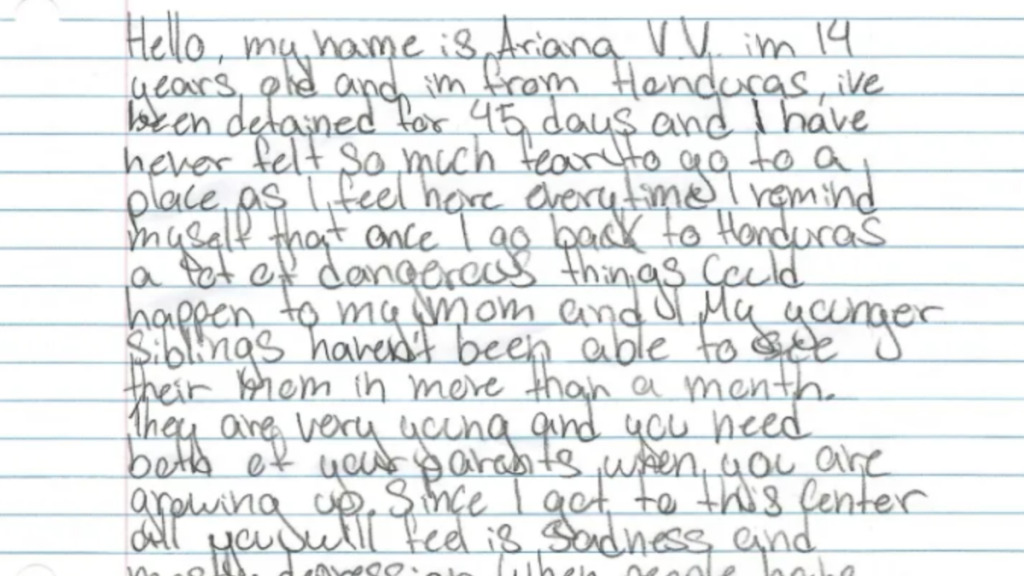
The letters have been scanned and transcribed, and can be read on ProPublica’s website.
“Hello, my name is Ariana V.V. im 14 years old and im from Honduras, ive been detained for 45 days and I have never felt so much fear to go to a place as I feel here everytime I remind myself that once I go back to Honduras a lot of dangerous things could happen to my mom and my younger siblings haven’t been able to see their mom in more than a month. They are very young and you need both of your parents when you are growing up. Since I got to this Center all you will feel is sadness and mostly depression. ”
“Not a lot of people know what is happening in the Centers where immigrants are placed at,” Ariana went on. “ haven’t been getting any school time. Every single person in here had their jobs they had their lifes, they aren’t any danger for this Country.… Since the day my mom and I get detained in Manhattan NY, my life was instantly paused, from my knowledge you can’t be under custody for more than 15 or 20 days, well here in Dilley Immigration Processing Center people have been in this place for 7 months, 5 months, 4-2 months, its not fair that the ICE officers are not following the laws. All kids are being damage mentally, they witness how they’ve been treated..”
Psychiatrists, mental health professionals speak out against ICE

In an email interview with MindSite News, Eric Rafla-Yuan, psychiatrist and chair of the Committee to Protect Public Mental Health’s Leadership Team, spoke to the direct impact health care providers have already seen as a result of the surge in ICE activity, particularly as it relates to mental wellbeing.
He also explained how ICE’s actions affect all citizens – not just immigrant communities – as well as the long term traumatic impact those actions can have, and the support people should expect from health care providers.
“As psychiatrists, we want the public and policymakers to understand that immigration enforcement practices like those being reported now can harm the emotional wellbeing of society at large. The effects include measurable mental health outcomes, such as anxiety, depression, trauma-related symptoms, and crisis presentations, as well as broader, harder-to-quantify, but very real consequences: fear, mistrust, social withdrawal, and disruption of family stability. Trauma lasts for a lifetime, and we witness, both in our clinical settings, as well as through daily news coverage, regular traumatization of individuals living in the United States, both citizens and non-citizens alike.”
You can read the entire interview here.
‘It’s not enforcement; it’s terror’: Pediatricians, Parent Groups and Social Workers Join the Cry
With the killings of Minnesota residents Renee Good and Alex Pretti still fresh on many hearts and minds, other national organizations – including the American Academy of Pediatrics, the American Psychological Association, the National Association of Social Workers and the National Parents Union – have also spoken out about the trauma and long-term harm posed by ICE’s violence and recklessness.
When ICE began arresting children near Minnesota public schools, National Parents Union President Keri Rodrigues wrote:
As a mother, I am heartbroken. As an American, I am disgusted. We live in the only country where parents send their kids to school and quietly wonder if they will make it home alive, unharmed, untaken.
Over the last several days, multiple children – some as young as five years old – have been arrested and detained by ICE agents in the Minneapolis area and were shipped to facilities in Texas. And today in south Minneapolis, federal immigration officers detained two teenagers on their way home from school as neighbors filmed and demanded answers. These kids were not the targets of ‘immigration enforcement,’ they were the victims of racial profiling, assumed to be non-citizens and held without their parents’ knowledge.
“This is not ‘normal.’ No child should grow up with the feeling that their safety depends on trying to be invisible. When government actions make children afraid to walk outside, go to school or come home, that is not enforcement, it is terror.
In other news…
Chanea Bond, a high school English lit teacher in Fort Worth, has AI-proofed her classroom – and the kids like it. Initially baffled by Bond’s paper-heavy approach, junior Meyah Alvarez says it’s working. “It was different, but I do like it now,” Alvarez told NPR. “I feel like it actually does get my brain thinking.” That’s the whole point, Bond says, despite some educators musing that not incorporating AI into the classroom will cause students to fall behind. “I just don’t see a world where students learning how to think and learning how to articulate themselves puts them at a disadvantage,” she says.
The name “MindSite News” is used with the express permission of Mindsight Institute, an educational organization offering online learning and in-person workshops in the field of mental health and wellbeing. MindSite News and Mindsight Institute are separate, unaffiliated entities that are aligned in making science accessible and promoting mental health globally.

Author

Related Articles

A Bustling Hollywood Clubhouse Helps LA Residents with Mental Illnesses Thrive
Fountain House Hollywood is one piece of a project to remake mental health care in the neighborhood, which officials termed “Hollywood 2.0.”

Illinois Mental Health Courts Offer Treatment Over Prison. Is it Working?
A joint investigation into Illinois mental health courts reveals a system of “mixed results,” where life-changing success stories meet high barriers to entry and unequal access.

The Children Left Behind After Family Violence
And how you can help your child with social media habits that “mirror symptoms of addiction to substances.”
