
Teens Close to Parents More Likely to Have Strong Social Network as Adults
New research finds that close relationships with parents during middle and high school can predict a strong social life two decades afterward.

Good morning, MindSite News readers.
In this edition, we’ll look at why a new study finds you may enjoy a better social life if you were close to your parents as a teen. Also, NBC News reporting underscores why “less lethal” weapons should never be used against peaceful protestors. How UCLA’s school of public health has supported the public during and after the terrifying wildfires of 2025. And a sad farewell to Jesse Jackson and Frederick Wiseman.
Close to Your Parents? You’re More Likely to Enjoy a Rich Social Life

“To many teens, nothing sounds worse than hanging out with their parents. But what if family bonds during adolescence meant a better social life down the line?”
That’s the question journalist Emily Baumgaertner Nunn recently explored in the New York Times, following new research published in JAMA Pediatrics finding that close relationships with parents during middle and high school predicted a strong social life as long as two decades afterward.
“We tend to think of adult loneliness or low social connectedness as byproducts of individual choice,” said Dr. Andrew Garner, a pediatrician and researcher at Case Western Reserve University, who was not involved with the study. This particular research, he told the Times, “forces us to think developmentally.”
Researchers looked at data from 5 survey waves of The National Longitudinal Study of Adolescent to Adult Health. Participants in the sample were around 16 in the first wave, (1994-1995), and around 37 by the fifth (2016-2018).
Those who had stronger family connections in adolescence tended to have higher social connections in adulthood – defined, among other things, as having three or more friends and socializing at least once a week.
The young people who were most connected to family went on to be more than twice as likely to have a rich social network in adulthood. Researchers adjusted for socioeconomic status.
The study indicates that strong social connections can be passed from one generation to the next. But what about parents who did not grow up in a close-knit, supportive household, but want that for their children? The researchers suggest that pediatricians can support parents to model that kind of connection for their children.
“We want children to get their immunizations, and we love to help parents with concrete milestones like healthy eating, toilet training and sleeping well,” Garner told the Times. “But we also want to ensure that every child is seen, understood and valued.”
‘Broken Bones, Burning Eyes: How ICE Deploys ‘Less than Lethal’ Weapons on Protesters
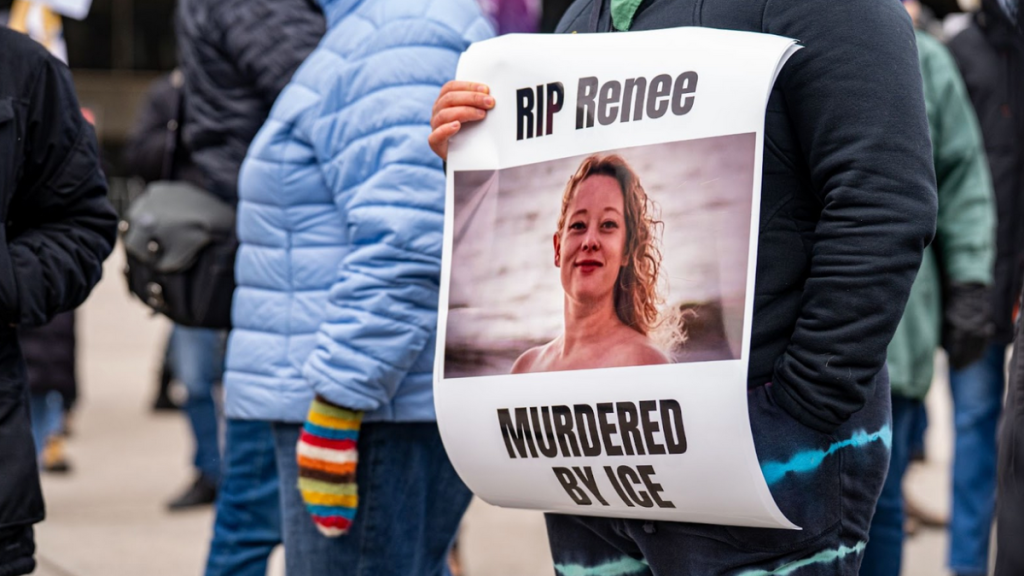
Alec Bertrand, a 30-year-old musician and recording engineer, was hit multiple times with projectiles while peacefully protesting ICE activity in California. Besides being struck in the testicle, shoulder, and leg fired by federal agents, he felt a rubber bullet hit his hand, shattering the bones in one of his fingers and causing profuse bleeding. Even after surgery on his finger, he can no longer play guitar. He had to leave his job and has since started physical and psychological therapy.
Minneapolis resident Leon Virden, 73, was horrified after hearing about ICE’s January 24 killing of Alex Pretti. He and his son drove to the scene and joined a small group of peaceful protestors chanting in an alley, where federal officers with identifying patches from ICE and another agency showed up.
As is increasingly common during protests a federal agent threw a flash-bang grenade at the protestors, which exploded, “shattering Virden’s face,” according to NBC News.
Expanded, aggressive immigration enforcement activity has become a key feature of the second Trump administration, and Bertrand and Virden are two more victims of its violent side. The fact that agents seem to use force indiscriminately contributes to a sense of “constant fear” and anxiety for many across the country.
These days, Virden is recuperating at home, taking Tylenol – his jaw had to be surgically rebuilt.
“I’m really pissed off that these, you can call them anything you want, I call them agents of the Antichrist, that they can come in and do this and get away with it,” Virden said. “I’m pissed off. I hurt a bit, and I just want to see some change.”
Virden is one of the hundreds of protesters injured at the hands of DHS force.
As Jon Schuppe and Natasha Krecki of NBC News write in their excellent investigation of DHS’ use of “less lethal” weapons, “they batter bodies with rubber bullets and sear eyes with pepper spray. They lob tear gas and explosive flash-bangs at chanting crowds. They smash car windows. They shove people to the ground. They ram vehicles and point their guns.”
“Federal officers carrying out President Donald Trump’s immigration crackdown in cities across the country have shot 13 people with guns. But far more often, they have used harsh tactics to scare or repel those they see as getting in their way.”
And, as the reporters note, “courts in at least four states have found that officers used force inappropriately and indiscriminately.”
In a review of dozens of incidents since the spring – involving interviews with experts and witnesses, as well as court documents and videos – NBC News found that Department of Homeland Security officers repeatedly used “less lethal” weapons in ways that would violate their own policies or general policing guidelines unless they believed their lives were in danger.
Rubén Castillo, a former federal prosecutor and federal judge who now leads the Illinois Accountability Commission, which is reviewing allegations of abuse against immigration officers, said he’d “never seen federal agents so out of control and acting in such a malicious manner. They said they were going after ‘the worst of the worst,’ then they became the problem.”
You can read NBC’s report on ICE’s violence here, as well as its earlier report on 13 shootings by ICE ICE agents.
UCLA ‘Filling the Void’ In Public Health Guidance After 2025 Wildfires
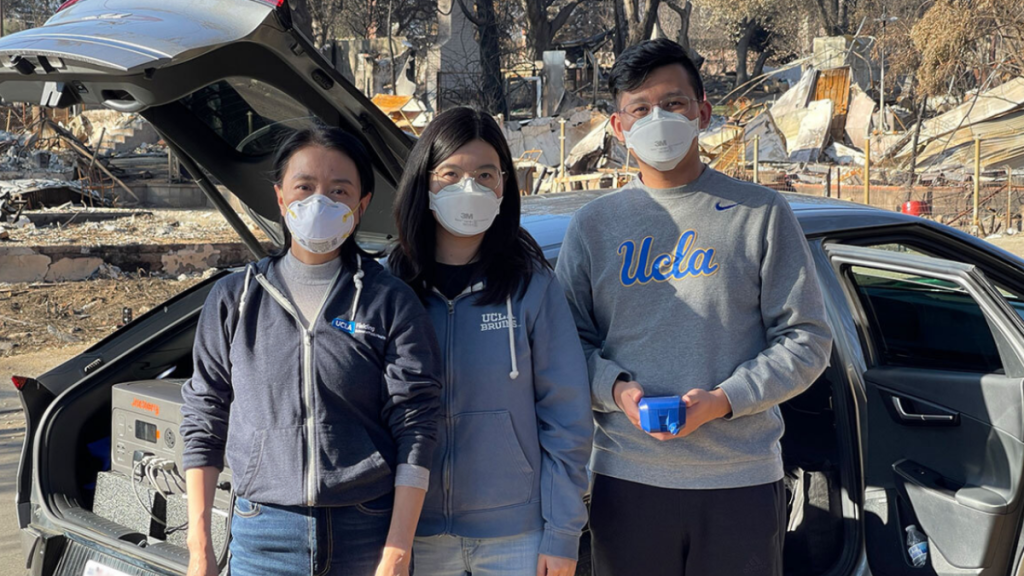
It’s a little more than a year after the devastating January 2025 wildfires in Los Angeles County, and the UCLA Fielding School of Public Health has been tracking their impact and funneling support to the community ever since.
Work began almost immediately, protecting staff and students at risk and supporting those who were displaced by the fires, said Dr. David Eisenman, a physician and professor in the Department of Community Health Sciences and director of the UCLA Center for Public Health and Disasters.
In January, Eisenman reflected on the lingering impact of the blazes, including the psychological: “Right now, we are studying the mental health consequences in the community, and we would expect to see elevated rates of depression, post-traumatic stress disorder and anxiety among people who were evacuated from the fires.”
After the wildfires, which killed at least 31 people and destroyed 18,000 structures, the faculty, students and staff rallied to do outreach ranging from tracking the health of firefighters to training recovery and construction workers how to do their jobs safely, according to a UCLA press release.
They also began the largest on-going study of the fire’s public health impact and set up free health and safety testing into communities hardest hit in the Altadena and Palisades fires.
“This is truly an example of mission-driven research,” said UCLA Chancellor Dr. Julio Frenk, distinguished professor in the Fielding School’s Department of Health Policy and Management. “It connects not only different disciplines but different levels of analysis, and it connects with communities and policymakers to ensure that discoveries are translated into action.”
Among the research is a planned 10-year-study looking into the short- and long-term impact of wildfires on health. According to the Atlantic, preliminary data shows higher rates of depression, anxiety, and perceived stress in LA County one year on.
And an on-going effort led by UCLA Fielding faculty that studies how mental health issues impact homelessness has expanded to focus on how the wildfires factor into these issues.
“In southern California, and around the world, emergency preparedness for natural and man-made disasters is essential,” said Dr. Michael Jerrett, professor in the Department of Environmental Health Sciences at the UCLA Fielding School. “This fire was quite unique in the sense that we had an enormous amount of human infrastructure burned [and] that has led to a myriad of toxic effects that we’ve haven’t seen in a large urban area before…UCLA is really trying to fill the void, that we may have seen from federal government agencies, in supplying the public with credible public health guidance.”
In other news…
Today we celebrate the life and work of documentary filmmaker Frederick Wiseman, dead at 96, whose film “Titicut Follies,” exposed terrible abuses in a mental hospital and was banned for two decades. His portrait of the horrors of Bridgewater State Hospital for the criminally insane in Massachusetts finally became public when the ban — ostensibly imposed to protect the residents’ privacy — was lifted in 1991.
Wiseman won an honorary Academy award in 2016 and made 35 documentaries on neighborhoods and institutions, including one on suburban high schools, “wielding the camera with an ethical ferocity,” Dan Friedman wrote in the Forward. He “sought to repair the world through film.” Other reviewers noted Wiseman “gave a moral accounting of America’s soul.”
Some of his later films were among his best-received, including “In Jackson Heights” (2015) and “ExLibris: The New York Public Library” (2017), which a New York Times reviewer called “one of the greatest movies of Mr. Wiseman’s extraordinary career and one of his most thrilling.”
We also mourn the passing of Jesse Jackson, 84, a leader of the civil rights movement who was with Dr. Martin Luther King on the evening King was assassinated in Memphis, Tennessee. A civil rights activist for more than seven decades, Jackson was also a minister, political figure and maker of good trouble.
He grew up in the segregated South and fought tirelessly to overturn segregation; he later founded Operation PUSH and the National Rainbow Coalition, made two presidential bids and remained a strong force for change in public life.
As he said: “Leaders must be tough enough to fight, tender enough to cry, human enough to make mistakes, humble enough to admit them, strong enough to absorb the pain, and resilient enough to bounce back and keep on moving.”
The name “MindSite News” is used with the express permission of Mindsight Institute, an educational organization offering online learning and in-person workshops in the field of mental health and wellbeing. MindSite News and Mindsight Institute are separate, unaffiliated entities that are aligned in making science accessible and promoting mental health globally.

Author

Related Articles

Dads’ Paid Parental Leave Is Good for Families
A look at how the whole family benefits when dads receive paid parental leave.

When Protecting Kids From Risk Goes Too Far
We explore childhood independence and the psychological cost of shielding kids from risk.
How to Save a Life: Lessons From 2 Bridges, 15 Years Apart
David Bartley, a suicide prevention expert who survived an attempt himself, on what saves lives.