
Portland’s self-run village for unhoused people costs less and houses more folks

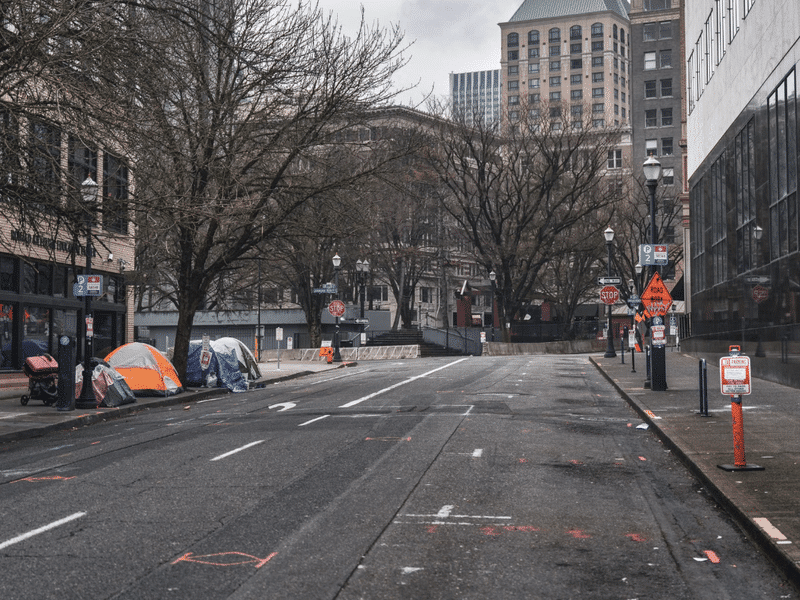
Since a 2024 Supreme Court ruling stripped federal protections from people living on public property with nowhere else to go, sweeps of unhoused encampments have increased nationwide. But clearing a camp does not resolve the next destination of its residents. Dignity Village, in Portland, Oregon, offers an innovative solution: let them decide for themselves. “Welcome to our radical experiment in collective self-empowerment to end homelessness!” the village manual declares, according to the New York Times.
Founded in 2001, the village took shape after unhoused Portlanders, worn down by repeated encampment evictions, staged “shopping cart parades” that drew national attention. The protestors eventually settled on a plot of city-owned land next to a composting facility, where officials have reluctantly let them stay ever since. With help from volunteers, tents evolved into basic wooden structures or tiny homes with no running water that are now powered by donated rooftop solar panels. The self-governed community, which houses around 60 people, also boasts a guard shack, computer lab, bathhouse and greenhouse, which doubles as an emergency shelter. An obscure state law that designates the site an urban campground gives residents some flexibility on building codes.
To live in Dignity Village, residents must contribute 10 hours of work each week to community maintenance, limit drug and alcohol use to private spaces and agree to have disputes resolved by the village’s elected council. Rules on cleanliness, hoarding and fire safety are also enforced according to standards that the fire marshal and environmental regulators require. Beyond that, the community relies on peer pressure and care, not punishment, to keep the peace, expelling people only in extreme cases that usually involve violence.
That approach sets Dignity Village apart from the rule-heavy tiny home villages spreading across the country, which many unhoused people avoid in favor of the street. “Your peers hold you accountable if you’re slacking or engaging in negative behaviors, which hits a lot different than if a staff member of a traditional shelter nags you or gets you in trouble,” said Victory Lafara, a social worker who has long advocated for the community. “It means more and actually motivates people to make the changes they need to make.”
And compared to city-run shelters, sustaining Dignity Village is extremely affordable. Funded primarily by residents’ $100 monthly dues and resident-run businesses, including landscaping and firewood sales, the entire operation costs about $60,000 per year, or $1,000 per resident.
Portland’s city-run tiny home villages, on the other hand, cost taxpayers an estimated $40,000 per person. Although city leaders are not fully sold on the model, some city council members are. “I am going to be looking for opportunities to take money away from the city’s shelter system and divert it towards enabling more of this,” said economist and Portland City Councilor Mitch Green, who also noted that spending on shelter programs was the “biggest driver” of the city’s recent $170 million budget shortfall.
The name “MindSite News” is used with the express permission of Mindsight Institute, an educational organization offering online learning and in-person workshops in the field of mental health and wellbeing. MindSite News and Mindsight Institute are separate, unaffiliated entities that are aligned in making science accessible and promoting mental health globally.


Author

Related Articles

Future Friends, a Concert Series to Reduce Loneliness and Increase Belonging
The Future Friends concert series pairs live music, phone-free social events, and mental health resources to fight loneliness on college campuses.
California Orders Sacramento County to Work With Five Cities to Reduce Homelessness
New legislation requires Sacramento County homelessness efforts to be coordinated among five cities to bridge funding gaps and shelter needs.

‘In There, Everything Is Lost’: Why ICE Detainees in Texas Try to Kill Themselves
Five immigrants in Texas ICE detention centers share their stories of severe neglect, harsh conditions, and struggling with mental health while facing deportation.