
How Can Endless Trauma Even Be Measured?
Better tools are needed to describe the never-ending trauma experienced by Gazans that Western measures label simply PTSD, a Palestinian-American professor says.


Monday March 18, 2024
By Don Sapatkin

Good Monday morning. In California, Assembly member and former Speaker Anthony Rendon is spending his last year in office making happiness a policy goal. CalMatters and AP had stories about the first meeting of a legislative body he created: the Select Committee on Happiness and Public Policy Outcomes.
In today’s Daily: Better tools are needed to describe the never-ending trauma experienced by Gazans that Western measures label simply PTSD, a Palestinian-American professor says. Happiness also comes to Carnegie Hall. “Overdose” or “poisoning”: stigmatized families lobby lawmakers for a change. And a synthetic, proprietary version of psilocybin shows a big effect on depression in a clinical trial.

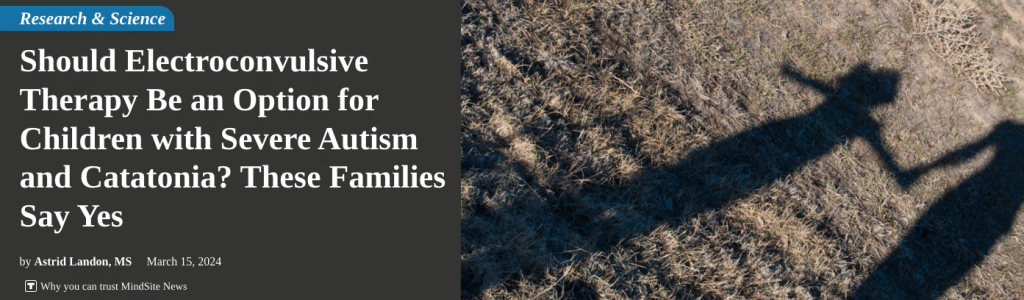
Some parents of children with severe autism say only ECT can relieve the horrific symptoms of catatonia that causes them to hit and harm themselves, sometimes hundreds of times a month. These are their stories. Continue reading…
As death and trauma mount in Gaza, a Palestinian researcher says standard mental health measurements are woefully inadequate
We need new language and ways to understand the depth of trauma currently faced by Palestinians in Gaza, says health and human rights scholar Yara M. Asi, in a thought-provoking New York Times audio essay (9:21, transcript available).
She argues that Western perspectives and mental health diagnostic tools are insufficient to measure and understand the true impact of sustained, ongoing conflict on civilians.
“Officially, I have been doing research on Palestinian health for more than 10 years in various settings, looking at both physical and mental health outcomes. But unofficially, as a Palestinian from the West Bank, I’ve been observing these trends and these dynamics my entire life,” says Asi, an assistant professor at the University of Central Florida and a visiting scholar at Harvard. She says:
People who have lost loved ones, children who have lost their parents, people who have been amputated – it’s simply not sufficient to say, well, they’re going to have post-traumatic stress disorder. These are lifelong traumas. And we don’t do either those populations or our own work and the rigor of our work any favors by merely trying to make what we’re trying to measure easier…to describe in a journal article.
Asi was born in the West Bank city of Nablus and arrived in the U.S. at age 5. She clearly remembers when soldiers would come to her village and demand that all young and middle-aged men come for questioning. “This was always a very scary experience, because we all heard of families for whom a cousin, an uncle, a brother did not come back from these interrogations.” These experiences showed her “the urgency of not just studying the health of these people but studying and understanding the upstream drivers of their health.” She notes that the measures used to quantify and describe mental health were developed in western countries, mostly the U.S.
When you look at the measures themselves, they are typically these very short statements or questions with a five- or 10-point scale response. ‘So how often did you think of the traumatic event – scale of 5?’ That kind of thing. We are told everything can be medicalized, and thus it can be measured. And if it can’t be measured, it doesn’t exist.
But Asi argues that PTSD is not just a number which if you’re above it, you have PTSD, and if you’re below it, you don’t.
We have seen Palestinian scholars use measures of social suffering or of measuring the wounds inside. We have seen in other contexts, people use phrases like ‘feeling like a worn, tattered piece of clothing.’ And I think the problem from the scientific perspective is: How do you measure feeling broken? How do you measure feeling like a tattered piece of clothing?
Concerts for your mental health…at Carnegie Hall
Come to this concert at Carnegie Hall and a host will invite you to breathe in and out mindfully. The Well-Being Concerts presented by the renowned New York concert hall’s Weill Music Institute “combine world-class musical performances with elements of self-
care and mindfulness, animated by evidence that music helps people heal and thrive,” the Carnegie website proclaims. “Each concert creates an immersive, nurturing space in which audiences and performers share in the soul-nourishing benefits of music, create shared experiences, and explore tools for well-being that last long after the performance.”
The 16-concert series was inspired, in part, by a 2019 World Health Organization report about the role of the arts in improving health and wellbeing. The lighting is soft and warm and audience members form a circle around the performers. The first concerts were specifically for health care workers from New York’s public hospitals and people impacted by the criminal justice system. The response was so positive the series was expanded. Some concerts are open to the general public; others are designed for specific audiences such as veterans. Both artists and attendees say they experience the concerts differently than a typical performance. “It feels much more connected,” said vocalist Sarah Elizabeth Charles. “We’re trying to really hold the space for the audience to have as fruitful of an experience as possible.”
Read more at the upbeat news site GoodGoodGood. And check out the “well-being playlist” that features works from classical to jazz, Phillip Glass to Shirley Horn. (My editor listened to it while he edited this newsletter and says it helped.)
“Overdose” or “poisoning”? If the death was in your family, terminology matters – but so does fairness
As fentanyl-tainted pills masquerading as prescription medications inundate the country, grieving families are pressing to change the language used to describe drug deaths from “overdose” to “poisoning.”
The latter, they say, suggests that their loved ones were addicted and blames them for their own deaths, whereas the former indicates that they were victims.“If I tell someone that my child overdosed, they assume he was a junkie strung out on drugs,” Stefanie Turner, a co-founder of Texas Against Fentanyl, told the New York Times. The state last fall began requiring death certificates to say “poisoning” or “toxicity” rather than “overdose” if fentanyl was the leading cause. Bills calling for similar changes were introduced in several states last year.
In toxicology and medicine, “overdose” and “poison” have value-neutral definitions. But the public understands them differently: Overdose implies criminal self-harm and moral shortcoming, while poisoning happens to “innocent” people. In some ways, the debate has come full circle: A few decades ago, coroners, especially in small counties, sometimes simply avoided stating stigmatizing causes on death certificates, whether suicide or AIDS or drugs, to protect families’ reputations.
As a journalist who covered addiction for many years and saw the deadly damage caused by stigma, I sympathize with efforts to reduce it through language. But I have a problem with this one. For one thing, drug addiction – and death – has many causes, almost all of them accidental. Where do you draw the line between fentanyl poisoning and heroin overdose? Both might be traced back to the use of painkillers prescribed by doctors and later bought on the street to prevent withdrawal when a prescription was no longer available.
If only fentanyl-related deaths are called “poisonings,” how is that fair to the tens of thousands of families whose loved ones “overdosed” on OxyContin because they didn’t realize their tolerance plummeted during a period of abstinence in rehab or jail? How do you avoid “poisoning” becoming the accepted term for the deaths of middle-class users whose families have political clout while the deaths of poor or homeless people continue to be “overdoses”?
In other news…
The FDA granted breakthrough therapy status for Cybin Inc’s synthetic psilocybin for treating major depressive disorder. The designation means the Toronto-based company will be able to work more closely with the drug regulator than typical and may be eligible for accelerated approval. Last week, Cybin reported Phase 2 clinical trial data showing that 75% of patients who took two doses of the drug, CYB003, had sustained improvement in their symptoms after four months, according to a company press release. The results should pave the way for Cybin to initiate a pivotal Phase 3 trial for the drug, the company said. CYB003 can be used without withdrawing patients from antidepressants they are already taking – but which, on their own, have not provided adequate symptom relief. Cybin, which is publicly traded, also recently announced it would raise $150 million from a private offering. And it said it was starting another Phase 2 trial for another drug, CYB004, for treating generalized anxiety disorder.
Congress wants the VA to run large clinical trials of psychedelics like MDMA and psilocybin to test their effectiveness, in conjunction with talk therapy, in helping veterans with PTSD, major depression and other mental illness. Language making this recommendation was inserted into the bipartisan funding bill signed into law a week ago that avoided a partial government shutdown, the Politico Future Pulse newsletter reported. The legislation follows a defense bill passed late last year that contained an amendment authorizing the Pentagon to study psychedelic treatments for service members.
Some deep blue cities and states are abandoning progressive approaches to drug use and homelessness, Axios reported. The intertwined overdose, mental health and housing crises have become increasingly visible and disturbing to the public in places like Oregon, California and San Francisco, prompting a backlash and pushing lawmakers to adopt harder-line policies. In Philadelphia, newly elected Mayor Cherelle Parker said the city would no longer fund needle exchange from the $10 million a year it gets from the national opioid settlement, KYW Newsradio reported. Parker said she’s not against harm reduction programs but their funding should come from other sources, as it did for decades. The city will prioritize long-term care, treatment and housing of people with substance use disorders. Protesters said they worried the shift signals a move away from harm reduction policies.
If you or someone you know is in crisis or experiencing suicidal thoughts, call or text 988 to reach the 988 Suicide & Crisis Lifeline and connect in English or Spanish. If you’re a veteran press 1. If you’re deaf or hard of hearing dial 711, then 988. Services are free and available 24/7.
Recent MindSite News Stories
Islamophobia Is Driving a Mental Health Crisis Among Michigan’s Muslim Youth

As the Israel-Gaza conflict stretches into its sixth month, anti-Muslim sentiment has hit a fever pitch, say community leaders in Dearborn, near Detroit, home to the largest concentration of Arabic-speaking and Muslim people in the country.
8 Ways to Deal With the Loss of a Beloved Pet

It’s hard for parents to know what to do when a beloved pet dies — and how to comfort their children. Psychologist Barbara Greenberg has some advice.
If you’re not subscribed to MindSite News Daily, click here to sign up.
Support our mission to report on the workings and failings of the
mental health system in America and create a sense of national urgency to transform it.
For more frequent updates, follow us on Facebook, Twitter and Instagram:

The name “MindSite News” is used with the express permission of Mindsight Institute, an educational organization offering online learning and in-person workshops in the field of mental health and wellbeing. MindSite News and Mindsight Institute are separate, unaffiliated entities that are aligned in making science accessible and promoting mental health globally.
Copyright © 2021 MindSite News, All rights reserved.
You are receiving this email because you signed up at our website. Thank you for reading MindSite News.
mindsitenews.org
The name “MindSite News” is used with the express permission of Mindsight Institute, an educational organization offering online learning and in-person workshops in the field of mental health and wellbeing. MindSite News and Mindsight Institute are separate, unaffiliated entities that are aligned in making science accessible and promoting mental health globally.


Author

Related Articles

Rumors of Kids Quitting College En Masse Are Exaggerated
This week: what the data says about Gen Z students quitting college, and why postpartum mental illness is more than depression.

Why Is Georgia Blocking Recovery Homes for Substance Abuse?
Georgia towns are using zoning loopholes to shut recovery homes down, even as addiction and mental illness surge statewide.

Why Are Mothers Punished for Parenting?
Those of us who roamed freely as kids can be arrested for letting our kids do the same.