
Surviving Solitary, with a Little Help from His Daughter
Michael Johnson, who suffered from bipolar disorder, spent 11 years in prison. He was held in solitary confinement for three years and almost lost his will to live. His daughter may have saved him.

Friday, March 29, 2024
By Josh McGhee
Spring has finally sprung and that means flip-flopping between hoodies and a winter jacket here in Chicago. For this month’s Diagnosis: Injustice, I dig into the story of Michael Johnson, a man with bipolar disorder who spent 11 years in Illinois prisons on a three-year sentence.
In lock-ups, his mental health took a serious dive and, at one point, he spent three straight years in solitary confinement, scarcely leaving his cell. You may have read about him last year when his lawsuit made it all the way to the Supreme Court. What you probably didn’t know was that his 14-year-old daughter’s desire to visit him in prison changed the course of his life.
We also learn about the tragic story of Fredreaka Jack, who died three months after being released from a state forensic hospital. Finally, I’ll share the podcast that has me gripping my steering wheel as I drive to pick up my kid.
Let’s get into it…

A story of survival

Back in November’s Diagnosis: Injustice, I spoke to Daniel Greenfield, the Supreme Court and appellate counsel for the MacArthur Justice Center, about a case involving an Illinois man held in solitary confinement for three years and only let out of his cell for 10 minutes to shower each week.
That case, which was originally filed pro se by the incarcerated man, Michael Johnson, made its way to the Supreme Court, but they refused to hear it.
“Mr. Johnson’s case was different than the usual solitary confinement case because as an added punishment for misconduct born of his mental illness, prison officials deprived him of all access to exercise,” Greenfield told me. “What that means is that for those three years Mr. Johnson was locked, essentially 24/7, in a windowless cell sealed by a solid metal door.”
The result of this isolation: an unraveling that included compulsive picking at his skin. His muscles atrophied and he smeared feces on his body and across his cell.
After speaking to Greenfield, I wanted to get to know the man who lived that reality so I made the three-hour drive down to Bloomington to speak with Johnson face-to-face.
What I found was a man who lived a tough life balancing growing up between Chicago and the South. A man, who faced addiction, made mistakes, and suffered grave consequences for those mistakes. A man, whose childhood traversed through psychiatric hospitals, juvenile detention centers, jails and prisons. Most importantly, a father and daughter trying to get back years stolen from them in the name of “criminal justice.”
In total, Johnson would spend 11 years and 11 months in prison for robbing family members while living with addiction.
Read about how he ended up in that tiny cell and how he got out here.
She was released from a forensic hospital and left to her own devices. Three months later, she was dead
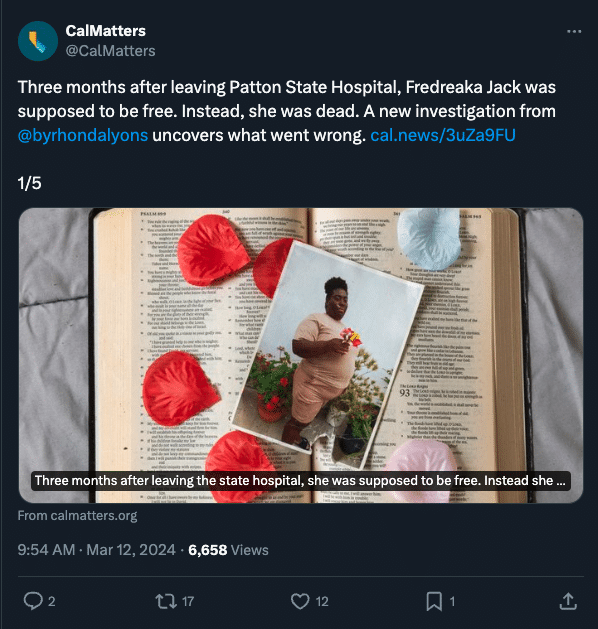
At Patton State Hospital, a state forensic facility in San Bernardino, California, Fredreaka Jack could depend on someone to hand her medications each day to manage her schizophrenia and bipolar disorder, as well as her blood sugar, hypertension and hypothyroidism. But that all changed after she was released.
After two years in custody including one at Patton, a court granted her a petition to be paroled in the community. She was sent to Walden House, a state-funded reentry program in Los Angeles County. She was dead within three months.
“I have never expressed to nobody how much this hurts,” said Jack’s mother Sharon. “I thought my baby was coming home to me. They took that opportunity away from me.”
Her death illustrates the many holes in California’s public parole system, according to an investigation by CalMatters. The nonprofit news site reviewed thousands of pages of medical records and court documents and concluded that her death “was almost preordained.”
After winning her appeal, she was released from the state’s hospital care and sent to Walden House, where she was forced to navigate the mental and physical health care system on her own. She was given 30 days of medication and the same amount of time to find a doctor and psychiatrist in a new community.
The doctor she found didn’t write her a prescription for diabetes medication, despite her blood glucose being nearly three times the normal range. When prescriptions were filled for her blood pressure, Walden House didn’t log her receiving the medication for days at a time.
Jack ended up in the emergency room over and over again. Over a three-month period, she lost nearly 50 pounds, a sign of diabetes.
At her last ER visit, in July of 2022, a doctor referred Jack back to her psychiatrist – and didn’t seem to believe her. “Patient did not appear to be a reliable historian and has delusional speech,” the doctor wrote in her medical records.“She has a history of schizoaffective disorder, and this is her 4th visit to this emergency room this month.”
She would die nearly 14 hours later from complications from Type 2 diabetes.
Read the full CalMatters investigation here.
What I’m Listening to
Since the beginning of February, I’ve awoken every Tuesday hoping for a nice hour-long drive to listen to On Our Watch Season 2: New Folsom.
This gripping podcast from KQED Radio, the NPR station in San Francisco, explores corruption and cover-ups at California State Prison, Sacramento, better known as New Folsom.
Over six episodes, host Sukey Lewis and co-reporter Julie Small follow the fentanyl-related death of a former prison guard at the facility,
a death by suicide of another correctional officer who dared to cross the thin blue line and how it all connects to the murder of an incarcerated man in the dayroom of the prison. Through interviews with family members of the officers and the incarcerated, the reporters illustrate in grim detail the toll that living or working in California prisons can take on their mental health.
As episode 6 began to wind down, Lewis and Small surprised listeners with a bombshell: a confidential source leaked to them new evidence and secret internal tapes.
You can catch up on the first six episodes here, before episode 7 drops on April 2nd.
Until next month,
Josh McGhee
If you or someone you know is in crisis or experiencing suicidal thoughts, call or text 988 to reach the 988 Suicide & Crisis Lifeline and connect in English or Spanish. If you’re a veteran press 1. If you’re deaf or hard of hearing dial 711, then 988. Services are free and available 24/7.
Recent MindSite News Stories
Booted From the Army, He Spiraled. Now He Works to Solve the Veteran Homelessness Crisis
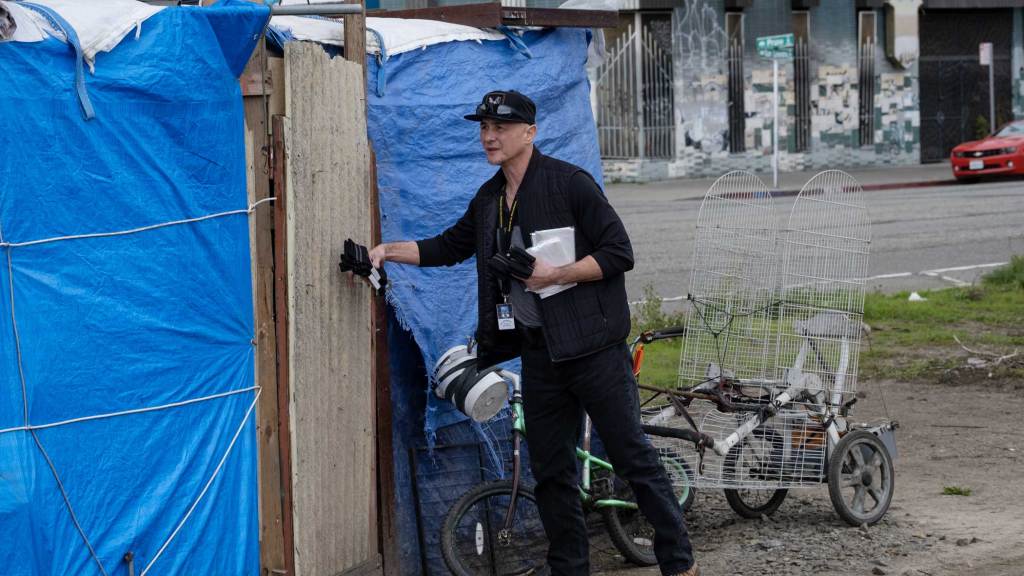
California has more homeless veterans living on the street than any other state – an estimated 7,400. Dennis Johnson was once one of them. Today, he works to help his fellow vets get into housing.
California’s Prop. 1 Ekes Out a Win as Gavin Newsom Seeks to Change How People with Mental Illness Get Help

Gavin Newsom made mental health a priority when he took office five years ago. This ballot initiative will provide billions of dollars to fund housing and treatment facilities for mentally ill Californians – but will also pull money from community services.
If you’re not subscribed to MindSite News Daily, click here to sign up.
Support our mission to report on the workings and failings of the
mental health system in America and create a sense of national urgency to transform it.
For more frequent updates, follow us on Facebook, Twitter and Instagram:

The name “MindSite News” is used with the express permission of Mindsight Institute, an educational organization offering online learning and in-person workshops in the field of mental health and wellbeing. MindSite News and Mindsight Institute are separate, unaffiliated entities that are aligned in making science accessible and promoting mental health globally.
Copyright © 2021 MindSite News, All rights reserved.
You are receiving this email because you signed up at our website. Thank you for reading MindSite News.
mindsitenews.org

The name “MindSite News” is used with the express permission of Mindsight Institute, an educational organization offering online learning and in-person workshops in the field of mental health and wellbeing. MindSite News and Mindsight Institute are separate, unaffiliated entities that are aligned in making science accessible and promoting mental health globally.


Author

Related Articles

Chicago Launches its First Psychiatric Street Team
Meet Chicago’s first Street Psychiatrist, a student of the street medicine pioneer Jim Withers. Plus, a look at the American Penal Press Contest.

Trump’s Student Loan Changes Cause Anxiety and Panic
Borrowers face rising payments under the Trump administration’s student loan changes. Plus: teaching emotional literacy to teen girls, and why the new CDC youth mental health report is facing criticism.
Rumors of Kids Quitting College En Masse Are Exaggerated
This week: what the data says about Gen Z students quitting college, and why postpartum mental illness is more than depression.