
A Jail Psychiatrist Laments his High Caseload
An Ohio jail psychiatrist wants stronger community mental health. And ongoing trauma in Gaza will lead to lifelong mental health scars, aid workers say.


Wednesday, May 22, 2024
By Courtney Wise

Greetings MindSite News Readers. In today’s Daily, a jail-based psychiatrist advocates for stronger community mental health. We are reminded of the mental agony experienced by everyone in Gaza. And a Colorado university partners with a health care giant to help mental health professionals get rapidly and affordably licensed. Plus, legislators in Great Britain tell the BBC they haven’t been alright.
This jail psychiatrist says his patient count can – and should be – a lot lower

If there’s anything psychiatrist Esam Alkhawaga is clear about, it’s this: He’d have fewer patients to treat at Greene County Jail in Xenia, Ohio, if there were a stronger social support and treatment system for people with mental illness.
Dr. A – as his patients call him – sees up to 10 patients per week and many of them shouldn’t be in jail, he told the Dayton Daily News. Their treatment now is linked to a criminal record that could have been avoided for many, had they been able to access appropriate care first.
“Instead of finding a dignified place for these people to live, get treatment, and spend enough time until they recover,” he says, they “end up being in jail.”
It’s especially difficult for patients with severe illnesses like untreated bipolar disorder. A 2009 study of 79,000 people, mostly men, in Texas prisons found that people with bipolar disorder were 3.3 times more likely to have had four or more previous incarcerations than those with no serious mental illness. People keep coming back because they lack consistent, close support on the outside, Alkhawaga said. He has seen patients who did well on supervised probation overdose and die the day after their probation ends. So now, he encourages some to request a probation extension to get the structure they need.
He spends a good deal of time wrestling with insurance companies because they so often eliminate coverage before a person has made the jump from crisis to stability. “You admit somebody into the hospital with mania. After five days, insurance says they don’t meet the criteria for inpatient care, so [they] discharge them ‘half-manic,’” Alkhawaga said. “They leave the hospital, and then a week later, I see them in the Greene County Jail.”
He hopes programs like the Stepping Up Initiative can help reverse the reality that America’s jails and prisons double as our nation’s largest facilities for the mentally ill. Early detection is key, he said, so that people get help at the first signs of mental illness, distress, or substance abuse. Instead, he said, most are diagnosed late – neglected, misdiagnosed or misperceived.
Ongoing war prompting ‘catastrophic’ mental health crisis for Palestinians in Gaza

Residents of Gaza, adults and children alike, are living under bombardment with death and famine all around them and no escape possible. Those who survive will face mental and emotional scars likely to last the rest of their lives, aid workers said.
The mental health crisis is “already catastrophic … and it keeps getting worse and worse,” Audrey McMahon, a Doctors Without Borders psychiatrist who was stationed in Jerusalem until March, told ABC News. “Gaza has become an unlivable place. It’s just unfathomable. The foundation of mental health is security, is safety, something that you can predict; they don’t have that…Systematic attacks on civilians, on children, this really impacts your view of the world, your sense of humanity, and this is extremely [difficult] to change or heal afterwards.”
While the damaging impact of war on mental health is well-documented, the situation in Gaza is unparalleled, aid workers said. In most other regions hit by armed conflict, there are at least safe zones; in Gaza, there are almost none.
“Children have experienced not just one traumatic event, but what we call compound trauma, so traumatic event after traumatic event,” said Tess Ingram, a UNICEF spokesperson. “That’s something we rarely, if ever, see.” In other conflicts, “a child might experience a traumatic event and then be able to flee to safety. But in the case of Gaza, children are trapped, and there’s nowhere for them to go.”
Aid workers need help too, said McMahon. “They’re faced with an impossible situation. Do you choose between someone coming with an open wound bleeding that you need to do surgery quickly, or a child that is acutely malnourished and struggling to stay alive?” she said. “Who do you choose?”
Colorado partnership aims to help new therapists get licensed
A $4.2 million workforce accelerator – a partnership between Kaiser Permanente and Metropolitan State University of Denver – aims to boost licensing of mental health professionals by helping them more rapidly and affordably get the clinical hours they need to earn their credentials. The goal is to alleviate a shortage of licensed therapists and counselors that is even more dire in Colorado than it is in the rest of the country, Colorado Public Radio reported.
Candidates with master’s degrees need 2,000 clinical hours and 100 or more hours of supervision over roughly two years in order to get a state license that allows them to practice. If the program they’re in doesn’t pay for the time of their clinical supervisors, therapists-in- training have to do so themselves – at a cost of up to $10,000. According to one study, 57% of masters-level graduates never get licensed because of the costs and the burden.
This burden falls most heavily on people of color, with a predictable result. In Colorado, where about 38% of residents are Black, Latino, Asian or Native American, 81% of mental health professionals are white. The program has so far placed 33 participants into clinical supervision slots, mostly in nonprofit and public agencies caring for vulnerable, underserved populations. Next year, that number could reach 87 post-master’s candidates and 36 pre-master’s.
“For every single step of the process to become a licensed clinician, there is some kind of financial barrier that a lot of people often run into, and it creates a pretty significant disparity in the profession,” said C. Blanck, a graduate nearing completion of their 2,000 hours. “If you’re not connected to a network of resources, you’re likely going to have to pay for supervision on your own.” The financial relief provided by the new program has been a “big anxiety release,” Blanck said.
In other news…
The MPs, too, are not alright. British Member of Parliament Elliot Colburn, feeling hopeless after receiving death threats and abuse, survived a suicide attempt earlier this year. As a politician in despair, he’s not alone. For this BBC News investigation into the mental health and wellbeing of politicians, MPs talked candidly about the pressure they’re under and the escalating mental health crisis in parliament. “Politics has left me a broken human being,” said one former government minister.
Coburn told Jennifer Nadel, co-director of London-based Compassion in Politics, that his job is the reason he didn’t reach out for help before attempting to take his life. “I just did not think that people would be particularly sympathetic,” Colburn said. “When it comes to an MP’s mental wellbeing, we’re not necessarily seen as having, on a human level, those same set of emotions that other people have.” In addition to audio interviews with MPs, Nadel wrote about her conversations with MPs in an essay for The Guardian.
Actor Taye Diggs and sister Christian campaign against stigma. Almost 20 years ago, Christian, now 48, was diagnosed with schizophrenia. “I didn’t know what to do,” when he first learned of the diagnosis, Taye Diggs told CBS News. Today, he’s working with his sister to show that a quality life can proceed after a schizophrenia diagnosis. “I’m someone who’s living my possible,” she says in this brief video filmed with her brother for a schizophrenia awareness campaign, Live Your PosSCZible. The campaign is sponsored by Bristol Myers Squibb, which last year spent $14 billion to acquire the maker of KarXT, a schizophrenia drug with blockbuster potential that could gain FDA approval in September.
Michigan governor signs mental health parity bill. The bill, which received bipartisan support, compels health insurers to cover treatment for mental health and substance use services on par with traditional medical coverage, the Detroit Free Press reports. “Right now, there are too many loopholes that allow providers to avoid paying for certain medical mental health treatments,” said Gov. Gretchen Whitmer. With its implementation, insurance providers may no longer impose greater deductibles, co-payments, or out-of-pocket maximums on behavioral health services than it would for medical services.
If you or someone you know is in crisis or experiencing suicidal thoughts, call or text 988 to reach the 988 Suicide & Crisis Lifeline and connect in English or Spanish. If you’re a veteran press 1. If you’re deaf or hard of hearing dial 711, then 988. Services are free and available 24/7.
Recent MindSite News Stories
MindSite News Reporters Win Two Awards

MindSite News, the nation’s only national news outlet reporting exclusively on mental health, is pleased to announce that two MindSite News reporters have won awards for excellence in journalism.
Report an Mental Health Crisis in San Francisco, Here’s What Happens Next
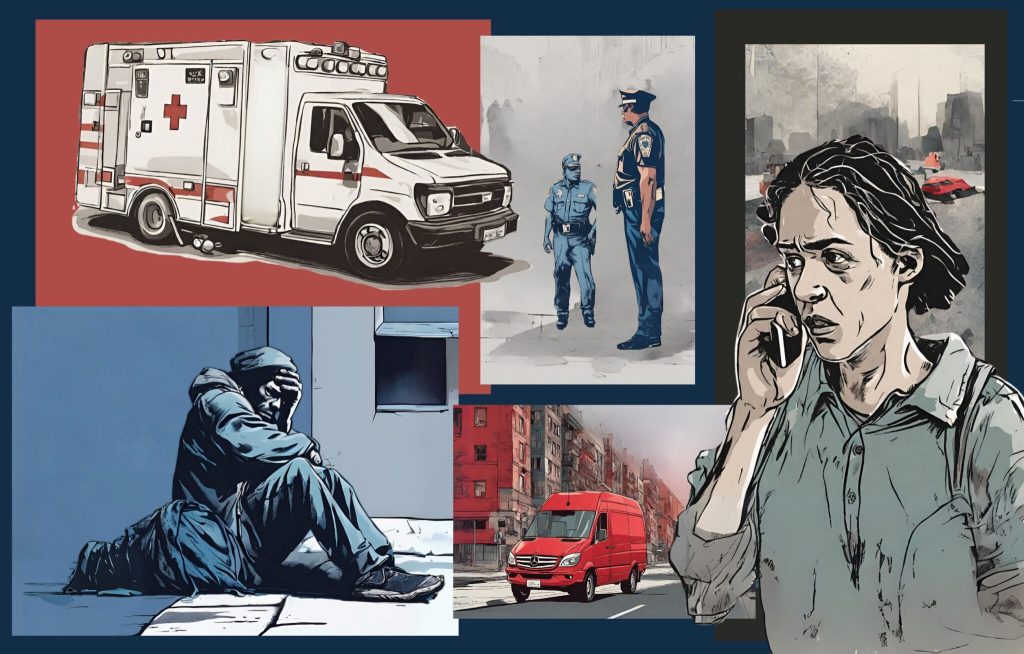
In San Francisco, as in many cities, it’s not uncommon to cross paths with a person experiencing homelessness in the throes of a mental health crisis. The scene can be tragic, confusing and can feel dangerous.

The Tortured Cycle Through San Francisco’s Strained Mental Health and Detention Systems
Last year, thousands of people fell into San Francisco’s badly strained system for treating severe mental health and drug-related crises. Many who enter that system receive temporary care and multiple involuntary psychiatric holds that fail to address long-term needs.
If you’re not subscribed to MindSite News Daily, click here to sign up.
Support our mission to report on the workings and failings of the
mental health system in America and create a sense of national urgency to transform it.
For more frequent updates, follow us on Facebook, Twitter and Instagram:

The name “MindSite News” is used with the express permission of Mindsight Institute, an educational organization offering online learning and in-person workshops in the field of mental health and wellbeing. MindSite News and Mindsight Institute are separate, unaffiliated entities that are aligned in making science accessible and promoting mental health globally.
Copyright © 2021 MindSite News, All rights reserved.
You are receiving this email because you signed up at our website. Thank you for reading MindSite News.
mindsitenews.org

Mental health can't wait.
America is in a mental health crisis — but too often, the media overlooks this urgent issue. MindSite News is different. We’re the only national newsroom dedicated exclusively to mental health journalism, exposing systemic failures and spotlighting lifesaving solutions. And as a nonprofit, we depend on reader support to stay independent and focused on the truth.

It takes less than one minute to make a difference. No amount is too small.
The name “MindSite News” is used with the express permission of Mindsight Institute, an educational organization offering online learning and in-person workshops in the field of mental health and wellbeing. MindSite News and Mindsight Institute are separate, unaffiliated entities that are aligned in making science accessible and promoting mental health globally.


Author

Related Articles
A Cat Love Story, and The Battle Over Opioid Settlement Dollars
A major policy shift in Pennsylvania now allows opioid settlement funds for public defenders, a move that could transform how counties address addiction and the legal system.

Generative AI More Harmful Than Helpful in K-12 Classrooms
A new study from the Brookings Institution finds that generative AI does more bad than good in today’s classrooms.