
Trump’s Campaign to Demonize Immigrants and People with Mental Health Challenges
Eight years after Donald Trump’s election sparked a mental health crisis among immigrant communities targeted for deportation and violence, those fears are building all over again. So are efforts to provide support.


Friday, November 1, 2024
By Rob Waters
Good morning, MindSite News readers.
Two days after Donald Trump was elected president in Nov. 2016, mental health advocates in Chicago gathered to discuss concerns about the election’s impact on immigrants’ mental health.
One of the attendees, an associate professor of social work named Maria Ferrera, recalls that immigrants she was in touch with were terrified by the rhetoric coming from Trump. Many of them were also calling suicide lines, in record numbers.
“The level of stress was just uncharted,” Ferrera recalled. She and other advocates formed the Coalition for Immigrant Mental Health, a network of groups working to provide mental health support to immigrants in Chicago who lacked legal documents.
Fast forward eight years, and those fears are exploding all over again in the lead-up to what is one of the most consequential presidential elections in the history of our country. At a rally in New York City last Sunday night, Trump vowed to initiate “the largest deportation program in American history” on his first day in office and pledged to “rescue every city and town that has been invaded and conquered.”
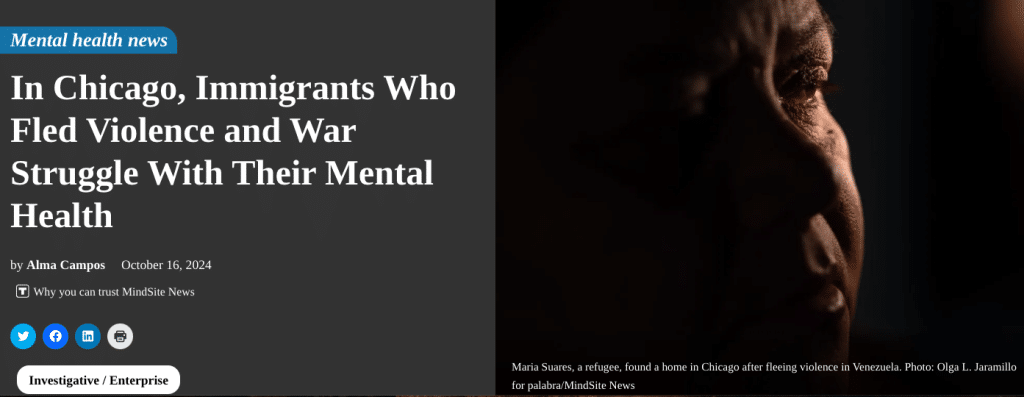
As we report today in a new story – ‘The Fear Cut Through My Family’: Alarm Over Trump’s Potential Return Sparks Deep Anxiety Among Chicago Immigrants – immigrants in Chicago and across the country are stunned and afraid.
Trump has announced that he will also seek to use the military, including the National Guard, to round up and deport up to 20 million undocumented immigrants and enforce harsher border policies. He has called migrants “animals,” “stone cold killers,” “the “worst people,” and the “enemy from within” and has made numerous false claims about people from other countries, including repeating a social media lie that Haitian immigrants in Springfield, Ohio are eating dogs and cats.
In our story today – a collaboration between the Chicago bureau of MindSite News and palabra, the multimedia platform of the National Association of Hispanic Journalists – we take a deep look at how this issue is playing out in Chicago, the city with the fourth-largest immigrant population in the country. We report not only on the fear and anxiety but also what immigrant-led coalitions – like the one Maria Ferrara helped start eight years ago – are doing to protect immigrants’ mental health and infuse them with hope.
The story by Chicago-based reporter Alma Campos, who regularly covers immigration issues, is the second part of Silent Battles, a reporting project on the mental health of immigrant, refugee and asylum communities in the U.S. The first story in the series looked at the trauma many news arrivals to the U.S. have been through as they fled violence and war.
Trump’s campaign of threats and demonization against immigrants is a close companion to his continuous stigmatization of people with mental illness – and it threatens to turn back the clock, as I discussed with Philadelphia Inquirer columnist Will Bunch a couple of weeks ago.
“People with mental health conditions have been campaigning for years against the social stigma directed against them — and in recent years have made a lot of progress,” I told him. “Donald Trump seems to be on a one-man campaign to bring back that kind of stigma.”
When he talks about homeless people or mass violence, Trump throws out terms like “mentally ill monsters.” And he keeps repeating — with no evidence to back it up — the idea that Latin American countries are throwing open the doors of their mental hospitals and sending people across the border.
His claims that millions of people “are pouring into our country” from mental institutions are a way to demonize immigrants fleeing war and violence in other countries and to stigmatize people struggling with mental health challenges. But there are also policy implications.
When Trump says on his campaign website that “the streets of our once-great cities are now controlled by gangs and cartels and plagued with mentally ill and drug-addicted homeless,” he is not only disparaging vulnerable people, he is making an argument for locking them away.
In his campaign platform, he vows to “bring back mental institutions” and to have police take the lead in addressing mental health on the streets. This moves away from recent trends in many cities of using mental health professionals to respond to people experiencing mental health crises — a trend with a lot of bipartisan support and the backing even of many police officials.
This kind of rhetoric turns back the clock on the effort to reduce stigma. And it incites hatred against two of the most vulnerable groups in our country – immigrants and people with mental health challenges.
It is not hard to see the historical parallels between the push for “Mass Deportation Now!” – made in red, white and blue signs on display at the Republican National Convention of 2024 – and the cries of “the Chinese Must Go!” as mobs, urged on by politicians, tried to burn down San Francisco’s Chinatown back in the 1870s. Or the chants of “Jews will not replace us!” by the “very fine” white supremacists who marched through Charlottesville, Virginia in 2017, the first year of the Trump presidency.
Hatred and demonization are on the march. It is not a pretty picture, and it could have deep and lasting implications.
If you or someone you know is in crisis or experiencing suicidal thoughts, call or text 988 to reach the 988 Suicide & Crisis Lifeline and connect in English or Spanish. If you’re a veteran press 1. If you’re deaf or hard of hearing dial 711, then 988. Services are free and available 24/7.
If you’re not subscribed to MindSite News Daily, click here to sign up.
Support our mission to report on the workings and failings of the
mental health system in America and create a sense of national urgency to transform it.
For more frequent updates, follow us on Facebook, Twitter and Instagram:

The name “MindSite News” is used with the express permission of Mindsight Institute, an educational organization offering online learning and in-person workshops in the field of mental health and wellbeing. MindSite News and Mindsight Institute are separate, unaffiliated entities that are aligned in making science accessible and promoting mental health globally.
Copyright © 2021 MindSite News, All rights reserved.
You are receiving this email because you signed up at our website. Thank you for reading MindSite News.
mindsitenews.org

The name “MindSite News” is used with the express permission of Mindsight Institute, an educational organization offering online learning and in-person workshops in the field of mental health and wellbeing. MindSite News and Mindsight Institute are separate, unaffiliated entities that are aligned in making science accessible and promoting mental health globally.


Author

Related Articles

Rumors of Kids Quitting College En Masse Are Exaggerated
This week: what the data says about Gen Z students quitting college, and why postpartum mental illness is more than depression.

Why Is Georgia Blocking Recovery Homes for Substance Abuse?
Georgia towns are using zoning loopholes to shut recovery homes down, even as addiction and mental illness surge statewide.

Why Are Mothers Punished for Parenting?
Those of us who roamed freely as kids can be arrested for letting our kids do the same.