
Relief Funds Offer Help for the Mental Health of Farmers with Land Poisoned by ‘Forever Chemicals’
For decades, the chemical industry knew about the dangers of PFAS, chemical compounds linked to cancer, hormone disruption and other serious health problems. Known as “forever chemicals” because they don’t break down, they’ve been used in consumer items from non-stick pans and takeout food packaging to personal care products. Unfortunately, exposure to PFAS has also surged to farmland across the United States in the form of sludge from sewage and wastewater treatment plants.
In Maine, the discovery of PFAS on farms where sludge was used as fertilizer starting decades ago has led to depression, high anxiety and even despair among many organic farmers after testing revealed their tranquil fields and orchards were contaminated.
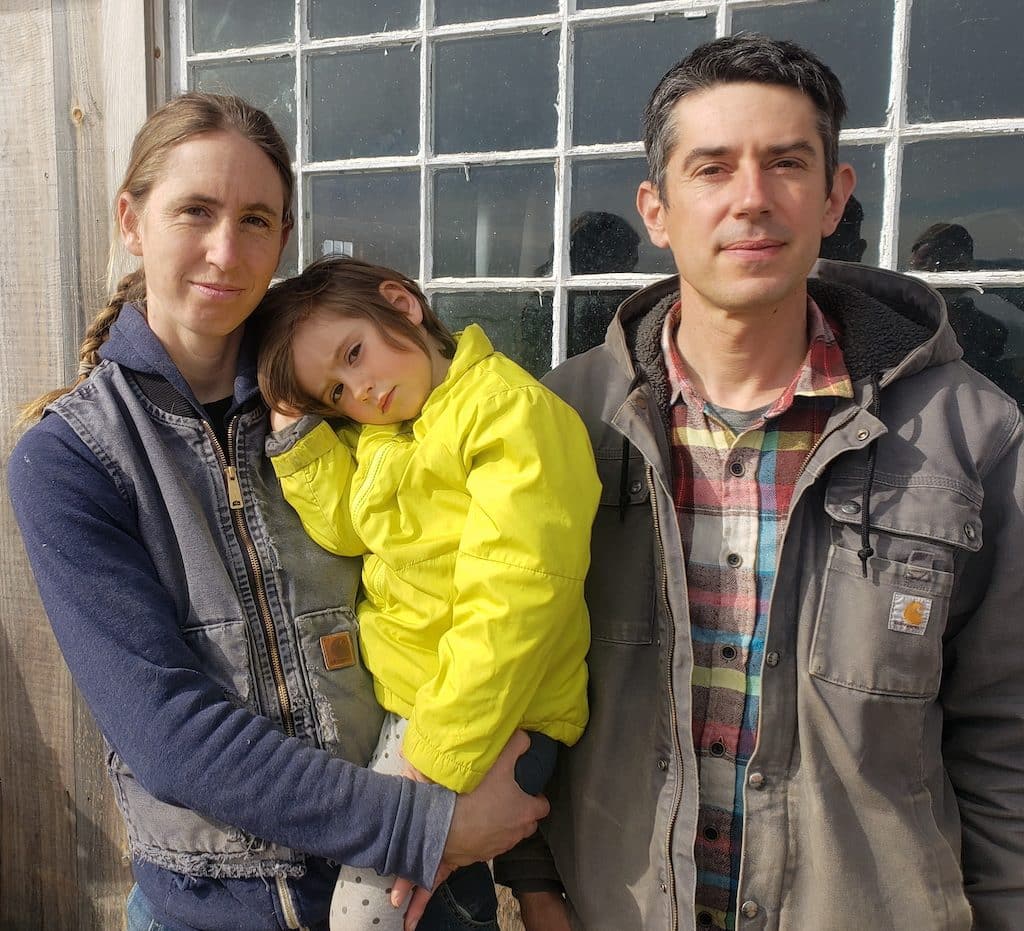
For Johanna Davis and Adam Nordell of Songbird Farm in Unity, Maine, finding out that PFAS had infiltrated their organic farm plunged them into a crisis. Their soil, water and even their bodies were all severely contaminated.
“Sludge-derived PFAS has upended our farm business, thrown our livelihood into question, devalued our land and created an enormous amount of stress about potential health consequences for us and our four-year-old child,” Davis told the Maine Organic Farmers and Gardeners Association.
In 2022 the couple hired a private laboratory after learning that their land had been fertilized with municipal sludge decades before they purchased it. It turned out that the water they and their toddler were drinking contained 400 times more PFAS than the state considers safe.
Davis and her husband Adam recalled their shock and disbelief in an interview with the Maine Public Radio news organization: “Just devastated. Heartbroken. Really angry…(It’s) terrifying.”
“At least we know and we can stop drinking our water. But who still doesn’t know?” Davis told the station. “Who is drinking water right now that’s as high as ours? Who is about to have a baby? It’s so too late, it’s so too late to be telling everybody this. And it can’t be soon enough.”
The couple asked stores to pull their produce from the shelves while they did further testing. Two years later, Davis and Nordell became the first to have their contaminated land bought by the Maine Farmland Trust – as a research center for the study of PFAS, with an emphasis on soil remediation.
And the other good news is that relief funds can aid farmers’ mental health in this crisis. PFAS contamination takes a huge toll on farmers whose land has been or may soon be affected. Thanks to a first-of-its-kind government relief fund, Maine farmers impacted by PFAS contamination can now apply for emergency aid, and by the end of 2024, the PFAS fund expects to launch additional programs, including a program to provide access to mental health services for eligible individuals.
“For the folks who have found contamination on their land, this has certainly been extremely stressful to the point of devastating for some who have lost their farms, their livelihoods,” says Sarah Alexander, executive director of the Maine Organic Farmers and Gardeners Association (MOFGA).
In addition to state funds, the Maine Organic Farmers and Gardeners Association and the Maine Farmland Trust set up a private fund. So far they have raised a million and a half dollars to help cover, among other things, income replacement and mental health support.
“One of the first things we heard as a need from our community and from our farmers was to provide mental health support and wellness support to be able to help address the stress, the extreme stress that people were feeling,” said Alexander. “So we provided a round of initial mental health wellness stipends that folks could use in whatever way felt most supportive, whether that was seeking counseling or seeking other wellness support that might help them get through this.”
“And what we’ve now heard now that we’re a couple of years into this is that the folks that are still dealing with it, this is long-term stress, they’ve had two years of uncertainty of the unknowns: Is my business going to make it? Am I going to be able to figure this out? Are we healthy? Did we get all the things in place that we need to do to protect our own health and our family’s health? And so we’ve actually just expanded our private fund that’s being managed by the nonprofits, Maine Farmland Trust and Maine Organic Farmers and Gardeners Association to do a round of expanded mental health support and wellness stipends for the folks that have been dealing with this for longer.”
Mental health support is important for all farmers affected by ‘forever chemicals,’ Alexander adds.
“Whether organic or not, farmers want to provide food for their communities,” Alexander continued. “And so the idea that you might be growing something that you thought was perfectly safe for your community but may not be, adds another level of stress. You feel just that you’ve let folks down, even though this has happened without you knowing about it. But I think the other piece of stress that came for everybody — in both the agricultural system and the food system — is that after this discovery there was so much fear and uncertainty about what is out there. And that still does exist to an extent.”
Alexander explains that the first PFAS contamination on state farms was found in routine water testing in 2016, which was traced back to a dairy farm in southern Maine; since then, at least six farms shut down entirely before relief funds were made available.
A heavily forested state, Maine has only 7,000 farms, and some licenses to spread sludge on 700 of them date back at least 30 years. The state’s Environmental Protection Agency, which is planning to test all 700, has so far found 70 farms whose soil contamination exceeds the current thresholds. And stricter standards for some ‘forever chemicals’ mean more will be added to the list.
As the state works to rid farmland soil of PFAS, Alexander said, it’s a natural reaction for some farmers to wish they had never heard of them.
“We don’t want PFAS in our food system. We don’t want PFAS in our water,” said Alexander. “I think the initial stress response of uncertainty and what may happen if we do find them almost makes people wonder if it’s better not to find out.”
“But it’s better to know. What we’ve really tried to encourage and build the support around is that knowing is important. Because then there are steps we can take to address it together.”
The name “MindSite News” is used with the express permission of Mindsight Institute, an educational organization offering online learning and in-person workshops in the field of mental health and wellbeing. MindSite News and Mindsight Institute are separate, unaffiliated entities that are aligned in making science accessible and promoting mental health globally.
