
Message to employers: Try a little tenderness
A California courtroom took testimony from 39 inmates about jail mental health. A US Air Force general posts on Twitter about his need for mental health support. Listening sessions on reparations for African Americans harmed by past and continuing injustices will start in California.


February 2, 2022
Good morning MindSite News Readers! In today’s newsletter: A California courtroom took testimony from 39 inmates about jail mental health. A US Air Force general posts on Twitter about his need for mental health support. Listening sessions on reparations for African Americans harmed by past and continuing injustices will start in California. And more.
“The Great Resignation” to employers: Try a little tenderness

Toxic workplaces and pandemic-related grieving are the drivers of “The Great Resignation,” according to an article from the World Economic Forum. Workplaces in which people felt exploited or uncared for were key contributors to worker flight, according to data collected by MIT Sloan in January. In fact, toxicity in the workplace was 10 times more likely to contribute to an employee leaving a job than what they were getting paid.
Top predictors of attrition during Great Resignation:
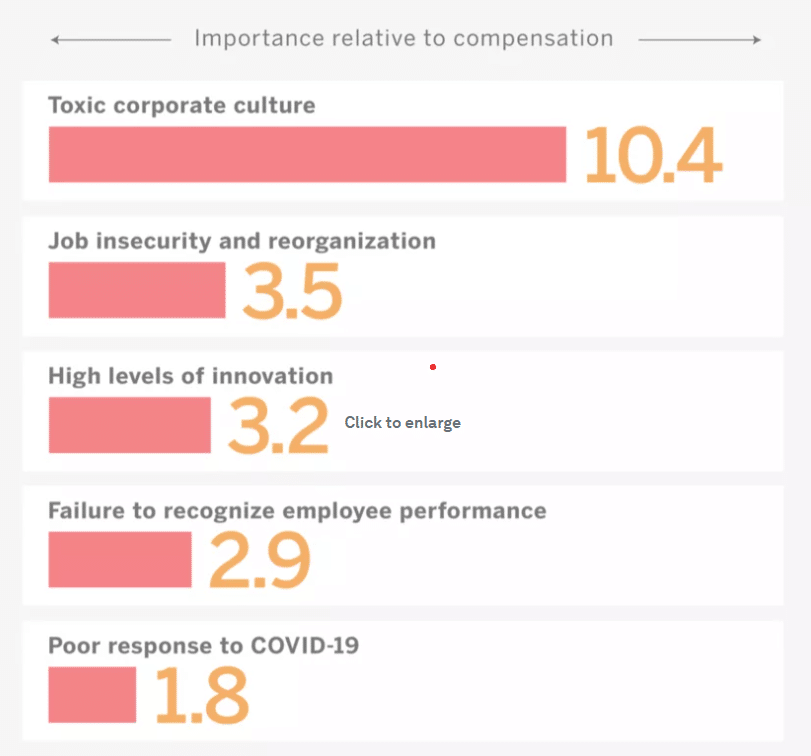
Source: World Economic Forum
If employers create work environments in which people feel cared for and appreciated, they’re 60% more likely to keep those employees for three or more years. Such environments also will help in recruitment, since satisfied employees are 90% more likely to recommend their workplaces to others. Employers will also do well to create paid bereavement leave policies and expand counseling benefits for the many employees who lost a loved one from the COVID-19 pandemic.
Such changes are not only the right thing to do, the authors noted, they also pay off. Replacing disaffected long-term workers “requires one-half to two times the employee’s annual salary,” writes author Maria Vassilio.
Inmates weigh in at trial on jail mental health conditions
An unusual thing happened in a federal court case in San Jose this week: 39 inmates testified remotely from Santa Rita Jail in Dublin, California, offering their opinions about the future of mental health care for the 2,200 inmates confined there. The inmates, many of whom have mental health problems, gave their views on a $25 million settlement agreement in a lawsuit on behalf of inmates with mental illness. According to the San Francisco Chronicle, the inmates detailed ways that existing conditions have harmed their mental health and were unanimous in saying that the proposed settlement doesn’t go far enough.
The agreement calls for mental health screening of all new inmates, therapeutic housing units, new standards for use of force and solitary confinement, and the hiring of 250 additional sheriff deputies. That proposal met with criticism. “The jail doesn’t need to hire more sheriffs. They need to hire more mental health professionals,” one inmate said, according to the Chronicle. Another said they need “more out-of-cell time … more trained staff to help people with their issues instead of more enforcement. We’re normal people, too. We’re just in a bad situation.” Cousins could approve the settlement or open it up for further negotiations.
“Whatever the outcome,” Chronicle reporter Bob Egelko wrote, “something unusual, perhaps unprecedented, has occurred in the case: The inmates’ voices have been heard in court.”
California’s historic reparations committee to hold “listening sessions”

Advocates call for reparations for Blacks descended from slavery. Photo: Shutterstock
Black Californians will have the opportunity to talk about how they and their peers should receive reparations for the state’s past and continuing injustices via public listening sessions, according to an article by California Black Media. The California Task Force to Study and Develop Reparations Proposals for African Americans, which includes civil rights, faith-based and human rights leaders as well as activists and scholars, is charged with submitting recommendations for reparations to the California State Legislature by 2023.
“We really want to talk to people in our community that get overlooked the most,” said Chris Lodgson, a founding member of the Coalition For a Just and Equitable California, one of the organizations setting up the listening sessions, which will include people from across the social and economic spectrum. “People who are unhoused, formerly incarcerated, from the foster care system, street organizations, et cetera, are the people we want to hear from,” he said.
Experts say mental health apps are fine for mild symptoms, but….

Journaling or ranking your emotions on a mental health app might be good ways to track how you’re feeling in the moment. But mental health experts say people who experience more severe mental health symptoms should also work with a mental health professional, according to an article in Discover Magazine. Why? Because if you’re not feeling great, you might focus on the negative mood rather than finding a way out of it. Such were the findings of research that looked at the effect on people with bipolar disorder who used an app to track their moods daily: Rather than feeling better, they experienced worse symptoms than a comparative group who did not use the app.
That’s where therapists come in, experts said. Not only could they help clients process their emotions, they could also direct them to apps that may be more productive. One researcher asked patients with bipolar disorder to reflect on experiences such as leisure, self-esteem and relationships. “It was quite validating to reflect on a broad range of life experiences, not just their symptoms,” said Emma Morton, a postdoctoral fellow at the University of British Columbia who studies digital tools for mental health. “It picks up areas of strength as well as areas that people might be struggling with.”
In other news:
On the supportive housing front: California Gov. Gavin Newsom announced in a statement that $1.1 billion is now available to help people who are homeless transition into housing and receive mental health and medical support.
To combat stigma, Air Force Gen. Mike Minihan posted his calendar on Twitter detailing his appointment with a psychiatrist, New York Daily News reports. “Mental health is simply health,” Minihan said. “There can be no stigma in my headquarters, command, or family.”

Introducing: MindSite News Review of Books
Today, we inaugurate a new section in our arts and culture coverage: The MindSite News […]

Why Is Mental Illness Dogged by Stigma?
In Nobody’s Normal, anthropologist Roy Richard Grinker makes a compelling argument to embrace neurodiversity while […]

Can Virtual Therapy Meet Our Need for Intimacy?
Teletherapy not only increases access and affordability to therapeutic insights, the author argues, it generates […]
If you’re not subscribed to MindSite News Daily, click here to sign up.
Support our mission to report on the workings and failings of the
mental health system in America and create a sense of national urgency to transform it.
For more frequent updates, follow us on Facebook, Twitter and Instagram:

The name “MindSite News” is used with the express permission of Mindsight Institute, an educational organization offering online learning and in-person workshops in the field of mental health and wellbeing. MindSite News and Mindsight Institute are separate, unaffiliated entities that are aligned in making science accessible and promoting mental health globally.
Copyright © 2021 MindSite News, All rights reserved.
You are receiving this email because you signed up at our website. Thank you for reading MindSite News.
mindsitenews.org

The name “MindSite News” is used with the express permission of Mindsight Institute, an educational organization offering online learning and in-person workshops in the field of mental health and wellbeing. MindSite News and Mindsight Institute are separate, unaffiliated entities that are aligned in making science accessible and promoting mental health globally.


Author

Related Articles

Cornell Assault Prompts Parents to Talk With Their Sons
Sexual assault on campuses nationwide is still a grave problem.

The Unseen Toll: Depression, Anxiety Plague Black Women a Year After Being Fired by DOGE
When Trump cut DEI programs and allowed DOGE to gut the federal workforce, hundreds of thousands of Black women lost their jobs. Many are still reeling.

Exclusive: A Maternal Policy Expert Weighs in on Lindsay Clancy Mistrial
Policy expert Joy Burkhard discusses maternal mental health policy, postpartum psychosis misunderstandings, and new CA mental health parity laws.