
A Must-Read in NY Times: Voices of America’s Homeless
Listen to the voices and stories of homeless people – in their own words – thanks to a beautifully realized special feature from the New York Times Opinion section. Also: two stories related to California’s Proposition 1, Gov. Gavin Newsom’s controversial effort to remake mental health services in California.


Monday, February 26, 2024
By Rob Waters
Good morning, MindSite News readers. Don Sapatkin is off today. In today’s newsletter, we hear the voices and stories of homeless people – in their own words, thanks to a beautifully realized special feature from the New York Times Opinion section. We also take a look at two stories related to California’s Proposition 1, Gov. Gavin Newsom’s controversial effort to remake mental health services in California. Let’s dive in.
‘I would take people and have them experience what it is like being homeless’
That was 52-year-old Clyds Hohn’s response to a question from the New York Times: “What would you do to stop homelessness?” The Times Opinion Section, in a beautiful digital feature and 16-page section of Sunday’s newspaper titled “A Life Without a Home,” centers the voices of homeless people across the country.

The Times sent reporters and photographers out to bring us the portraits and stories of people living on couches and in encampments, shelters, motels and car parks. The project was created over many months with help from Lori Teresa Yearwood, a former journalist for the Miami Herald who herself became homeless and spent two years on the streets. In the introduction to the section, the Times quoted Yearwood, who died last September, about the ways housed people discount those without shelter.
“Society created a new species of people, and we carefully crafted an image of them: one of broken passivity and victimhood, people in need of constant scrutiny and monitoring,” Yearwood said in a 2022 speech. “When we shift and widen the perspective of the unhoused, that’s when things radically change.”
Yearwood, the Times noted, “understood what many who have not experienced homelessness ignore: that people without shelter have something to say — and often something of great worth — about what it’s like to live inside this country’s cobbled-together solutions.”
Here are some of the things that unhoused people told the Times reporters:
Lizbeth Santiago, 28, sleeps with her two children on the floor of her sister’s living room in Fort Worth: “Living with my sister feels terrible. It’s very tense. My children are very loud and rambunctious while her son is quiet. My sister, having anxiety and paranoia and autism, it’s upsetting for her. So I feel quite bad.”
Brenda, 53, was staying in a room with a cousin and her 19-year-old autistic son: “I have more anxiety. I’m unsure of everything. I’m scared only because of my 19-year-old son. It’s hard to get inside the mind of somebody with autism, but I know one thing for certain is that when his schedule gets disrupted, it disrupts him. And then I feel badly. I tell him things are going to be better, but it’s hard. I tried and failed to make a life for myself.”
Fiona Reuscher, 43, lives in her car with her partner, Sage, and their teenage son: “Once everything is taken from you, it becomes how much more do you have to give up? We’ve had shelters that have said, ‘We can take you, but we don’t allow dogs.’ We’ve already given up everything. You’re not going to take away our best friends. These are our dogs. These are our emotional support animals. These are our protectors. They’re like our kids. You can’t do that. But they expect you to do this. They expect you to give these things up. They expect you to be happy with a doghouse because you’re in your car. No, we want housing. What’s good for you should be good for me. If it’s not good for you then why are you trying to pawn it off on me?”
Read the full interactive feature here.
A timeline looks at mental health and related policies in California over the past 75 years
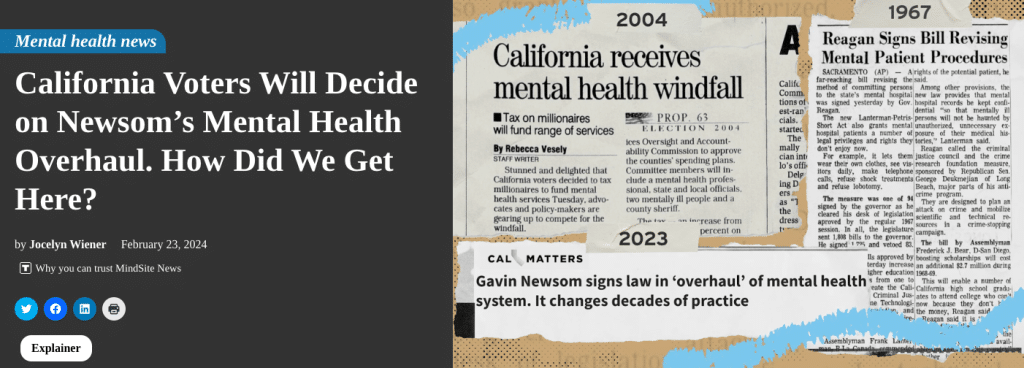
California Voters Will Decide on Newsom’s Mental Health Overhaul. How Did We Get Here?
Proposition 1, a March ballot measure in California, is the latest state proposal that aims to make major changes in mental health policy. CalMatter’s mental health reporter Jocelyn Wiener took a look at a history of these policies over the past 75 years, in a story republished here by MindSite News.
An Initiative Promised 20,000 Homes for Mentally Ill Californians. It Delivered Far Less

Proposition 1, a March ballot measure in California, promises to build 4,350 supportive housing units for homeless people with chronic mental illness. The CalMatters team takes a look and compares it to a similar ballot measure from 2018 dubbed No Place Like Home, asking a crucial question: Can it succeed where previous efforts fell short? Read it here, republished in MindSite News.
If you or someone you know is in crisis or experiencing suicidal thoughts, call or text 988 to reach the 988 Suicide & Crisis Lifeline and connect in English or Spanish. If you’re a veteran press 1. If you’re deaf or hard of hearing dial 711, then 988. Services are free and available 24/7.
Recent MindSite News Stories
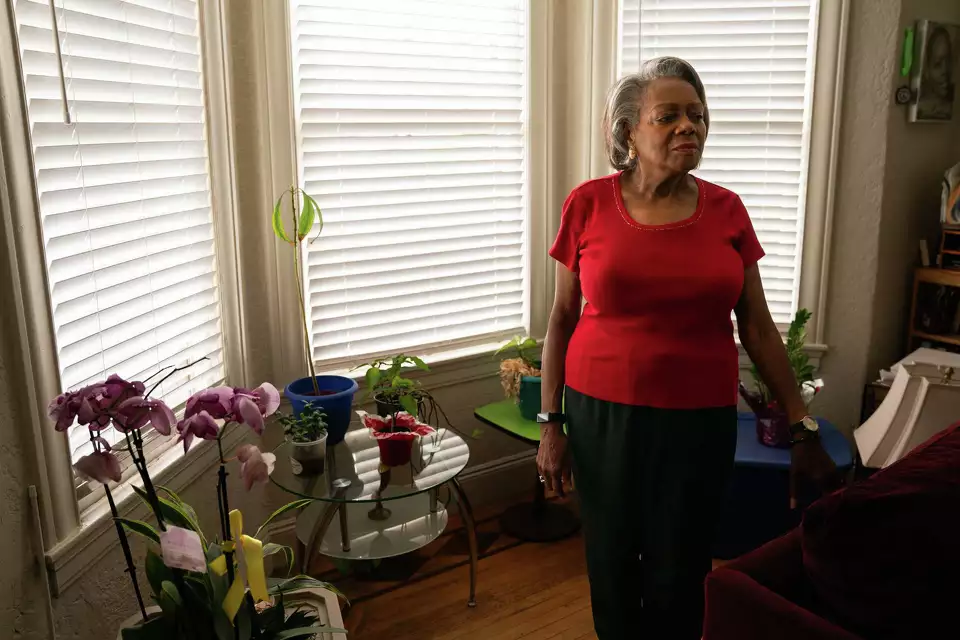
A San Francisco Program Helps People Manage Their Hoarding – and Stay Housed
Every year, 20 or more elderly San Franciscans are threatened with eviction because of their hoarding behavior. This program helps them.

The Night Parade: A genre-bending memoir shifts the cultural narrative on bipolar and grief
Jami Nakamura Lin has written a rich, exquisitely illustrated memoir that expands the cultural narrative on mental illness and grief.
If you’re not subscribed to MindSite News Daily, click here to sign up.
Support our mission to report on the workings and failings of the
mental health system in America and create a sense of national urgency to transform it.
For more frequent updates, follow us on Facebook, Twitter and Instagram:

The name “MindSite News” is used with the express permission of Mindsight Institute, an educational organization offering online learning and in-person workshops in the field of mental health and wellbeing. MindSite News and Mindsight Institute are separate, unaffiliated entities that are aligned in making science accessible and promoting mental health globally.
Copyright © 2021 MindSite News, All rights reserved.
You are receiving this email because you signed up at our website. Thank you for reading MindSite News.
mindsitenews.org

The name “MindSite News” is used with the express permission of Mindsight Institute, an educational organization offering online learning and in-person workshops in the field of mental health and wellbeing. MindSite News and Mindsight Institute are separate, unaffiliated entities that are aligned in making science accessible and promoting mental health globally.


Author

Related Articles

Rumors of Kids Quitting College En Masse Are Exaggerated
This week: what the data says about Gen Z students quitting college, and why postpartum mental illness is more than depression.

Why Is Georgia Blocking Recovery Homes for Substance Abuse?
Georgia towns are using zoning loopholes to shut recovery homes down, even as addiction and mental illness surge statewide.

Why Are Mothers Punished for Parenting?
Those of us who roamed freely as kids can be arrested for letting our kids do the same.