
System Failure: a California Man’s Two-Decade Struggle to Get the Right Care
A California mother has worked for decades to get the right care for her mentally ill son. It hasn’t worked. The podcast Brain Stories tells theirs.

A few days before Thanksgiving of 2023, a middle-aged man named Pharoh walked out of a psychiatric hospital with nowhere to go. He had no place to live. No plan. Just a prescription for schizophrenia medication that he would never fill.
His mother, Anita, had no idea where he was. And (almost) immediately, he was back on the street, homeless. Again. And she was angry. So angry, she began filling out the long application for a new program called the Community Assistance, Recovery and Empowerment (CARE) Act – a California law intended to break the cycle of hospitalizations and homelessness for those living with schizophrenia.
She grabbed all the paperwork, hopped in her car, picked up her siblings for moral support and drove down to the courthouse to personally watch the application get stamped.
That next Thanksgiving, she set a plate for Pharoh and the rest of the family around the table. He never showed up. Once again, he was on the street – unhoused and untreated – even though he’d been in the CARE program for a year. The system had once again failed.
The story of Pharoh, Anita and the broken system they got caught in is featured in a recent episode of Brain Stories, a podcast dedicated to telling stories of people living with mental illness. The podcast identified them only by their first names to protect their confidentiality.
Back when Pharoh was a junior in high school, the family had moved to San Diego. He was a good student, well-liked, played sports and worked part-time. But when the time came to apply to colleges, the always ambitious boy suddenly became unmotivated.
“I said ‘well, okay, Army, Navy, Air Force, Marines… until you figure out what you want to do with your life,” Anita told interviewer and executive producer Frank Kosa during an episode of Brain Stories.
Pharoh chose the Army, where he seemed to excel during boot camp. Anita proudly cheered him on the day he graduated from basic training.
“I saw a changed young man,” she said.
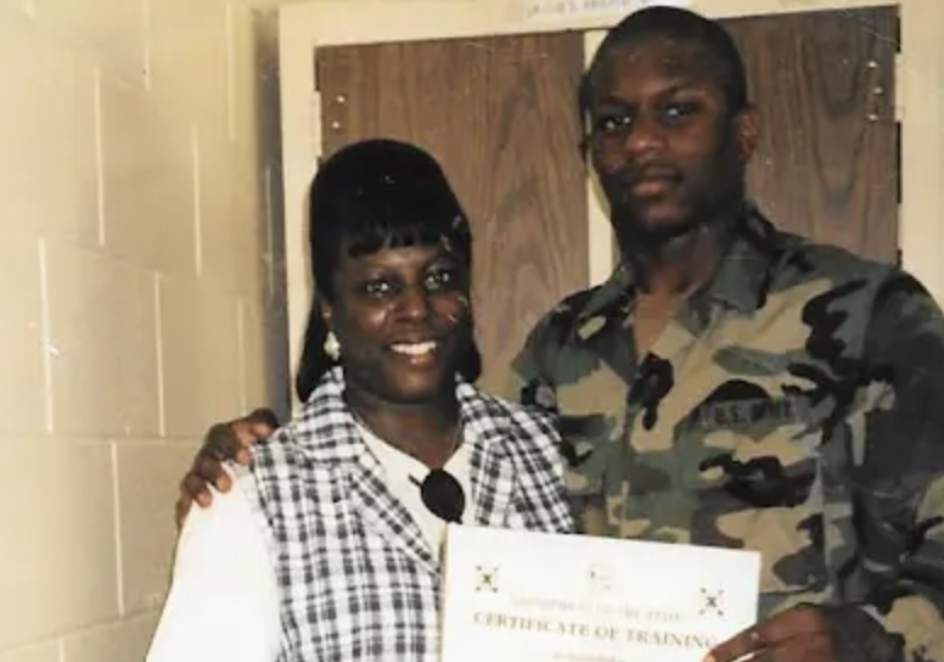
He applied to be a medical specialist and became one of just two in his class chosen to train at the prestigious Walter Reed Army Medical Center in Washington, D.C. For years, he got medical training, signed up for college classes and was rising through the ranks of the military.
“We went on a trip to DC. We saw him, went to the hospital, watched, saw him all dressed in his whites. Everybody said to us, ‘Oh, he’s such a great guy. He’s gonna do great.’ Hearing that I was like, ‘Wow, he’s on his pathway,’” Anita said.
Then, Pharoh came home on break. He didn’t look as put-together as he used to. And he drank – a lot. Worried, she urged him to see his sergeant when he returned to the Army. She had a bad feeling when she dropped him off for his flight back to D.C., which only got worse when she returned home and opened his closet door to find a mountain of liquor bottles.
“It was like somebody trying deaden something, and I was like, okay, he’s in trouble,” she said.
Pharoh never made that flight to D.C. He ended up with some friends who had been kicked out of the Army, drinking in a hotel room during a snowstorm in Pennsylvania. Though he paid for the room, they eventually kicked him out.
Alone in the freezing cold, he called his mother, who booked him a room for the night and wired him money for a train ticket to D.C. When Pharoh made it back to Washington, he was placed on restriction and given substance use treatment. This relaxed the worried mom, but it was short-lived. A week later, she was told, he was drinking again and got into a fight.
“That’s something in his entire life to that point, Pharoh had never been in a fight. He wasn’t that kind of guy. He was a man’s man, but he wasn’t violent. He didn’t like violence.”
Pharoh was court-martialed for assault. And even though an Army psychiatrist diagnosed him with an early-onset form of schizophrenia, he was convicted, given more time in the brig and denied a medical discharge, which would have given him veterans’ benefits including health care. It also meant the Army missed the chance to treat his illness early – when such treatment can be most effective.
When he was finally released and sent home on a three-day bus ride back to San Diego, he was seriously ill. He would spend the next two decades cycling on and off the streets and in and out of jails and prisons. At one point, he was even sent to the notorious and brutal super-max Pelican Bay State Prison in remote northern California.
Through all his trials, his mother has fought for him, got involved with NAMI – the National Alliance on Mental Illness – and pushed to change a broken system that is especially harmful to young Black men like Pharoh.
This episode of Brain Stories was produced and narrated by Ruth Shim, a psychiatrist at the University of California, Davis, whose research focuses on the impact of racism in psychiatry and medicine. Listen to the full journey of Anita and Pharoh here or wherever you listen to podcasts.
The name “MindSite News” is used with the express permission of Mindsight Institute, an educational organization offering online learning and in-person workshops in the field of mental health and wellbeing. MindSite News and Mindsight Institute are separate, unaffiliated entities that are aligned in making science accessible and promoting mental health globally.

Author

Related Articles

Insomnia, Fear and Dread: The Ordeal of Awaiting Word from Relatives in Iran
Iran’s internet blackout has left relatives in the U.S. frantic with worry.

Checking for ICE Before Every Class: The New Reality for Minnesota’s International Students
Since the start of Operation Metro Surge, S, an international student in St. Paul, has lived in a state of high alert.
As Muslims Across the U.S. Face Mounting Stress, We Revisit Our Story about a Detained Filipino Journalist
Ya’akub Ira Vijandre, a Filipino photojournalist and DACA recipient, was detained by ICE last October for posts extolling Islamic principles.
