
Millennials Weigh Having Children On Their Own Terms
Not having children is also a valid path, and one that everyone should consider, Merle Bombardieri argues in her 1981 book.

Greetings, MindSite News Readers.
In today’s Daily, a decades-old book gives millennials unsure about having children the permission to choose or reject parenthood, on their own terms. International college students in Minnesota describe the daily stress of stepping out the door for class, and one woman uses her personal experience and the tragic loss of Rob and Michele Reiner to implore adults to remember the siblings of folks with severe mental illness.
Weighing Whether to Have Kids? This 45-Year-Old Book Remains Remarkably Relevant

It took five years for therapist Merle Bombardieri’s 1981 book The Baby Decision to sell 8,000 copies. Then it fell out of print and was largely forgotten.
But now that the babies of her early readers are all grown up – millennials, they call us – it’s been rediscovered and has become an underground hit. As we weigh climate change, economic uncertainty and global political chaos, the book takes the radical position (for its time, and arguably still) that parenthood should not be a given.
Bombardieri instead argues that choosing not to have children is an equally valid path, and that everyone – even those enthusiastic about the prospect of parenting – should sit with both options before procreating.
Confronted with a marriage proposal from a partner wanting five kids, journalist Sanjena Sathian lays out how the book’s tools helped her choose her path in a first-person piece in New York Magazine.
Among them? Guided visualizations, journaling prompts, and a “chair dialogue” exercise, in which one stages a debate between their parent self and their child-free self. The point is to employ your imagination to imagine both roads, and then employ your agency to take the one you choose, rather than auto-driving along either out of social prescription.
Bombardieri, now 76, came to the subject through her own fraught decision – a declined proposal followed by months of hard conversation in which she and her partner, Rocco, tried to arrive at a satisfying vision of what motherhood could mean for her.
Sathian relays Bombardieri’s concerns: “Raised by a bright mother stultified by domestic expectations, Merle feared that children might impede her independence. She resented Rocco’s “assumption that if I loved him, and because I had a uterus and because I had breasts, I would want to use those body parts with him.” Merle said no — a radical decision – in the 70s, no less!
But Merle and Rocco didn’t break up. Instead, they weighed the decision, discussing their future on long walks, including Rocco’s involvement with child-rearing. Merle even worked at a couple of day cares, and met parents that affirmed she could keep expanding into herself, even after becoming a mother. Rocco and Merle married within the year and eventually raised two children together.
Sathian made her own choice too: she didn’t marry the baby-minded boyfriend. When she did get married, it was to a partner ambivalent about parenthood, unfazed by her plan to not have kids.
They’ve built a different life, intentionally, together. She still occasionally pictures the children she didn’t have, the way anyone might think about a path not taken. Thanks to Bombardieri’s book, it doesn’t rattle her.
Checking for ICE Before Every Class: The New Reality for Minnesota’s International Students
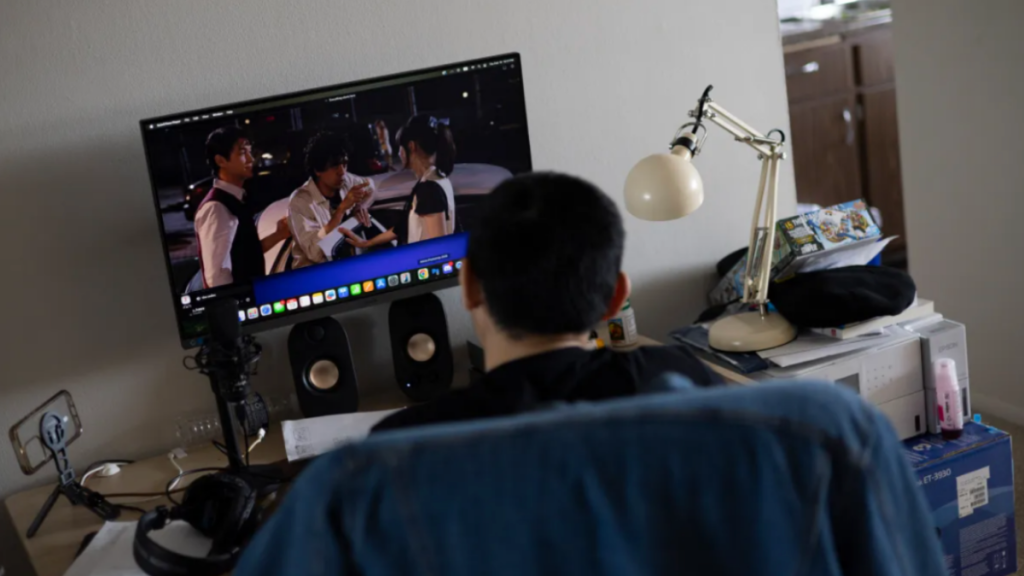
Before heading to his college classes each morning, S scans iceout.org to check for ICE activity between his apartment and campus. He packs his driver’s license, photo copies of his passport from Myanmar, his F-1 visa and his I-94, marking his legal arrival in the U.S.
“I have to make sure there is a safe route,” said S, who is earning his degree in computer graphics and design. He did not want to use his name in this story for fear of arrest.
Since the start of Operation Metro Surge in December, S – one of nearly 15,000 international students attending Minnesota colleges and universities – has lived in a state of high alert. And despite U.S. Border Czar Tom Homan’s announcement on Feb. 12 that the surge would end, he remains anxious.
So begins a look at the distress ICE activity is bringing to the Twin Cities’ international students, originally published by MinnPost and now available on our site.
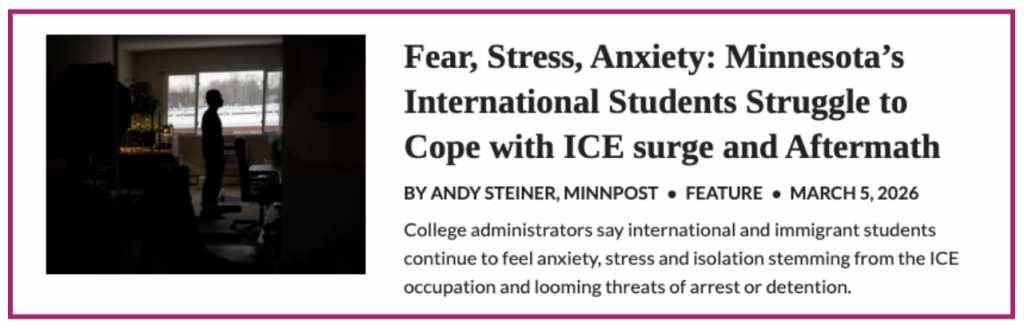
For S, the stakes are clear. Friends have been snatched away – in January, one seeking asylum was pulled over by ICE agents, detained, and sent to Texas within 24 hours. Two days later, ICE pulled an apartment building’s fire alarm to force residents outside. Terrified and mentally overwhelmed, a friend living in the building attempted suicide.
“This has caused a lot of stress on the whole community,” S said.
While universities in the Twin Cities have responded with emergency housing funds, expanded walk-in counseling, legal resources, and “Know Your Rights” sessions, the situation continues to put international students in an impossible bind – hiding inside feels like the safest option, but their visas require them to attend in-person classes.
“I couldn’t study well this semester,” he said. “Even when I am on campus, where it is supposed to be safer, I am on high alert.”
Coming from Myanmar, where therapy isn’t as popular, S had never considered trying it before the surge. Amid the stress, though, he says he’s had two free sessions and plans to book more.
His counselor has equipped him with some coping tools, including breathing exercises and grounding techniques. They’re small, but making an impact. “She helped me see that even though things are hard now, on the inside at least I am still safe.”
In other news…
Growing up in the shadow of mental illness: When Nick Reiner was charged with killing his parents, most of the public conversation turned to the failures of the mental health system – and writer Debra Manetta understood why. But her mind kept going somewhere else: his siblings. As the only sibling of a brother diagnosed with schizophrenia, Manetta knows firsthand the fear, shame, vigilance, and quiet responsibility other children carry when their sibling is severely ill. “So often, siblings who grow up alongside serious mental illness are overlooked,” she writes in a personal essay for STAT News, and the silence, she argues, has real consequences.
For Manetta, childhood meant moving through school with the appearance of normalcy while hiding her brother’s illness, convinced that if anyone knew “they would think less of me.” Before she consciously understood the impact of her brother’s illness, she was shaped by it, learning early to “anticipat(e) chaos, managing my own emotions so my parents didn’t have to, and learning to measure my worth by how little burden I added.” She even wished sometimes her brother weren’t alive, and battled crushing guilt about it alone, with no one to help her understand that such feelings were a natural response to fear. “This is what ‘being strong’ can look like,” she says, “internalizing disappointment, mistaking performance for worth, and carrying responsibility that should never belong to a child.”
When her brother died by suicide at 24, she was cast adrift into an absence of care. So, she concludes with a plea for change: Insurance should cover preventive therapy for siblings, not just crisis intervention after the worst has happened. Pediatricians, schools, and mental health providers should routinely screen siblings for anxiety, depression and trauma. And when. hospitals create discharge plans, siblings should be included. “Siblings like the Reiners deserve to be seen,” she writes, “not just after tragedy, but long before it.”
As the US continues the war against Iran, some veterans are speaking out against it. A number of studies found a need to improve health care for veterans of the wars in Iraq and Afghanistan, which have instead been cut under this second Trump administration. And now, US soldiers are dying and at risk of mental health trauma and vets are being mistreated.
Yesterday, Brian McGinnis, a former Marine sergeant – and current Green Party candidate for Senate in North Carolina – stood up in the Senate to shout “No one wants to fight for Israel!” Three Capitol police officers grabbed McGinnis to force him out, aided (unasked) by Republican Sen. Tim Sheehy from Montana, a former Navy Seal. Sheehy lifted McGinnis’s legs as he clung to the Senate doorframe with one hand and wrenched him backward until a snap was heard, The New York Times reports.
McGinnis, who was later arrested, said his arm was broken. In the meantime, the U.S. and Israel continue their unlawful attacks on Iran, striking two more schools and 13 hospitals and health facilities, despite condemnation from humanitarian organizations and skepticism from allies including the UK and Spain. –Diana Hembree
A new study suggests that ADHD comes with real strengths – and that knowing how to use them may actually improve mental health. A team of researchers in Europe compared 200 adults with ADHD to 200 without, in the first large-scale effort to measure psychological strengths associated with the condition, Fast Company reports.
People with ADHD were more likely to identify with 10 specific strengths, including hyperfocus, creativity, intuition, humor and having broad interests. While participants with ADHD still reported a lower overall quality of life, the study found that people who understood their strengths and could apply them accordingly had better mental health and well-being – in both groups. Lucia Hargitai, the lead researcher on the study, says the research could prompt better understanding for people with ADHD – and the study suggests that that understanding could make a meaningful difference.
The name “MindSite News” is used with the express permission of Mindsight Institute, an educational organization offering online learning and in-person workshops in the field of mental health and wellbeing. MindSite News and Mindsight Institute are separate, unaffiliated entities that are aligned in making science accessible and promoting mental health globally.

Author

Related Articles
He Almost Killed His Father. Now He Helps Others At Risk.
In today’s newsletter, we explore how one man healed after a dangerous psychotic break that nearly led him to murder.
Fallout Over Supreme Court Ruling on Conversion Therapy
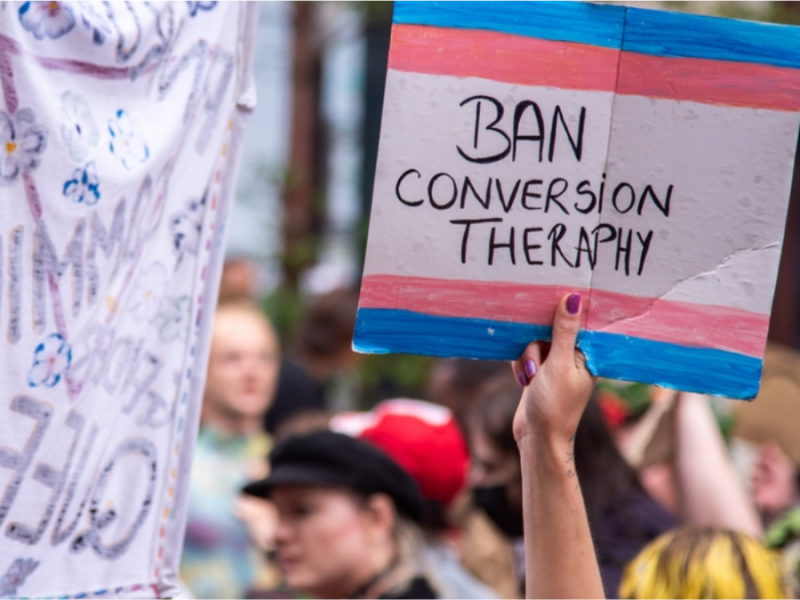
Despite the Supreme Court ruling, conversion therapists can still be sued for a practice the United Nations calls “torture.”

On No Kings Day, Millions Rallied to Denounce Trump and “Epstein War”
Anti-Trump protests took place in all 50 states, Puerto Rico and other US territories and in countries around the world.
